Author: WestonBlaha

  • Legacy Dies in the Hands of a Corpse

    Legacy Dies in the Hands of a Corpse

    Legacy is a funny word because it means different things to different people. And not everyone agrees on how to define one’s “legacy.” Yet in the end, there are really only two kinds of legacy: a legacy of faithfulness and a legacy of pride.

    A legacy of pride seeks to preserve itself. It is built around personalities, memories, accomplishments, and the desire to remain the center of the story. It asks, How do we protect what we have built? It is ultimately anchored to people, and because people pass away, it cannot endure.

    A legacy of faithfulness is different. It understands that God’s kingdom is bigger than any individual, any generation, or any particular season of ministry. It asks a different question: How do we faithfully hand forward what God has entrusted to us? It is willing to sacrifice comfort for mission, familiarity for fruitfulness, and personal preference for the good of those who come after.

    The difference can be seen throughout Scripture. Consider King Nebuchadnezzar standing atop Babylon declaring, “Is not this great Babylon, which I have built?” His concern was preserving and celebrating his own greatness. Then consider David. David’s greatest contribution was not building a kingdom that depended upon David. His greatest contribution was preparing for a kingdom that would continue after David was gone. He gathered resources he would never personally use. He made preparations for a temple he would never see. He spent his final years investing in a future generation because he understood that God’s purposes were larger than his own lifetime.

    Most importantly, a God-honoring legacy is always a legacy that is passed on. The goal is never our name. The goal is Christ’s name. The goal is never preserving our comfort. The goal is advancing His kingdom.

    As I reflect on my pastorate at Grace Fellowship, the word legacy keeps returning to my mind. Yet, it is not my legacy that concerns me most. It is the church’s.

    Over the last four years, Grace Fellowship has repeatedly chosen faith over fear. She called a pastor when it was not obvious the finances could sustain it. She expanded ministry staff to meet the needs of a growing congregation. She embraced a name change, refreshed her identity, and welcomed wave after wave of new faces into the fellowship. None of those decisions were easy. Every one of them required trust. Every one of them required sacrifice. Every one of them demanded faith that God was doing something bigger than preserving the status quo.

    That is why I keep returning to the parable of the talents.

    Three servants were entrusted with resources that belonged to their master. Two took what had been entrusted to them and put it to work. They faced uncertainty. They assumed risk. They accepted the possibility of failure. Yet when the master returned, they were commended because they understood that what they possessed was never ultimately theirs. Their responsibility was not merely to preserve the master’s resources but to employ them in service to the master’s purposes.

    The third servant thought differently. He buried the talent. He protected it. He preserved it. He returned exactly what had been entrusted to him.

    And yet he was rebuked.

    Not because he squandered the master’s resources, but because fear had become more important than faithfulness. Preservation had replaced mission. Safety had replaced stewardship.

    The church faces that same temptation in every generation.

    Every congregation eventually reaches a moment when it must decide whether it will become a museum or a mission. Whether it will devote itself to protecting what previous generations built or investing those gifts so that future generations might flourish. Whether it will cling tightly to what God has entrusted or open its hands and pass it forward.

    That is the question of legacy.

    The future legacy of Grace Fellowship will not ultimately be determined by Weston Blaha or by the next pastor. Pastors come and go. Every shepherd eventually hands the staff to another—or worse, a shepherd hangs up the staff because there are no longer any sheep to tend.

    The legacy of Grace Fellowship will be determined by her people.

    Will future generations look back and say that this church faithfully invested everything God entrusted to her for the sake of Christ’s kingdom? Will they thank God that an earlier generation was willing to sacrifice, risk, and dream beyond its own lifetime? Will they inherit a church that was always looking outward rather than backward? Those are the questions that now stand before us.

    My friends, faithful legacies are never built by holding on. They are built by handing off. And no good legacy ever ends clutched in the hands of a corpse.

  • The Radioactive Cross: Why the Tombs Burst Open on Good Friday

    The Radioactive Cross: Why the Tombs Burst Open on Good Friday


    There is a moment in Matthew’s Gospel so strange that many modern readers—and even some pastors—simply skip over it. At the moment Jesus dies, the earth shakes, rocks split, and:

    “The tombs also were opened. And many bodies of the saints who had fallen asleep were raised, and coming out of the tombs after his resurrection they went into the holy city and appeared to many.” (Matt. 27:52-53).

    For skeptics, the passage is often dismissed as symbolic exaggeration. For many Christians, it becomes little more than strange apocalyptic scenery surrounding the crucifixion. But Matthew is not recording random special effects. The opened tombs are the logical consequence of what happens when the Holy One enters death itself.

    To understand why the graves burst open, we must first look at another moment earlier in Matthew’s Gospel: a bleeding woman reaching through a crowd to touch the edge of Jesus’ garment.


    The Bleeding Woman: A Resurrection Story in Miniature

    In Matthew 9:20–22, a woman suffering from chronic bleeding reaches out to touch the “hem” of Jesus’ garment. The Greek word used is kraspedon—the tassel or fringe worn on the corners of a Jewish man’s robe. These tassels were tied to covenant identity and obedience (Num. 15:38–39). But there is something interesting happening here.

    Centuries earlier, Malachi had prophesied:

    “The sun of righteousness shall rise with healing in his wings” (Mal. 4:2).

    The Hebrew word for “wings” is kanaph, which can also mean the corners or edges of a garment. In other words, in reaching for the hem of Jesus’ robe, the woman is taking hold of the promised healing of the Messiah Himself. She believes that life radiates outward from Him. And she is right.

    But the deeper shock of the story is not simply that she is healed. The deeper shock is how she is healed. Under the logic of Leviticus, uncleanness spreads outward. An unclean person contaminates what they touch. The bleeding woman should make others unclean. But when she touches Jesus, the direction reverses.

    Instead of her impurity infecting Him, His holiness overwhelms her impurity. Rather than uncleanness spreading outward, holiness spreads outward.

    This is the first clue that Jesus is not just another clean Israelite. He is the source of a new creation powerful enough to reverse the curse of sin itself.

    Realistically, the woman’s condition is a kind of living death:

    • perpetual impurity
    • separation from worship
    • weakness
    • loss of life-blood
    • social exile

    And yet the moment she touches Christ, life begins swallowing death. The bleeding woman is not merely a healing story–she is a resurrection story in miniature.


    The Holiness That Invades Death

    This is why Matthew 27 matters so much. At the cross, the pattern reaches its climax. The same holiness that healed the bleeding woman now enters the grave itself. And death cannot survive the contact.

    Matthew records that at Jesus’ death:

    • the earth shook
    • rocks split
    • tombs opened
    • saints were raised

    This is powerful and intentional imagery. Matthew is showing the curse beginning to collapse under the weight of the crucified Christ. The bleeding woman touched Him and was healed. Now the grave touches Him—and the grave breaks open.

    Just as her body could not remain diseased in His presence, neither could the tombs remain closed in His presence. The miracle has expanded from one suffering woman to creation itself.


    Zechariah 14: The King Has Arrived

    This also explains why Matthew’s imagery sounds so much like Book of Zechariah 14.

    Zechariah prophesied that on the Day of the Lord, YHWH Himself would arrive as King:

    “On that day his feet shall stand on the Mount of Olives… and the Mount of Olives shall be split in two” (Zech. 14:4).

    The mountain splits.
    The earth trembles.
    Creation breaks open before the arrival of the divine King.

    Matthew intentionally echoes this imagery at the crucifixion:

    • the earth quakes
    • rocks split
    • tombs open

    Why?

    Because the cross is more than an unjust execution–it is the arrival of the King into the realm of death.

    When the Son of God entered the grave, creation itself reacted. The cursed ground began to crack beneath the weight of its Creator’s foot.

    The earth does not split because God is absent. The earth splits because God has arrived. The old world order is beginning to break apart. Death’s reign is being invaded from within.


    “Kiss the Son”

    This gives terrifying depth to Book of Psalms 2:

    “Kiss the Son, lest he be angry, and you perish in the way” (Ps. 2:12).

    In the ancient world, to kiss the king—or even the hem of his garment—was an act of surrender and allegiance. The bleeding woman reaches toward Christ in faith and receives life. But the kingdom of death encounters this same Christ and is shattered like pottery beneath a rod of iron.

    The same holiness that heals also judges. The same presence that restores creation destroys the curse consuming it. Christ is not passive before death.

    He is its conqueror.

    At the cross, death finally touches something it cannot corrupt, and in that moment, death itself begins to die. Puritan John Owen calls this “the death of death in the death of Christ.”


    The Firstfruits of Resurrection

    This is why the opened tombs matter so deeply. Matthew is showing us the first visible cracks of the resurrection age breaking into history.

    The saints who rise with Christ on the third day are not random additions to the story. After Christ, they are the firstfruits of what Christ’s death accomplishes. The resurrection is not merely a legal declaration of forgiveness; it is the reclamation of creation itself.

    It is the beginning of a new world where:

    • impurity no longer spreads
    • death no longer reigns
    • graves no longer hold their captives

    The cross is not Christ being overwhelmed by death. The cross is Christ invading death with incorruptible life.

    When Christ entered the grave, He did not enter as a helpless victim. He entered as Life itself.

    And death could not contain Him.


    The Gospel According to the Open Tombs

    Matthew 27 teaches us that wherever the holiness of Christ extends, the curse begins to unravel. A woman’s bleeding stops.
    Demons flee. Storms obey. The earth trembles. Rocks split. Tombs open.

    The opened graves on Good Friday are not strange interruptions in the story. They are not “Christian myth” that circulated or apeared in later manuscripts. They are the inevitable result of the Holy One entering the world’s deepest uncleanness and reversing it from the inside out.

    The bleeding woman was the preview.

    The opened tombs were the announcement.

    The resurrection of Christ–bringing the saints from the grave around him–would be the victory itself.

  • In Defense of Mother’s Day

    In Defense of Mother’s Day

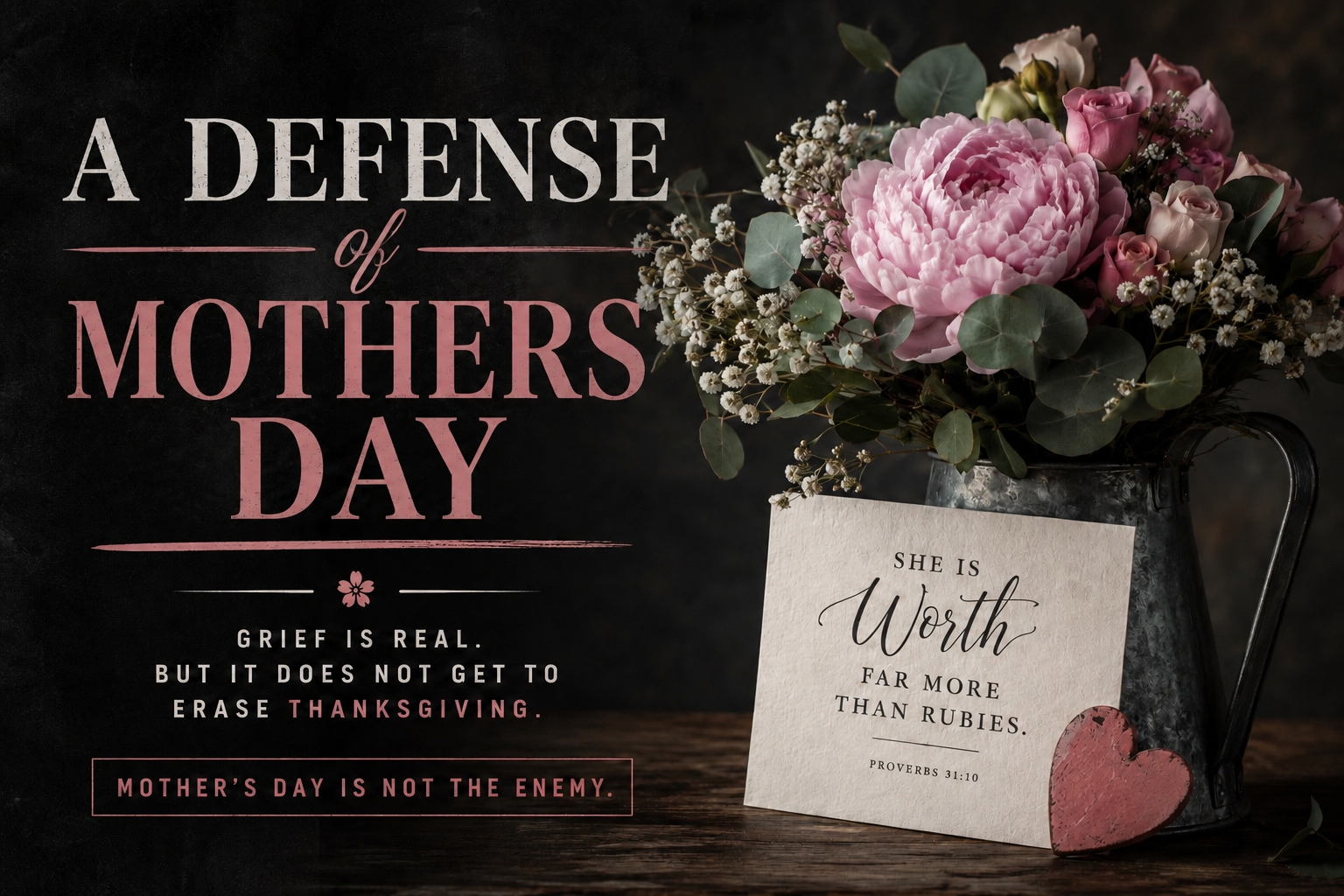
    Sadly, Mother’s Day has become another casualty of our culture’s obsession with victimhood. Every year I hear the same chorus warning:

    “What about women who can’t have children?”

    “What about women who lost babies?”

    “What about painful family situations?”

    And I would ask that a careful ear is leaned my way: those pains are real. Barrenness is painful. Miscarriage is painful. Loneliness is painful. Scripture itself recognizes that grief. But fifteen years of pastoral ministry have taught me that this complaint, however sincere, is also consistently wrong. Here’s the problem that we need to address: we have begun treating personal sorrow as a veto against public celebration.

    A woman being unable to bear children is deeply tragic. There is a reason barrenness plays such a central role in the biblical theme of redemption. But it is not a reason to stop honoring faithful mothers any more than a funeral is a reason to cancel weddings. As Christians, we do not respond to God’s blessings by silencing celebration because someone else did not receive the same gift. When Scripture speaks of children, it does not apologize for calling them a blessing:

    Behold, children are a heritage from the Lord, the fruit of the womb a reward.” — Psalm 127:3

    Modern culture trains people to interpret every celebration through the lens of personal deprivation: “If I do not have it, then you should not publicly rejoice in it.” That is not a sign of Christian maturity—that is an expression of cultivated resentment.

    The Christian response to another person’s blessing should always be thanksgiving to God for His goodness, even when His providence toward us is different. Romans 12 commands us:

    “Rejoice with those who rejoice; weep with those who weep.”

    Notice: Scripture commands both. We should absolutely weep with grieving women. We should counsel the hurting. We should love the lonely. But we should not flatten every joyful occasion into an exercise in emotional risk management. Mother’s Day is not cruel because motherhood reminds some women of loss. By that logic, Father’s Day harms orphans and weddings harm the unmarried. Baby showers harm the infertile. And every “believer’s baptism” wounds the prodigal parent.

    A society governed by grievance eventually loses the ability to celebrate anything at all. The Church should resist this impulse. We honor mothers because motherhood is good. We celebrate children because children are blessings. And we thank God publicly for His gifts without embarrassment.

    It’s important to recognize a hard truth: Not every person receives every gift. But Christians are called to worship God for His goodness anyway. So, we celebrate our mothers. We honor them. We remember them. But we do not use our grief or trials to demand that other men and women do not get to praise God for his goodness. 

    This Sunday, honor your wives/mothers. Remind them of how good God is to give them the unmatched responsibility of raising arrows in the quiver. Celebrate them and celebrate with them—this is the only appropriate Christian posture.

    But do hear this: I am not asking hurting women to perform happiness. I’m asking them not to demand that joy be silenced because they are hurting.

    The body of Christ is edified when joy is celebrated and grief is lamented. Mother’s Day is a day of joy—let us edify one another on it.

  • Why Clear Doctrine Matters

    Why Clear Doctrine Matters

    This week, one of our elders taught on the Councils, Creeds, and Confessions of the church. It was a wonderful exposition of why doctrinal clarity is essential for the peace and purity of the Body of Christ. As I reflected upon the EPC’s debate over sexuality and ordination, his lesson caused me to consider one of the most common misunderstandings in conversations about doctrinal clarity—especially in discussions surrounding same-sex attraction (SSA) and pastoral qualifications. For many, the assumption is that clear doctrine exists primarily to keep people out. But that’s not actually its primary function.

    The Point of Clear Doctrine

    Clear doctrine exists to give the church judicial clarity—the ability to identify, confront, and, if necessary, discipline real error and misconduct (consider Acts 15 and the Jerusalem Council). Without clear definitions—without clear doctrine—there is no meaningful accountability. When doctrinal language becomes vague, when categories are left intentionally open-ended, it does not create the anticiapted pastoral flexibility. Rather, it creates judicial paralysis. The church cannot correct what it refuses to clearly define.

    This is not because the church only cares about certain “big sins” and ignores others. Scripture is clear: all sin matters, and all sin must be addressed. But not all sin functions in the same way in the life of the church—especially when it comes to ordination and public teaching. Some sins are addressed primarily pastorally through repentance, counsel, and the ordinary means of grace. Others become judicial matters when they are taught, justified, or embedded into categories that shape doctrine, identity, telos, or the qualifications for office.

    And it is at that point that clarity becomes essential.

    Why This Matters for Ordination

    This is where the concern lies with frameworks that allow for a “celibate, same-sex attracted pastor” without carefully defining concupiscence, the nature of desire (natural/unnatural), sin, and sanctification. Even if such a framework is introduced with good intentions—filled with the charity of the EPC ethos— it inevitably creates a category that can be expanded from within. And that expansion is not simply a theoretical or hypothetical concern; it is a structural weakness that only becomes evident once exposed through its abuse.

    If a man is ordained under a category that affirms ongoing identification with disordered desire—like SSA— then that same category becomes the very shield he may later use if he begins to teach or speak in ways that undermine biblical sexual ethics. The system has already granted him a definitional foothold.

    At that point, discipline becomes nearly impossible—not because the church lacks courage or access to Scripture, but because it lacks clarity. To put it simply: you cannot enforce a standard that you have not clearly articulated.

    It Is Just A Pack of Skittles, Right?

    Consider a simple analogy:

    A movie theater has a policy: no outside food or drinks. In practice, the employee at the door may exercise discretion when someone slips in a small pack of Skittles. The rule still applies — but enforcement is proportionate, and “pastoral” common sense governs the moment. However, that is not the main point of the rule. The rule exists so that when someone walks in carrying an entire pizza and a 2-liter soda, the theater has the authority to act. Without the rule, there is no basis for enforcement.

    But now, complicate the analogy. Suppose the theater also has a fire code: no open flames. Someone lighting a single candle at their seat is not a bigger “Skittles problem.” It is a categorically different violation — one that implicates the safety of everyone in the building, not merely the theater’s revenue model. The fire code and the food policy are both rules, but they exist for different reasons, protect different things, and require different responses.

    The same logic applies here. Pastoral discretion appropriately governs many sins that touch ordination questions. But when a category of desire is not merely a misuse of a good thing — but is directed toward an object Scripture identifies as contrary to the created order itself — the church is no longer dealing with a “Skittles” problem. It is dealing with an open flame. And a church without clear doctrine on that distinction has no basis for knowing which problem it’s actually facing — until it’s too late.

    Clarity Prevents Both Neglect and Abuse

    Doctrinal standards are not primarily about catching every minor infraction. People will lie. People will hide things. Pastors will lie. Pastors will hide things—we all know this is part of the fallen order in which we live. And while doctrinal standards are not indifferent to so-called “smaller sins,” they establish clear boundaries so that:

    • ordinary sin can be addressed pastorally and corrected, and
    • serious error—especially when it is taught, justified, or institutionalized—can be addressed judicially.

    Without that distinction, two errors emerge:

    1. We either minimize sin altogether (“everyone struggles, so nothing can be addressed”), or
    2. We weaponize discipline inconsistently (“this sin matters, but that one doesn’t”).

    Clear doctrine guards against both. It ensures that the church is not left debating definitions in the moment of crisis. There is no confusion, no appeal to ambiguity, no shelter in undefined categories. In other words: clarity beforehand prevents both neglect and abuse later.

    Guarding the Flock

    Clear doctrine is not about exclusion—though it does serve as a protective barrier—it is about faithful oversight. And this goes for all doctrinal concerns. The church is called not only to welcome and shepherd, but also to guard the flock (Acts 20:28–31). And guarding requires more than good intentions and amicability—it requires clear, enforceable standards.

    Without them, even the best-intentioned systems will eventually fail at the very point they are needed most.

    This post has not attempted to make the full theological argument. The theological distinctions for concupiscence, the natural/unnatural framework, and what ordination representationally requires , is developed more fully in a companion paper (to access that paper, please reach out to me).

    The goal here is simply this: clear doctrine is not the enemy of pastoral care — it is one of its necessary conditions.

  • The Path Sin Took—and How Christ Reorders the Kingdom

    The Path Sin Took—and How Christ Reorders the Kingdom

    In another post, (see here) we noticed a foundational pattern: God creates order → sin brings disorder → God restores that order. But post-creation, when God is resting from his ordering, how does this pattern work itself out in the Genesis narrative? To see it clearly, we need to go back to the beginning.

    The Collapse of God’s Kingdom Order

    In Genesis 1–2, God establishes a world that is not just good—it is ordered.

    • God rules as King
    • Man is His image-bearer
    • The woman is given as a corresponding helper
    • Creation functions in harmony under God’s word

    This is the Cosmic Kingdom: God’s people, in God’s place, under God’s rule.

    But in Genesis 3, that order is inverted:

    • The serpent speaks
    • The woman receives
    • The man follows

    Instead of God’s word ruling over man, and man exerting his dominion mandate, the serpent’s word rules over them both. So the pattern becomes:

    Serpent → Woman → Man → Death

    Sin weaving through mankind—this is Cosmic Kingdom disorder.

    • The wrong voice is obeyed
    • The wrong authority is followed
    • The right order is reversed

    And the result is exile, curse, and death.

    Christ Enters to Reorder What Was Disordered

    But the story of Scripture does not end with God abandoning His Kingdom—it ends with God reclaiming and reordering it. When Jesus Christ comes He steps into the very structure that was corrupted. Where Adam failed to guard and obey, Christ obeys perfectly. Where Adam received the word of the serpent, Christ resists him. And more than that, in 2 Corinthians 5:21:

    “He made him to be sin who knew no sin…”

    Christ enters into the consequences of that disorder—not as a sinner like Adam, but as the sin-bearer.

    The Reconstitution of the Kingdom

    However, Christ does not remain in death—He rises, and in doing so begins to rebuild what was lost. In Ephesians 1:16-23 Christ is set over all powers and authorities, now in dominion over creation—a role Adam had lost:

     “I do not cease to give thanks for you, remembering you in my prayers, 17 that the God of our Lord Jesus Christ, the Father of glory, may give you the Spirit of wisdom and of revelation in the knowledge of him, 18 having the eyes of your hearts enlightened, that you may know what is the hope to which he has called you, what are the riches of his glorious inheritance in the saints, 19 and what is the immeasurable greatness of his power toward us who believe, according to the working of his great might 20 that he worked in Christ when he raised him from the dead and seated him at his right hand in the heavenly places, 21 far above all rule and authority and power and dominion, and above every name that is named, not only in this age but also in the one to come22 And he put all things under his feet and gave him as head over all things to the church,23 which is his body, the fullness of him who fills all in all.

    And in Ephesians 5:25-27, we read:

    “Christ loved the church and gave himself up for her, 26 that he might sanctify her, having cleansed her by the washing of water with the word, 27 so that he might present the church to himself in splendor, without spot or wrinkle or any such thing, that she might be holy and without blemish.”

    In short, Christ is:

    • Sanctifying
    • Cleansing
    • Preparing His Bride

    Now consider these actions in light of Genesis 3. Humanity, corrupted in Eden—through the word of the Serpent to the woman’s deception, and to Adam’s failure to stand firm—is now being restored and reordered. The garden workers are being redeemed. The Kingdom is being rebuilt:

    • A people purified
    • A Bride—Christ’s Eve—restored
    • The sons of God brought back under His Cosmic Kingly rule

    The Final Judgment of Disorder

    The story reaches its climax in Revelation 20. The serpent—the original source of this disorder—is finally judged. So the full movement of redemption looks like this:

    Serpent → Woman → Man → Death

    Christ (sin-bearer) → Redeemed Bride → Judgment of the serpent → Life

    The path sin once took into the world becomes the path by which God reverses it. And yet, God does more than just restore Eden—He fulfills it. In Revelation 21–22 we read that:

    • God dwells with His people
    • The curse is no more
    • The Kingdom is fully established

    This is the completion of God’s creational purpose.

    Why This Matters

    The Bible is a story of sin and forgiveness. But it is also the story of a King who:

    • Reclaims His world
    • Reorders what was disordered
    • Reconstitutes a people under His rule

    So when you read Scripture, ask: Where does God undo this disorder—and how is He rebuilding His Kingdom?

    Because that is what He is doing—from Genesis to Revelation.

  • The Empty Tomb as the Mercy Seat: What John Wants Us to See on Easter Morning

    The Empty Tomb as the Mercy Seat: What John Wants Us to See on Easter Morning

    On Easter Sunday, Christians around the world celebrate a simple but earth-shaking truth:
    Christ is risen. While all the gospels recount the resurrection, the Gospel of John includes details that, at first glance, may seem small or incidental. Details that, in our excitement, we rush past. Yet when we slow down and pay attention, we begin to see that these details are doing something profound. One of those details appears in John 20:12:

    She saw two angels in white, sitting where the body of Jesus had lain, one at the head and one at the feet.

    Why does John tell us this? Why mention where the angels are sitting? The answer may take us all the way back to the Old Testament: to the mercy seat.

    The Mercy Seat: The Place of Atonement

    To understand what John may be showing us, we need to revisit the Ark of the Covenant. At the center of Israel’s worship was the ark, and on top of the ark was what Scripture calls the mercy seat (Exodus 25:17–22). This lid was the place where atonement was made.

    Once a year, on the Day of Atonement, the high priest would enter the Holy of Holies and sprinkle blood on the mercy seat for the sins of the people. And what stood on either side of that mercy seat? Two cherubim—angelic figures—positioned at either end.

    So the image Leviticus paints is this:

    • A sacred space (the mercy seat)
    • Blood for atonement (from the sacrifical lamb)
    • Two angels, one on each side (guarding the space)

    This was the place where God dealt with sin and met with His people.

    The Tomb: A New Mercy Seat

    Now return to the resurrection account in John 20. Mary Magdalene looks into the tomb and sees:

    • Two angels
    • One at the head
    • One at the feet
    • And between them—the place where Jesus’ broken, bleeding body had been laid

    This is more than a throw-away detail. John could have simply said, “there were angels.” But instead, he gives us their exact positioning. Why? Because he wants us to see something. The empty tomb is being presented as a kind of new mercy seat.

    • The place where Christ’s body lay is the place where atonement has been accomplished
    • The angels stand as witnesses, just as the cherubim did
    • The sacrifice has already been made—not repeatedly, but once for all

    The mercy seat of the Old Covenant required ongoing sacrifice. The “mercy seat” of the tomb declares that the perfect lamb has been sacrificed.

    Not Just the Cross—The Resurrection Reveals It

    We often (rightly) focus on the cross as the place where atonement was accomplished. But John’s Gospel pushes us to see something more: The resurrection is the public vindication of that atonement. The cross is where Christ says, “It is finished.” The resurrection is where God declares, “It is accepted.” Thus, the empty tomb is indeed proof that Jesus is alive, but it is also the declaration that:

    • Sin has been dealt with
    • Death has been defeated
    • The sacrifice has been received
    • The old covenantal system is no longer needed

    In other words, the resurrection is not a separate or ancillary aspect of the atonement—it is the confirmation of it.

    Why John Shows Us This

    Throughout his Gospel, John consistently presents Jesus as the fulfillment of Old Testament realities:

    • Jesus is the true temple (John 2:19–21)
    • Jesus is the true Passover Lamb (John 19:36)
    • Jesus is the true source of living water (John 7:37–38)

    So it should not surprise us that here, at the resurrection, John is showing us: Jesus is the true and final mercy seat. No longer is atonement found on a golden lid in the Holy of Holies. Now it is found in a risen Savior.

    A Finished Work

    The imagery of the mercy seat reminds us of something essential to the Christian faith: Atonement is not ongoing; it is a completed work. The high priest of Israel had to return year after year. Christ offered Himself once, and the work is done. There is no more sacrifice to be made; there is no more blood to be offered. Instead, the empty tomb stands as a witness:

    • The debt has been paid.
    • The wrath has been satisfied.
    • The work is finished.

    What This Means for Us

    The danger for us is leaving this theolgical truth as merely that: a theological truth. But it should be much more than that. If Christ has truly made atonement for sin, and if that atonement has been accepted and confirmed in the resurrection, then:

    • You do not need to earn God’s favor
    • You do not need to carry your guilt
    • You do not need to wonder if enough has been done

    Everything necessary for your salvation has already been accomplished. The question is not:

    Has enough been done?”

    But:

    Do you believe it?”

    Seeing What John Saw

    John tells us that when he entered the tomb: “He saw and believed.” (John 20:8) He probably didn’t yet understand everything. He likely didn’t yet have a fully developed theology of the resurrection.

    But he saw enough.

    And John’s Gospel invites us to do the same. To look at the empty tomb; to see what it reveals; And to believe.

    Easter Is the Announcement

    As such, Easter is more than a celebration, it is an announcement:

    • The true mercy seat has been revealed.
    • The final sacrifice has been accepted.
    • The risen Christ now stands as the only ground of our salvation.

    And that means there is nothing left to add. Only something to receive.

    Final Question

    So the question this Easter is simple:

    Do you believe?

    Do you see what John is showing you? Do you trust that Christ has done everything necessary to bring you to God? Because the empty tomb is not empty: It is full of meaning.

    And it declares, even now: Christ is risen. He is risen indeed.

  • Federal Headship and the Collapse into Moralism

    Federal Headship and the Collapse into Moralism

    During the Ice-pocalypse of 2026, I spent some time reading Ruined Sinnners to Reclaim.1 It is a theolgically rich and convicting book that re-ignited my interest in an aspect of Covenant Theology called “Federal Headship.”

    Federal Headship is one of the most frequently misunderstood doctrines of Covenant Theology. It is also one of the most commonly abandoned; often without recognizing it until it is too late. And when it is abandoned, the theology of sin does not become simpler or more humane. It simply veers—almost inevitably—into one of two damning ditches.

    Federal Headship is the biblical teaching that God deals with humanity through covenantal representatives. Adam stands as the head of the human race–the old creation; Christ stands as the head of the new creation. As such, Covenant Theology holds that guilt and righteousness are not first acquired by imitation, but by representation. Scripture’s controlling categories are not merely “following Adam” or “following Jesus,” but being “in Adam” and “in Christ.”2

    When that covenantal structure is flattened into moral influence or denied altogether, the theological consequences become predictable. The story of redemption slips off the road into one of two theological ditches: Pelagianism or Liberalism.

    The First Ditch: Pelagianism and the Denial of Condemnation

    Pelagianism denies that Adam’s sin is imputed to his descendants. Imputation can be defined as God’s covenantal act of counting a representative’s guilt or righteousness as belonging to those united to him. Pelagius (360-420AD), from whose namesake we get “Pelagianism,” rejected the imputation of Adam’s sin upon mankind (regularly called “original sin”). Humanity, in his view, is born morally neutral. Adam is not a covenant head whose guilt is reckoned to us, but a negative example whose behavior we unfortunately repeat.3 Repeated behaviors grow to enslave the will, leading to bondage and slavery to sin. Significantly, for Pelagius, each individual’s bondage to sin is self-acted and disconnected to Adam’s first sin.

    The result is subtle but devastating. Condemnation is no longer covenantal. Instead, it becomes merely behavioral. Sin is reduced to imitation rather than inheritance. Judgment is grounded in accumulated personal acts. In effect, Pelagianism evacuates works of their covenantal weight in condemnation. Man is not guilty in Adam; he only becomes guilty once he personally chooses to sin.

    And while this is an appealing perspective, it fails to align with Scripture. As Saint Augustine (354-430AD) repeatedly argued against Pelagius, this account cannot explain either the universality of death or the logic of Paul’s Adam/Christ parallel in Romans 5.4 Adam ceases to function as a Federal Head. Instead, he becomes a teacher—albeit a bad one.

    The Second Ditch: Liberal Theology and the Restoration of Works for Salvation

    At the opposite end of the biblical story, Theological Liberalism performs a remarkably similar move—but this time with Christ. Here—not in every liberal account explicitly, but functionally—Jesus is not the second Adam who stands in the place of His people, bearing their guilt and securing their righteousness. He is reduced to a moral exemplar, a model of love, justice, and self-giving that we are meant to imitate. The cross, therefore, is not substitutionary but exemplary. It serves no role in justification; only inspiration.5

    Salvation, in this framework, is no longer something declared but something achieved. Justification falls away and moral transformation becomes the controlling category. The question subtly shifts from “What has Christ done for us?” to “How closely are we following Him?”

    Ironically, this move reintroduces works as the basis of salvation—not always explicitly, but inevitably. If Christ is primarily an example, then final acceptance with God rests on the quality of our imitation. Christ, like Adam before Him, is not a covenant head. He is merely a teacher.

    Same Grammar, Different Ends

    Pelagianism and Liberal Theology are often treated as theological opposites. In one sense, they are. One minimizes guilt while the other minimizes grace. One is optimistic about human moral capacity, while the other is optimistic about moral progress. But structurally, they share the same grammar.

    • Both reject Federal Headship.
    • Both replace imputation with imitation.
    • Both collapse covenant into ethics.

    Pelagianism removes works as the ground of condemnation, whereas Theological Liberalism restores works as the means of salvation. One tells us we were never truly guilty. The other tells us we must now become worthy.

    The Narrow Road Between the Ditches

    Biblical Christianity refuses both errors by standing firmly on covenantal ground. In Adam, we are truly guilty apart from personal acts of disobedience. In Christ, we are truly righteous apart from personal acts of obedience. As the Reformed confessions consistently insist, the same representative logic that grounds our condemnation is the logic that grounds our assurance.6 Federal Headship humbles us by removing boasting at the front end of the story, and it comforts us by removing fear at the back end. The narrow road is not moralism, and it is not optimism. Importantly, Federal Headship is the lived reality of union with Christ. Paul makes this explicit in Romans 6, where he grounds both justification and sanctification, not in moral effort, but in participation in Christ’s saving work:

    "Do you not know that all of us who have been baptized into Christ Jesus were baptized into his death? We were buried therefore with him by baptism into death, in order that, just as Christ was raised from the dead by the glory of the Father, we too might walk in newness of life.” (Rom. 6:3–4)

    Notice the logic. Paul does not say that baptism symbolizes our intention to follow Jesus’ example. He says we were baptized into Christinto His death, burial, and resurrection. The believer’s new life flows from a prior union, not from moral imitation. Because Christ is our covenant head, His death counts as our death, and His life counts as our life. Sanctification is not the means of entering union with Christ; it is the fruit of already belonging to Him.

    This is why Federal Headship is not opposed to spiritual transformation or sanctification. Rather, it is the only foundation that can sustain these things. When union with Christ is preserved, obedience becomes possible without becoming meritorious, and grace remains grace. Only a Gospel grounded in representation rather than imitation can both condemn us honestly and save us completely.

    1. David Gibson, Jonathan Gibson, Ruined Sinners to Reclaim: Sin and Depravity in Historical, Biblical, Theological, and Pastoral Perspective, (Wheaton: Crossway, 2024). ↩︎
    2. Romans 5:12–21; 1 Corinthians 15:21–22, 45–49. Paul’s Adam/Christ typology depends explicitly on representative headship rather than imitation. ↩︎
    3. Pelagius’s views are preserved primarily through his Commentary on Romans (fragments) and through the writings of his opponents. See Pelagius, Commentary on St. Paul’s Epistle to the Romans, trans. Theodore de Bruyn (Oxford: Oxford University Press, 1993). ↩︎
    4. Augustine, On the Merits and Forgiveness of Sins, and on the Baptism of Infants, esp. Book I–II, where Augustine directly ties original sin, death, and federal representation to Romans 5. ↩︎
    5. For representative examples of moral-exemplar Christology, see Albrecht Ritschl, The Christian Doctrine of Justification and Reconciliation, and Adolf von Harnack, What Is Christianity? These works explicitly reinterpret atonement away from substitution toward moral influence. ↩︎
    6. Westminster Confession of Faith, ch. 6 (“Of the Fall of Man, of Sin, and of the Punishment Thereof”) and ch. 11 (“Of Justification”), which explicitly ground both condemnation and justification in federal headship and imputation. ↩︎
  • Straw Men Are Great Kindling For House Fires

    Straw Men Are Great Kindling For House Fires

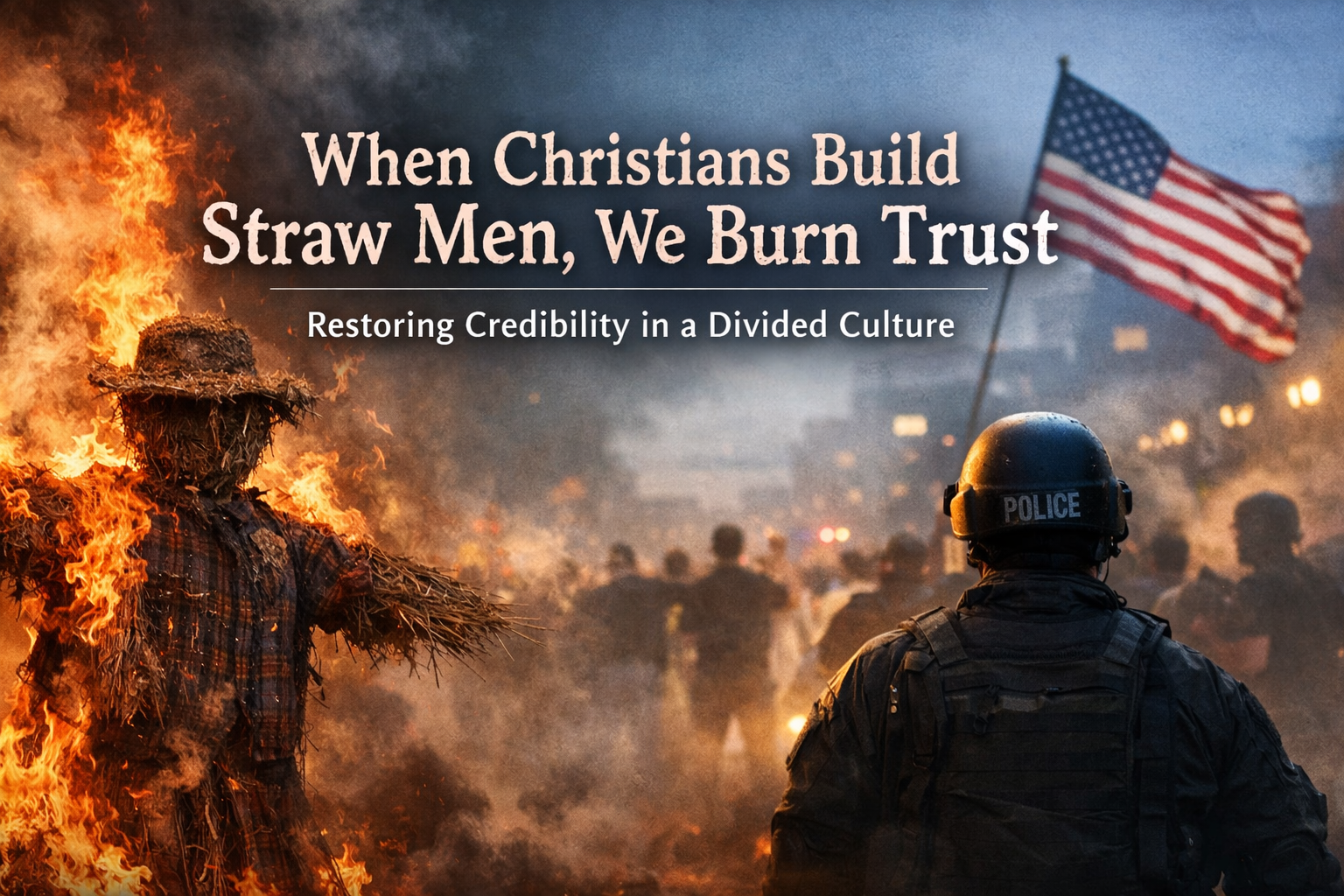
    I tend to be slow to respond to cultural crises, not because I lack an opinion, but because I often lack clarity. And when a professing Christian—be that a pastor, deacon, politician, military, or “ordinary” citizen—makes accusations, comparisons, or arguments from a position which lacks clarity, the result often causes more damage than healing. False facts routinely take the elevator while truth takes the stairs. The downstream effect of this is that Christian credibility has become a casualty of our cultural era.

    In other words, the credibility of the Christian witness often loses its trustworthiness in areas of the Gospel because it first lost its trustworthiness in the secular arena. Too many Christians have forgotten that when Christians speak, we are to be careful, fair, and committed to reality rather than tribal victory. And when that credibility erodes, our witness to Christ erodes with it.

    The Cost of False Equivalency

    A recent example has made this painfully clear. In the past week, I’ve seen many Christians equate Alex Pretti (who was shot in Minnesota this week) with Kyle Rittenhouse. The argument goes something like this: “Both were armed. Both were present during unrest. Therefore, both situations are the same.” But that is not careful reasoning. It is allowing emotions to shortcut the nuance, becoming a classic case of false equivalency, often propped up by straw-man reasoning.

    Thus, whatever conclusions one ultimately reaches about either case, the situations are not equivalent. The Pretti incident involved an armed confrontation with law enforcement. Rittenhouse, by contrast, famously held his hands up, complied with police, and did not initiate confrontation with authorities.

    To flatten these events into the same moral category is false equivalency. And when Christians do this, we communicate that facts matter less than the outcomes we prefer. That shifts the sphere of debate from questions of justice and righteousness to that of rhetoric.

    The Other Side’s Inconsistency

    But honesty requires we say more. For years—especially since COVID—some Christians have loudly argued for civil resistance, even armed resistance, against perceived tyranny. Rhetoric about standing firm, refusing compliance, “don’t tread on me,” and resisting unjust authority has been widespread in Christian circles. Given that history, those same voices should be slow and careful when condemning someone simply for being armed in a tense situation.

    If we champion resistance in theory but denounce it reflexively when it becomes uncomfortable or politically inconvenient, we reveal that our commitments are not morally principled, rather they’re selective and flexible. Truth cuts both directions. And Christians must be willing to let it do so.

    Straw Men Hurt More Than Arguments

    And this brings us to the deeper issue. When Christians misrepresent situations—whether by exaggeration, oversimplification, or selective comparison—we aren’t merely making bad arguments. We are training the watching world to distrust us. And once people stop trusting our words about justice, law, or truth, they will not suddenly trust us when we speak about sin, grace, or Christ. The gospel does not need spin. It does not need inconsistent rhetoric. It needs credible messengers.

    Scripture places a premium on truthful speech—not just sincere speech, but accurate, measured, fair speech. Wisdom literature repeatedly warns against hasty judgment. The New Testament ties our witness directly to our conduct and speech. When Christians become known for emotionalism rather than clarity, we stop being signposts. We become white noise, numbing culture to the uncomfortable sounds of sin and death unto their own destruction. Loving one’s neighbor means that truth—even if it means waiting for the stairs—trumps an emotional response of solidarity.

    Consistency Of Principle Matters

    Remember how many Christians pushed back against perceived government overreach during the COVID-19 era — asking governors, mayors, and other civil authorities to resist restrictions perceived as disproportionate or unlawful? That appeal to lesser magistrates (lower authorities) was rooted in a conviction that government must be held accountable to justice and the common good, even if it must move from the bottom-up instead of the top-down.

    Now, in Minnesota, many citizens are asking Gov. Tim Walz and other state leaders to push back against what they see as federal overreach in immigration enforcement operations — including recent confrontations between civilians and federal agents that have led to the fatal shootings of Minneapolis residents. My honest observation at this point is that failures exist on more than one side—some rhetoric has encouraged civilians toward physical confrontation with government officers, while officers operating in high-stress environments appear increasingly reactive. The result can be (and has been) tragic and, in many cases, avoidable.

    We don’t have to agree on every point of policy to sympathize with the principle — that government power should be exercised responsibly, transparently, and justly. And Christians who once demanded civilian restraint during pandemic responses should be slow to applaud violence now, simply because the political actors have changed.

    Just as the answer to mask mandates was not to approach law enforcement officers with a gun, neither is the answer to perceived federal misconduct to celebrate or escalate violence in the streets. There are avenues for proper discourse: legal challenges, public advocacy, peaceful protest, requests for investigation, and sustained civic engagement. No matter the issue, Christians on either side of the aisle must remember that we stand together demanding accountability from those in power—because we are people of the Truth: united to Christ, who is the Truth. As people shaped by Him, there can be no room for deceit in us.

    That reality ought to check our emotions and lead us toward public, open discourse rooted in truth — not cheering on violence, flattening situations into equivalency as if one turn deserves the other, or changing our tune when it no longer fits our agendas. When we lose that discipline of truth, we lose not just credibility but the very posture of Christlike witness that calls people to peace and justice.

    What Faithfulness Requires

    Faithfulness does not require us to have instant opinions on every breaking story. In fact, I would wager that we are much more likely to find agreeable solutions when we don’t. Sometimes the most Christian thing we can say is:

    “I don’t know enough yet.”

    Or:

    “These situations are not the same, and pretending they are doesn’t help anyone.”

    Or even:

    “There may be failures on more than one side, and we should be honest about all of them.”

    That posture signals maturity, wisdom, and teachability—not weakness or fear. The Church should be the place where truth-seeking outruns cultural outrage, where facts are handled carefully, and where moral clarity is grounded in reality rather than reaction. And this means: slow to speak, quick to pray, willing to talk.

    A Better Witness

    Christians are called to be a people shaped by truth—truth that exposes error on both sides of the political aisle. That will sometimes frustrate allies and disappoint critics. The odds are, your politicians or political party is not going to align with the principles of Kingdom of God. I know this, because the Bible tells me so. But holding for and to truth will restore something to the Christian witness that is desperately needed: trust.

    And trust is not a small thing.

    Because when people believe that Christians tell the truth—even when it costs them—they are far more likely to listen when we tell them about Christ.

  • Clean Is Not Holy: Covenant Membership, Baptism, and the Formation of God’s People.

    Clean Is Not Holy: Covenant Membership, Baptism, and the Formation of God’s People.

    In my experience, one of the most overlooked distinctions in Scripture is the difference between being clean and being holy. We often assume these categories are interchangeable. The Bible does not.

    Recovering this distinction does more than clarify Israel’s cultic (religious) system—it sheds fresh light on covenant membership, the role of baptism, and the status of children within the people of God. When handled carefully, it fits squarely within the Westminster Confession of Faith and guards paedobaptism from both sacramentalism and reductionism (as we will see shortly).

    Clean Is Not Holy

    Throughout the Old Testament, people, animals, and spaces are arranged according to a graded pattern:

    Unclean → Clean → Holy

    We see this pattern elsewhere across scripture: 

    World → Eden → Garden of Eden

    Courtyard → Holy Place → Holy of Holies

    Gentile → Israel → Priests

    Unclean. Clean. Holy. These are not (primarily) moral categories but relational positions with respect to the presence of YHWH.

    • The unclean are excluded from sacred space (Lev. 13:45–46).
    • The clean may dwell among the people and approach the sanctuary with limits (Lev. 15:31).
    • The holy are authorized for proximity and service (Exod. 19:22; Lev. 21:6–8).

    Crucially, in the OT system, only what is first clean may then become holy (Lev. 22:4–7). Holiness is not the prerequisite for approach—it is the goal of life lived near God’s presence. The tabernacle, priesthood, and sacrificial system all exist to teach Israel that God graciously brings people near, and then calls them to deeper conformity to His holiness.

    Covenant Membership Makes One Clean

    By redemptive blood and covenant promise, Israel is separated from the nations and placed into a new relational status before God:

    You shall be to me a kingdom of priests and a holy nation” (Exod. 19:6).

    This does not mean that every Israelite is regenerate or morally holy. Rather, Israel’s corporate status is one of covenant cleanness—they belong to the sphere where God dwells among His people (Lev. 11:44–45).

    This is why in the old covenant, Israel’s children are never treated as outsiders. They are addressed as covenant members (Deut. 6:6–7), included in covenant renewal ceremonies (Deut. 29:10–12), and disciplined as sons (Deut. 8:5). As a community, they belong. They are clean—yet they must still grow into holiness. They are to “be holy as I AM holy” (Lev 11:44, 19:2).

    This distinction can be illustrated well in the sacrificial system. As most people know, in the old covenantal, sheep are considerd clean animals (Lev. 11:2–3). Yet only those without blemish may be offered to YHWH (Lev. 22:19–25). As such, we can see that clean does not mean sacrificially fit—clean is the baseline; holiness–or in the case of the sacrificial sheep, lack of blemish–is the goal.

    The Sojourner: Near, but Not Yet Belonging

    The sojourner (gēr) lives among Israel and benefits from Israel’s holiness, yet remains distinct. Exodus 12:48 makes the boundary explicit: circumcision marks a transition from outsider to native. Critically, circumcision does not make the sojourner holy—it marks covenantal inclusion—it shifts them from the ceremonial category of unclean to clean. Covenant children, by contrast, are not sojourners awaiting entry. They are born inside the household (Gen. 17:7–13).

    Baptism as Covenant Cleanness

    In the New Testament, baptism functions as the covenant marker that places a person within the visible people of God (Acts 2:38–39; Col. 2:11–12). The Westminster Confession recognizes this, stating:

    Baptism is a sacrament of the New Testament… a sign and seal of the covenant of grace” (WCF 28.1).

    And:

    The efficacy of baptism is not tied to that moment of time wherein it is administered” (WCF 28.6).

    Baptism marks belonging, not justification nor completed sanctification.

    The Visible and Invisible Church

    A brief clarification is helpful here. Reformed theology has long distinguished between the visible church and the invisible church, and this distinction maps closely onto the biblical categories of clean and holy.

    The invisible church refers to the elect—those who are truly united to Christ by faith and known perfectly to God alone. Membership in the invisible church is determined by God’s saving work, not by outward markers or covenant signs. The visible church, however, is the historical, covenant community as it exists in the world. It consists of all those who profess the true religion, together with their children, and is marked by the public administration of the Word and the sacraments.

    Entrance into the visible church is not a claim about regeneration, but about covenantal status.
    Baptism, then, is a sign of visible inclusion, not a guarantee of inward holiness. It marks a person as belonging to God’s covenant people—set apart from the world, placed under God’s promises, and obligated to live in faithful obedience. In biblical terms, baptism renders someone clean with respect to covenant membership, even as holiness in its fullest sense remains something God must work in and through a life of faith.

    This distinction guards us from two errors. On the one hand, it prevents sacramentalism, which assumes that outward signs automatically produce inward grace. On the other hand, it resists reductionism, which collapses covenant membership into personal regeneration alone. Scripture allows—and requires—us to say that someone may truly belong to God’s people outwardly while still being called to become inwardly what that status demands.

    In other words, the visible church is the arena of formation. God places people—adults and children alike—within His covenant community, so that they may be called, shaped, disciplined, and nurtured toward holiness.

    “But Aren’t Believers Already Holy?”

    Scripture maintains both realities: believers are holy by placement and called to holiness in practice (1 Pet. 1:15; 2:9). Likewise, covenant children are called “holy” (1 Cor. 7:14), indicating covenantal consecration in Paul’s usage, not regenerated–just as the unbelieving spouse is made “holy” by their believing husband/wife. So, it must be recongnized that holiness often names placement before performance.

    A Note Clarifying “Holiness” and Covenant Placement
    When Scripture speaks of covenant members—especially children—as “holy,” it does not thereby assert regeneration, justification, or election. Rather, Paul uses “holy” covenantally, to denote placement within the consecrated sphere of God’s people, just as the Old Testament used categories of cleanness to distinguish those inside the covenant community from the unclean world outside (1 Cor. 7:14). This covenantal holiness establishes neither saving faith nor final righteousness, both of which come only by union with Christ. Instead, it names a real, objective status of belonging that carries both privilege and responsibility within the visible church.

    Some well-known theologians on 1 Cor. 7:14:

    • The children of believers are holy, not by nature, but by virtue of the covenant; for they are distinguished from the children of unbelievers” (John Calvin, Commentry on 1 Corinthians 7:14).
    • Charles Hodge states that “holy” means “set apart from the world and consecrated to God… not inwardly sanctified, but externally holy” (Hodge, Commentary on 1 Corinthians).
    • In By Faith, Not by Sight and Resurrection and Redemption, Richard Gaffin shows that Paul regularly uses sanctification language to describe status within Christ, not merely inward change.
    • Anthony Thiselton argues that “holy” in 1 Corinthians 7:14 means “belonging to the sphere of God’s saving activity” (Thiselton, The First Epistle to the Corinthians–NIGTC).
    • Gordon Fee argues that “holy” here refers to (1) Status within the Christian community and (2) being set apart by association with the believing parent (Fee, The First Epistle to the Corinthians–NICNT)

    So, there is a strong consensus that Paul’s use of holy is to be seen as a corollary to the OT concept of “clean” and, as such, it can be understood that baptism marks covenant placement rather than spiritual completion.

    The Normative Pattern and the Extraordinary Exception

    The thief on the cross shows that God may save apart from the ordinary administration of covenant signs (Luke 23:42–43). However, the rule remains normative:

    Although it be a great sin to condemn or neglect this ordinance (baptism), yet grace and salvation are not so inseparably annexed unto it…” (WCF 28.5).

    Now, it’s important to note that while all sin is unclean, not all uncleanness is sin (Lev. 12; 15; Num. 19). The thief on the cross was not in sin because he did not recieve baptism. His status in that moment between saving faith and his painful death does not override the work of Christ–that’s the mistake the Judaizers were making in the New Testament. As such, a believer may indeed be united to Christ prior to baptism, yet–if he is able–he is commanded to receive the mark as an act of obedience, public confession, and identification with the people of God (Acts 2:38; 10:47–48). And one who denies the mark must be questioned about their commitment to Christ.

    Christ Perfecting His Bride

    Christ alone is the spotless Lamb whose sacrifice secures our acceptance (Heb. 10:10–14). Yet He is also perfecting His bride:

    Christ loved the church and gave himself up for her… that he might present the church to himself in splendor” (Eph. 5:25–27).

    Christ loves His bride in order to perfect her. Warnings, exhortations, and discipline are not contrary to grace—they are instruments of it. He makes us holy even as we are holy, continuing the good work he began (we call this process “sanctification”).

    A Pastoral Word to the Baptized

    A brief word of pastoral wisdom–Sheep die one of two ways: offered as a pleasing sacrifice, or consumed by the mundane. Wholly burnt up for YHWH or wholly burnt up by the world. This is not about earning acceptance, but about living consistently with our belonging (Rom. 12:1; 2 Cor. 2:15). Baptism places us near the altar—it does not guarantee faithfulness upon it. Grace places us among the flock and holiness is the path by which that grace is displayed.

    The Path, Not the Finish Line

    Baptism does not mark the end of the journey. Rather, it marks the beginning of formation. This is how God ordinarily forms His people:

    from unclean → to clean → to holy.

    And it is Christ Himself who will finish the work He has begun (Phil. 1:6).

    In short: Baptism places us among God’s people as clean, not completed, and summons us to live lives that reflect the holiness Christ is faithfully working into His bride.

  • Why Christians Should Think Twice About Celebrating Hanukkah

    Why Christians Should Think Twice About Celebrating Hanukkah

    Every December, I see Christians posting menorahs, lighting candles, or saying things like, “Jesus celebrated Hanukkah, so I do too!” And on the face, it sounds histroical, thoughtful and reverent. But the history behind Hanukkah is far more complicated than most Christians realize. And if we take Scripture seriously (as we all should!), the festival raises some theological concerns that make Christian celebration “iffy,” if not inappropriate.

    Let’s walk through the real story.

    Hanukkah Is Not a Biblical Festival

    Hanukkah does not come from Moses, David, the Prophets, or any Old Testament command. It comes from the Maccabean/Hasmonean revolt in the 2nd century BC—a revolt that freed Judea from Seleucid (essentially Greek) oppression but produced its own theological and political problems.

    1. The Hasmoneans Were Not from Judah

    The Maccabees were Levites from the priestly family of Jehoiarib—not from the royal line of David. After the Maccabean revolt:

    • They did not restore the Davidic monarchy.
    • They crowned themselves rulers.
    • They merged priestly and kingly authority in a single family—something Scripture forbids.

    In the Scriptures, the kingship belongs to Judah (Gen 49:10), the high priesthood belongs to the line of Zadok (Ezek 40–48), and the prophets are sent by God. Hanukkah celebrates the moment when a priestly family took the throne that belonged to David’s line.

    2. Hanukkah Celebrates the Overthrow of the Zadokite High Priesthood

    In addition to seizing civil authority—the Hasmoneans took the high priesthood too, appointing themselves high priests despite not being from the line of Zadok. This is why the Qumran/Essene community (Dead Sea Scrolls) rejected Hanukkah entirely. They saw the Hasmonean high priests as illegitimate usurpers. In other words: A major Jewish sect in Jesus’ day rejected Hanukkah for the exact reasons Christians overlook today.

    3. Hanukkah Represents the Suppression of the Davidic Line

    By the time we get to Joseph and Mary, David’s royal family is politically sidelined, economically marginalized, and living in obscure working-class conditions. This is not an accident nor a coincidence. The Hasmoneans consolidated wealth and power around themselves, leaving David’s sons in the shadows. In short: Hanukkah celebrates the political arrangement that kept the true king’s family—Joseph’s family—off the throne.

    “But Jesus Celebrated Hanukkah!” — Did He Really?

    Many appeal to John 10:22: “At that time the Feast of Dedication took place in Jerusalem.” But notice what the text does not say. It does not say:

    • Jesus attended the festival
    • Jesus lit candles
    • Jesus observed rituals
    • Jesus endorsed the celebration

    John simply notes the time of year using the feastal calendar that Israel would have been familiar with. Jesus is walking and teaching in Solomon’s Portico—something He did constantly. And what does He do at Hanukkah?

    • He rebukes the temple leaders (John 10:26–30).
    • He confronts the very authorities who claimed legitimacy through the Hasmonean system that Hanukkah celebrates.

    If anything, John 10 is a rejection of Hanukkah’s claims, not an endorsement. As far as Scripture speaks, Jesus never celebrated Hanukkah. Instead, He used the occasion to declare Himself the true Shepherd-King—the Son of David —in opposition to the Hasmoneans.

    What About the Miracle of the Oil?

    We are often told the story of Hanukkah as it is found in it final form—the miracle of the oil that burned for eight days. But here’s the true background to that story:

    • The earliest sources (1 and 2 Maccabees) mention no oil miracle.
    • Josephus (1st century AD) mentions no oil miracle.
    • The Dead Sea Scrolls mention no oil miracle.
    • The earliest accounts describe an eight-day festival because they didn’t have time to celebrate the Feast of Booths earlier.

    So when does the oil story appear? In the Babylonian Talmud in the 5th Century AD.

    That’s roughly 700 years after the events! In other words, it is a later rabbinic legend—an attempt to spiritually reframe a holiday that originally celebrated a dynasty later viewed as corrupt.

    Which means: The most beloved part of Hanukkah wasn’t even part of Hanukkah until centuries after Jesus.

    Who Celebrated Hanukkah in Jesus’ Day?

    In Jesus’ time, Hanukkah was politically charged, and as such, not universally embraced.

    • The Pharisees largely supported it.
    • The Sadducees/Hasmonean priests embraced it—because it justified their power.
    • Many common Jews observed it culturally.
    • The Essenes/Qumran rejected it outright as an illegitimate festival.

    Judaism was not unified on Hanukkah, and neither was the early church.

    So Should a Christian Celebrate Hanukkah?

    A Christian may:

    • study Hanukkah historically
    • understand its role in Second Temple Judaism
    • teach how it sets the stage for Christ’s arrival

    But a Christian should not:

    • treat it as a spiritual or religious holiday
    • light menorahs devotionally
    • merge it with Advent
    • imitate rituals that historically celebrate illegitimate priest-kings

    Here’s why: Hanukkah celebrates the wrong king, the wrong priest, and the wrong restoration. Advent celebrates the arrival of the right King, the right Priest, and the true Temple. Hanukkah points to the failure of human rulers while Advent points to the triumph of Christ. Hanukkah shines a temporary, human light. Advent reveals “the true Light who gives light to everyone” (John 1:9). Hanukkah is longing for restoration. Advent is restoration arrived.

    Conclusion

    Christians do not need Hanukkah because Hanukkah needed Christ. The Maccabean revolt produced a dynasty that subverted David’s throne and Zadok’s priesthood—precisely the corruption Jesus came to confront. The “Festival of Lights” is ultimately a celebration of misplaced hope. Advent is the celebration of fulfilled hope. Hanukkah celebrates earthly attempts at empire, Advent remembers the true Kingdom established by Christ.

    Friends, the child born in Bethlehem—descended from a forgotten line of kings—came to take back the throne every other dynasty stole.