Category: Membership

  • Legacy Dies in the Hands of a Corpse

    Legacy Dies in the Hands of a Corpse

    Legacy is a funny word because it means different things to different people. And not everyone agrees on how to define one’s “legacy.” Yet in the end, there are really only two kinds of legacy: a legacy of faithfulness and a legacy of pride.

    A legacy of pride seeks to preserve itself. It is built around personalities, memories, accomplishments, and the desire to remain the center of the story. It asks, How do we protect what we have built? It is ultimately anchored to people, and because people pass away, it cannot endure.

    A legacy of faithfulness is different. It understands that God’s kingdom is bigger than any individual, any generation, or any particular season of ministry. It asks a different question: How do we faithfully hand forward what God has entrusted to us? It is willing to sacrifice comfort for mission, familiarity for fruitfulness, and personal preference for the good of those who come after.

    The difference can be seen throughout Scripture. Consider King Nebuchadnezzar standing atop Babylon declaring, “Is not this great Babylon, which I have built?” His concern was preserving and celebrating his own greatness. Then consider David. David’s greatest contribution was not building a kingdom that depended upon David. His greatest contribution was preparing for a kingdom that would continue after David was gone. He gathered resources he would never personally use. He made preparations for a temple he would never see. He spent his final years investing in a future generation because he understood that God’s purposes were larger than his own lifetime.

    Most importantly, a God-honoring legacy is always a legacy that is passed on. The goal is never our name. The goal is Christ’s name. The goal is never preserving our comfort. The goal is advancing His kingdom.

    As I reflect on my pastorate at Grace Fellowship, the word legacy keeps returning to my mind. Yet, it is not my legacy that concerns me most. It is the church’s.

    Over the last four years, Grace Fellowship has repeatedly chosen faith over fear. She called a pastor when it was not obvious the finances could sustain it. She expanded ministry staff to meet the needs of a growing congregation. She embraced a name change, refreshed her identity, and welcomed wave after wave of new faces into the fellowship. None of those decisions were easy. Every one of them required trust. Every one of them required sacrifice. Every one of them demanded faith that God was doing something bigger than preserving the status quo.

    That is why I keep returning to the parable of the talents.

    Three servants were entrusted with resources that belonged to their master. Two took what had been entrusted to them and put it to work. They faced uncertainty. They assumed risk. They accepted the possibility of failure. Yet when the master returned, they were commended because they understood that what they possessed was never ultimately theirs. Their responsibility was not merely to preserve the master’s resources but to employ them in service to the master’s purposes.

    The third servant thought differently. He buried the talent. He protected it. He preserved it. He returned exactly what had been entrusted to him.

    And yet he was rebuked.

    Not because he squandered the master’s resources, but because fear had become more important than faithfulness. Preservation had replaced mission. Safety had replaced stewardship.

    The church faces that same temptation in every generation.

    Every congregation eventually reaches a moment when it must decide whether it will become a museum or a mission. Whether it will devote itself to protecting what previous generations built or investing those gifts so that future generations might flourish. Whether it will cling tightly to what God has entrusted or open its hands and pass it forward.

    That is the question of legacy.

    The future legacy of Grace Fellowship will not ultimately be determined by Weston Blaha or by the next pastor. Pastors come and go. Every shepherd eventually hands the staff to another—or worse, a shepherd hangs up the staff because there are no longer any sheep to tend.

    The legacy of Grace Fellowship will be determined by her people.

    Will future generations look back and say that this church faithfully invested everything God entrusted to her for the sake of Christ’s kingdom? Will they thank God that an earlier generation was willing to sacrifice, risk, and dream beyond its own lifetime? Will they inherit a church that was always looking outward rather than backward? Those are the questions that now stand before us.

    My friends, faithful legacies are never built by holding on. They are built by handing off. And no good legacy ever ends clutched in the hands of a corpse.

  • In Defense of Mother’s Day

    In Defense of Mother’s Day

    Sadly, Mother’s Day has become another casualty of our culture’s obsession with victimhood. Every year I hear the same chorus warning:

    “What about women who can’t have children?”

    “What about women who lost babies?”

    “What about painful family situations?”

    And I would ask that a careful ear is leaned my way: those pains are real. Barrenness is painful. Miscarriage is painful. Loneliness is painful. Scripture itself recognizes that grief. But fifteen years of pastoral ministry have taught me that this complaint, however sincere, is also consistently wrong. Here’s the problem that we need to address: we have begun treating personal sorrow as a veto against public celebration.

    A woman being unable to bear children is deeply tragic. There is a reason barrenness plays such a central role in the biblical theme of redemption. But it is not a reason to stop honoring faithful mothers any more than a funeral is a reason to cancel weddings. As Christians, we do not respond to God’s blessings by silencing celebration because someone else did not receive the same gift. When Scripture speaks of children, it does not apologize for calling them a blessing:

    Behold, children are a heritage from the Lord, the fruit of the womb a reward.” — Psalm 127:3

    Modern culture trains people to interpret every celebration through the lens of personal deprivation: “If I do not have it, then you should not publicly rejoice in it.” That is not a sign of Christian maturity—that is an expression of cultivated resentment.

    The Christian response to another person’s blessing should always be thanksgiving to God for His goodness, even when His providence toward us is different. Romans 12 commands us:

    “Rejoice with those who rejoice; weep with those who weep.”

    Notice: Scripture commands both. We should absolutely weep with grieving women. We should counsel the hurting. We should love the lonely. But we should not flatten every joyful occasion into an exercise in emotional risk management. Mother’s Day is not cruel because motherhood reminds some women of loss. By that logic, Father’s Day harms orphans and weddings harm the unmarried. Baby showers harm the infertile. And every “believer’s baptism” wounds the prodigal parent.

    A society governed by grievance eventually loses the ability to celebrate anything at all. The Church should resist this impulse. We honor mothers because motherhood is good. We celebrate children because children are blessings. And we thank God publicly for His gifts without embarrassment.

    It’s important to recognize a hard truth: Not every person receives every gift. But Christians are called to worship God for His goodness anyway. So, we celebrate our mothers. We honor them. We remember them. But we do not use our grief or trials to demand that other men and women do not get to praise God for his goodness. 

    This Sunday, honor your wives/mothers. Remind them of how good God is to give them the unmatched responsibility of raising arrows in the quiver. Celebrate them and celebrate with them—this is the only appropriate Christian posture.

    But do hear this: I am not asking hurting women to perform happiness. I’m asking them not to demand that joy be silenced because they are hurting.

    The body of Christ is edified when joy is celebrated and grief is lamented. Mother’s Day is a day of joy—let us edify one another on it.

  • Why Clear Doctrine Matters

    Why Clear Doctrine Matters

    This week, one of our elders taught on the Councils, Creeds, and Confessions of the church. It was a wonderful exposition of why doctrinal clarity is essential for the peace and purity of the Body of Christ. As I reflected upon the EPC’s debate over sexuality and ordination, his lesson caused me to consider one of the most common misunderstandings in conversations about doctrinal clarity—especially in discussions surrounding same-sex attraction (SSA) and pastoral qualifications. For many, the assumption is that clear doctrine exists primarily to keep people out. But that’s not actually its primary function.

    The Point of Clear Doctrine

    Clear doctrine exists to give the church judicial clarity—the ability to identify, confront, and, if necessary, discipline real error and misconduct (consider Acts 15 and the Jerusalem Council). Without clear definitions—without clear doctrine—there is no meaningful accountability. When doctrinal language becomes vague, when categories are left intentionally open-ended, it does not create the anticiapted pastoral flexibility. Rather, it creates judicial paralysis. The church cannot correct what it refuses to clearly define.

    This is not because the church only cares about certain “big sins” and ignores others. Scripture is clear: all sin matters, and all sin must be addressed. But not all sin functions in the same way in the life of the church—especially when it comes to ordination and public teaching. Some sins are addressed primarily pastorally through repentance, counsel, and the ordinary means of grace. Others become judicial matters when they are taught, justified, or embedded into categories that shape doctrine, identity, telos, or the qualifications for office.

    And it is at that point that clarity becomes essential.

    Why This Matters for Ordination

    This is where the concern lies with frameworks that allow for a “celibate, same-sex attracted pastor” without carefully defining concupiscence, the nature of desire (natural/unnatural), sin, and sanctification. Even if such a framework is introduced with good intentions—filled with the charity of the EPC ethos— it inevitably creates a category that can be expanded from within. And that expansion is not simply a theoretical or hypothetical concern; it is a structural weakness that only becomes evident once exposed through its abuse.

    If a man is ordained under a category that affirms ongoing identification with disordered desire—like SSA— then that same category becomes the very shield he may later use if he begins to teach or speak in ways that undermine biblical sexual ethics. The system has already granted him a definitional foothold.

    At that point, discipline becomes nearly impossible—not because the church lacks courage or access to Scripture, but because it lacks clarity. To put it simply: you cannot enforce a standard that you have not clearly articulated.

    It Is Just A Pack of Skittles, Right?

    Consider a simple analogy:

    A movie theater has a policy: no outside food or drinks. In practice, the employee at the door may exercise discretion when someone slips in a small pack of Skittles. The rule still applies — but enforcement is proportionate, and “pastoral” common sense governs the moment. However, that is not the main point of the rule. The rule exists so that when someone walks in carrying an entire pizza and a 2-liter soda, the theater has the authority to act. Without the rule, there is no basis for enforcement.

    But now, complicate the analogy. Suppose the theater also has a fire code: no open flames. Someone lighting a single candle at their seat is not a bigger “Skittles problem.” It is a categorically different violation — one that implicates the safety of everyone in the building, not merely the theater’s revenue model. The fire code and the food policy are both rules, but they exist for different reasons, protect different things, and require different responses.

    The same logic applies here. Pastoral discretion appropriately governs many sins that touch ordination questions. But when a category of desire is not merely a misuse of a good thing — but is directed toward an object Scripture identifies as contrary to the created order itself — the church is no longer dealing with a “Skittles” problem. It is dealing with an open flame. And a church without clear doctrine on that distinction has no basis for knowing which problem it’s actually facing — until it’s too late.

    Clarity Prevents Both Neglect and Abuse

    Doctrinal standards are not primarily about catching every minor infraction. People will lie. People will hide things. Pastors will lie. Pastors will hide things—we all know this is part of the fallen order in which we live. And while doctrinal standards are not indifferent to so-called “smaller sins,” they establish clear boundaries so that:

    • ordinary sin can be addressed pastorally and corrected, and
    • serious error—especially when it is taught, justified, or institutionalized—can be addressed judicially.

    Without that distinction, two errors emerge:

    1. We either minimize sin altogether (“everyone struggles, so nothing can be addressed”), or
    2. We weaponize discipline inconsistently (“this sin matters, but that one doesn’t”).

    Clear doctrine guards against both. It ensures that the church is not left debating definitions in the moment of crisis. There is no confusion, no appeal to ambiguity, no shelter in undefined categories. In other words: clarity beforehand prevents both neglect and abuse later.

    Guarding the Flock

    Clear doctrine is not about exclusion—though it does serve as a protective barrier—it is about faithful oversight. And this goes for all doctrinal concerns. The church is called not only to welcome and shepherd, but also to guard the flock (Acts 20:28–31). And guarding requires more than good intentions and amicability—it requires clear, enforceable standards.

    Without them, even the best-intentioned systems will eventually fail at the very point they are needed most.

    This post has not attempted to make the full theological argument. The theological distinctions for concupiscence, the natural/unnatural framework, and what ordination representationally requires , is developed more fully in a companion paper (to access that paper, please reach out to me).

    The goal here is simply this: clear doctrine is not the enemy of pastoral care — it is one of its necessary conditions.

  • Clean Is Not Holy: Covenant Membership, Baptism, and the Formation of God’s People.

    Clean Is Not Holy: Covenant Membership, Baptism, and the Formation of God’s People.

    In my experience, one of the most overlooked distinctions in Scripture is the difference between being clean and being holy. We often assume these categories are interchangeable. The Bible does not.

    Recovering this distinction does more than clarify Israel’s cultic (religious) system—it sheds fresh light on covenant membership, the role of baptism, and the status of children within the people of God. When handled carefully, it fits squarely within the Westminster Confession of Faith and guards paedobaptism from both sacramentalism and reductionism (as we will see shortly).

    Clean Is Not Holy

    Throughout the Old Testament, people, animals, and spaces are arranged according to a graded pattern:

    Unclean → Clean → Holy

    We see this pattern elsewhere across scripture: 

    World → Eden → Garden of Eden

    Courtyard → Holy Place → Holy of Holies

    Gentile → Israel → Priests

    Unclean. Clean. Holy. These are not (primarily) moral categories but relational positions with respect to the presence of YHWH.

    • The unclean are excluded from sacred space (Lev. 13:45–46).
    • The clean may dwell among the people and approach the sanctuary with limits (Lev. 15:31).
    • The holy are authorized for proximity and service (Exod. 19:22; Lev. 21:6–8).

    Crucially, in the OT system, only what is first clean may then become holy (Lev. 22:4–7). Holiness is not the prerequisite for approach—it is the goal of life lived near God’s presence. The tabernacle, priesthood, and sacrificial system all exist to teach Israel that God graciously brings people near, and then calls them to deeper conformity to His holiness.

    Covenant Membership Makes One Clean

    By redemptive blood and covenant promise, Israel is separated from the nations and placed into a new relational status before God:

    You shall be to me a kingdom of priests and a holy nation” (Exod. 19:6).

    This does not mean that every Israelite is regenerate or morally holy. Rather, Israel’s corporate status is one of covenant cleanness—they belong to the sphere where God dwells among His people (Lev. 11:44–45).

    This is why in the old covenant, Israel’s children are never treated as outsiders. They are addressed as covenant members (Deut. 6:6–7), included in covenant renewal ceremonies (Deut. 29:10–12), and disciplined as sons (Deut. 8:5). As a community, they belong. They are clean—yet they must still grow into holiness. They are to “be holy as I AM holy” (Lev 11:44, 19:2).

    This distinction can be illustrated well in the sacrificial system. As most people know, in the old covenantal, sheep are considerd clean animals (Lev. 11:2–3). Yet only those without blemish may be offered to YHWH (Lev. 22:19–25). As such, we can see that clean does not mean sacrificially fit—clean is the baseline; holiness–or in the case of the sacrificial sheep, lack of blemish–is the goal.

    The Sojourner: Near, but Not Yet Belonging

    The sojourner (gēr) lives among Israel and benefits from Israel’s holiness, yet remains distinct. Exodus 12:48 makes the boundary explicit: circumcision marks a transition from outsider to native. Critically, circumcision does not make the sojourner holy—it marks covenantal inclusion—it shifts them from the ceremonial category of unclean to clean. Covenant children, by contrast, are not sojourners awaiting entry. They are born inside the household (Gen. 17:7–13).

    Baptism as Covenant Cleanness

    In the New Testament, baptism functions as the covenant marker that places a person within the visible people of God (Acts 2:38–39; Col. 2:11–12). The Westminster Confession recognizes this, stating:

    Baptism is a sacrament of the New Testament… a sign and seal of the covenant of grace” (WCF 28.1).

    And:

    The efficacy of baptism is not tied to that moment of time wherein it is administered” (WCF 28.6).

    Baptism marks belonging, not justification nor completed sanctification.

    The Visible and Invisible Church

    A brief clarification is helpful here. Reformed theology has long distinguished between the visible church and the invisible church, and this distinction maps closely onto the biblical categories of clean and holy.

    The invisible church refers to the elect—those who are truly united to Christ by faith and known perfectly to God alone. Membership in the invisible church is determined by God’s saving work, not by outward markers or covenant signs. The visible church, however, is the historical, covenant community as it exists in the world. It consists of all those who profess the true religion, together with their children, and is marked by the public administration of the Word and the sacraments.

    Entrance into the visible church is not a claim about regeneration, but about covenantal status.
    Baptism, then, is a sign of visible inclusion, not a guarantee of inward holiness. It marks a person as belonging to God’s covenant people—set apart from the world, placed under God’s promises, and obligated to live in faithful obedience. In biblical terms, baptism renders someone clean with respect to covenant membership, even as holiness in its fullest sense remains something God must work in and through a life of faith.

    This distinction guards us from two errors. On the one hand, it prevents sacramentalism, which assumes that outward signs automatically produce inward grace. On the other hand, it resists reductionism, which collapses covenant membership into personal regeneration alone. Scripture allows—and requires—us to say that someone may truly belong to God’s people outwardly while still being called to become inwardly what that status demands.

    In other words, the visible church is the arena of formation. God places people—adults and children alike—within His covenant community, so that they may be called, shaped, disciplined, and nurtured toward holiness.

    “But Aren’t Believers Already Holy?”

    Scripture maintains both realities: believers are holy by placement and called to holiness in practice (1 Pet. 1:15; 2:9). Likewise, covenant children are called “holy” (1 Cor. 7:14), indicating covenantal consecration in Paul’s usage, not regenerated–just as the unbelieving spouse is made “holy” by their believing husband/wife. So, it must be recongnized that holiness often names placement before performance.

    A Note Clarifying “Holiness” and Covenant Placement
    When Scripture speaks of covenant members—especially children—as “holy,” it does not thereby assert regeneration, justification, or election. Rather, Paul uses “holy” covenantally, to denote placement within the consecrated sphere of God’s people, just as the Old Testament used categories of cleanness to distinguish those inside the covenant community from the unclean world outside (1 Cor. 7:14). This covenantal holiness establishes neither saving faith nor final righteousness, both of which come only by union with Christ. Instead, it names a real, objective status of belonging that carries both privilege and responsibility within the visible church.

    Some well-known theologians on 1 Cor. 7:14:

    • The children of believers are holy, not by nature, but by virtue of the covenant; for they are distinguished from the children of unbelievers” (John Calvin, Commentry on 1 Corinthians 7:14).
    • Charles Hodge states that “holy” means “set apart from the world and consecrated to God… not inwardly sanctified, but externally holy” (Hodge, Commentary on 1 Corinthians).
    • In By Faith, Not by Sight and Resurrection and Redemption, Richard Gaffin shows that Paul regularly uses sanctification language to describe status within Christ, not merely inward change.
    • Anthony Thiselton argues that “holy” in 1 Corinthians 7:14 means “belonging to the sphere of God’s saving activity” (Thiselton, The First Epistle to the Corinthians–NIGTC).
    • Gordon Fee argues that “holy” here refers to (1) Status within the Christian community and (2) being set apart by association with the believing parent (Fee, The First Epistle to the Corinthians–NICNT)

    So, there is a strong consensus that Paul’s use of holy is to be seen as a corollary to the OT concept of “clean” and, as such, it can be understood that baptism marks covenant placement rather than spiritual completion.

    The Normative Pattern and the Extraordinary Exception

    The thief on the cross shows that God may save apart from the ordinary administration of covenant signs (Luke 23:42–43). However, the rule remains normative:

    Although it be a great sin to condemn or neglect this ordinance (baptism), yet grace and salvation are not so inseparably annexed unto it…” (WCF 28.5).

    Now, it’s important to note that while all sin is unclean, not all uncleanness is sin (Lev. 12; 15; Num. 19). The thief on the cross was not in sin because he did not recieve baptism. His status in that moment between saving faith and his painful death does not override the work of Christ–that’s the mistake the Judaizers were making in the New Testament. As such, a believer may indeed be united to Christ prior to baptism, yet–if he is able–he is commanded to receive the mark as an act of obedience, public confession, and identification with the people of God (Acts 2:38; 10:47–48). And one who denies the mark must be questioned about their commitment to Christ.

    Christ Perfecting His Bride

    Christ alone is the spotless Lamb whose sacrifice secures our acceptance (Heb. 10:10–14). Yet He is also perfecting His bride:

    Christ loved the church and gave himself up for her… that he might present the church to himself in splendor” (Eph. 5:25–27).

    Christ loves His bride in order to perfect her. Warnings, exhortations, and discipline are not contrary to grace—they are instruments of it. He makes us holy even as we are holy, continuing the good work he began (we call this process “sanctification”).

    A Pastoral Word to the Baptized

    A brief word of pastoral wisdom–Sheep die one of two ways: offered as a pleasing sacrifice, or consumed by the mundane. Wholly burnt up for YHWH or wholly burnt up by the world. This is not about earning acceptance, but about living consistently with our belonging (Rom. 12:1; 2 Cor. 2:15). Baptism places us near the altar—it does not guarantee faithfulness upon it. Grace places us among the flock and holiness is the path by which that grace is displayed.

    The Path, Not the Finish Line

    Baptism does not mark the end of the journey. Rather, it marks the beginning of formation. This is how God ordinarily forms His people:

    from unclean → to clean → to holy.

    And it is Christ Himself who will finish the work He has begun (Phil. 1:6).

    In short: Baptism places us among God’s people as clean, not completed, and summons us to live lives that reflect the holiness Christ is faithfully working into His bride.


  • Peace and Purity: Why the Church Cannot Have One Without the Other

    Peace and Purity: Why the Church Cannot Have One Without the Other

    In the EPC, every new member makes a simple but weighty promise: “Do you promise to promote the unity, peace, and purity of the church?” It’s easy to treat unity, peace and purity as three separate directions—as though we could prioritize one without jeopardizing the other. But Scripture and the Reformed tradition (especially the Westminster Standards) insist that peace flows from purity, not the other way around. Lose purity, and you lose peace. Seek peace at the expense of purity, and you get neither.

    Biblical Peace is the Fruit of Truth, Not the Absence of Conflict

    “Peace” in Scripture is not about absence of conflict. It is shalom—order, wholeness, integrity. And this cannot exist apart from truth. Jesus prayed, “Sanctify them in the truth; Your Word is truth” (John 17:17). Paul joins peace and purity repeatedly (2 Tim. 1:13; Titus 2:1–2). The early church enjoyed deep unity after anchoring themselves in “’the apostles’ teaching” (Acts 2:42–47). The Westminster Confession agrees: the church’s holiness and peace are a mark of the Spirit’s work, not human diplomacy.

    The purest Churches under heaven are subject both to mixture and error…(WCF 25.5)

    Purity is not perfection (though Christ will eventually perfect his Bride)—but it is the sincere pursuit of doctrinal and moral faithfulness. And this pursuit is what guards the church’s peace.

    Pursuing Peace at the Expense of Purity Always Harms the Flock

    Many churches avoid conflict by refusing to confront false teaching or unrepentant sin. That instinct feels peaceful and mercy-filled, but Scripture calls it dangerous. Paul warns that wolves will come “from among your own selves” (Acts 20:29–30). In 1 Corinthians 5:6-7 we read, “Do you not know that a little leaven leavens the whole lump? Cleanse out the old leaven…” In Ephesians he writes, “There must not even be a hint of impurity among you” (Eph. 5:3). Paul’s instruction is to guard the flock and address impurity within the church. This is accomplished through discipline. The Confession recognizes discipline as a means of grace:

    Church censures are necessary for reclaiming and gaining of offending brethren, for deterring of others… and for preventing the wrath of God… upon the whole Church.(WCF 30.3)

    In other words: Failing to guard purity is failing to guard people.

    A peace-at-all-costs church allows falsehood to spread, leaves the spiritually vulnerable unprotected and, most visibly, breeds deeper division later. The irony is evident: a church that seeks peace without purity ends up with neither peace nor safety.

    Purity Creates Peace Because Purity Keeps Christ at the Center

    In the Reformed tradition, “the purity of the church” has always centered on:

    • faithfulness to Scripture
    • right preaching of the gospel
    • proper administration of the sacraments
    • the loving, biblical exercise of discipline

    These are Christ’s appointed means of preserving peace.

    The Lord Jesus… hath instituted in His Church… ordinances, for the gathering and perfecting of the saints. (WCF 25.3)

    Purity safeguards those ordinances, and purified doctrine leads to peaceful relationships. Where truth is clear, consciences can rest. Where sin is addressed, reconciliation will grow. And, where boundaries are honored, unity flourishes.

    Purity does not threaten peace–purity produces peace. Just as pruning what is diseased enables healthly growth, so purity allows for health in the Body of Christ.

    The EPC Vow Is Not Two Values but One Integrated Commitment

    The EPC membership vow is not a balancing act of give and take. Too often the EPC motto “in essentials unity, in non-essentials liberty, and in all things charity” unintentionally becomes a Trojan Horse which allows impurity to fester in the body. But we must remember: The vow to pursue the peace and purity of the church is a single, indivisible covenantal promise, grounded in the unity of truth and love.

    All synods or councils… are to handle, determine, and conclude nothing, but that which is agreeable to the Word of God.” (WCF 31.3)

    That is purity–and that alone brings peace. The purpose of such purity is always the peace and edification of the church (Eph. 4:11–16). To pursue “peace” by avoiding Scripture is to abandon both Scripture and peace. To pursue “purity” with a harsh spirit is to forget the Lord of peace. But joined properly, peace and purity protect Christ’s people and reflect Christ’s character.

    A Pastoral Word

    We live in an age where tolerance is prized above truth, and conflict avoidance is mistaken for biblical peace. But the church’s call is higher and healthier. When peace is sought at the expense of purity, the church will be in crisis. Thankfully, Christ loves His church too much to allow her to sacrifice purity for quiet.

    • A pure church will be a peaceful church.
    • A peaceful church will be a protected church.
    • And a protected church will be a joyful church.

    So when we take the vow to pursue “the unity, peace, and purity of the church,” we are not promising three things—we are promising one thing in three parts: To uphold the truth in love, so that Christ’s people may flourish in peace.

    When a church tolerates false teaching or unrepentant sin, it violates the very conditions necessary for peace. It’s like ignoring infection in the name of “keeping the body calm.” Sooner or later, the whole body suffers.

  • Why Deuteronomy Is Not A List of Rules

    Why Deuteronomy Is Not A List of Rules

    In American courts, there’s something called case law. That means we don’t just make rules in the abstract; rather, we learn from real and experienced situations. Someone actually did something, there were consequences, and that story becomes a wisdom-pattern for everyone else. James Boyd White says law is basically “a world you learn how to live inside.” In other words — it’s less like reading instructions, and more like being formed by someone else’s real experience.

    What if we read Deuteronomy that way?

    When God says things like: “If you build a new house, put a parapet on the roof…” (Deut 22:8) —
    He isn’t giving random religious dogma — He’s providing case law.

    It’s God saying: someone once got hurt. Learn from their story. Live wisely because of it. Embody the 6th Commandment (preservation of life).

    So when Psalm 1 says “meditate on the law day and night,” it isn’t about memorizing rules — it’s about inhabiting a moral world already shaped by real lives, real consequences, and real covenant history. As such, we can label the law as second-hand experience — laws are meant to consider the steps that led to the law’s installation.

    An Example

    Let’s do a thought experiment with Deut. 22:8.

    When Deuteronomy commands, “When you build a new house, you shall make a parapet for your roof” (22:8), this is not some form of architecual micromanaging for the ancient Near Eastern HOA — it’s God training moral imagination. The Israelite was meant to think backward — “Someone in this community once fell from a roof. A moment of joy (a new house) became a household of grief.” That unrecorded story of avoidable tragedy now lives inside the law. This is how case law works: not abstract principle, but second-hand participation in remembered tragedy and proposed solution. In other words: its experiencial wisdom. As such, the question is not, “What rule must I obey?” but “How do I love my neighbor?” The 6th commandment is not “Do not kill” but “how do I not neglect the conditions that make preventable death likely.” The parapet is more than a fence — it is covenantal foresight. It is how wisdom prevents another funeral.

    In the law, God is training His people through remembered lives and experiences that they didn’t personally live in order to instill a culture of godly wisdom.

    As such, we don’t merely study Deuteronomy: We are meant to enter it — to let someone else’s faithfulness, or failure, disciple us before we ever face it firsthand.

    Think Through Process, Not Just Results

    In short, when we read Deuteronomy or the Sermon on the Mount, we are meant to read it as both derivative and constitutive. The wisdom of the law is learned through its derived reality of covenant past, and forms us constitutively for covenant future. Living with the mind of Christ demands thinking through the process that formed the law, not just the end result of the law.

    This is what the Pharisees missed, and what Jesus exemplified.

  • Heracles Bow, Church Hurt, and the Sin of Communal Isolation

    Heracles Bow, Church Hurt, and the Sin of Communal Isolation

    Heracles’ bow is a strange artifact in mythology. It was a gift of divine strength, once used by a hero to conquer monsters and complete impossible labors. But in the play Philoctetes by Sophocles, the bow has changed hands. It’s no longer in the hands of Heracles, the strong—it’s in the hands of Philoctetes. Philoctetes was wounded in service of his people–a venemous snake bite that festered eternally in his leg. It stank, it revolted, and his very own people set him adrift in exile because the rot was so revolting. This is the man Sophicles centers his play around: Philoctetes, the wounded and exiled.

    Suddenly, the bow is no longer a symbol of power–it’s become a symbol of pain and isolation. The task of Odysseyus is to return the bow to combat–but in doing so, he must first restore the man.

    This story, ancient as it is, speaks powerfully to a modern wound: church hurt. Like Philoctetes, many Christians have found themselves exiled—sometimes quietly, sometimes dramatically—not because they abandoned the church, but because they were abandoned by it. They still carry faith. They still carry spiritual gifts. They still love Jesus. But they are deeply wounded and deeply alone.

    Church Hurt and the Temptation to Isolate

    Church hurt doesn’t always look like betrayal or abuse. Sometimes it’s simply being overlooked. Sometimes it’s rejection. Sometimes it’s the slow ache of not being seen, not being believed, or being treated as disposable.

    The natural reaction to that kind of pain is to retreat. Like Philoctetes, the wound festers—not just physically, but spiritually. We begin to believe lies:

    • “I’m better off alone.”

    • “I’ll never trust the church again.”

    • “My gifts don’t matter anymore.”

    • “God might love me, but His people clearly don’t.”

    And so we hold the “bow”—our strength, our calling, our worship, our insight—but we wield it in exile. We keep the faith… from a distance. We conflate the perfect Christ with the blemished Bride.

    But this is not what God wants for you.

    Isolation Is Not Healing

    Hebrews 10:25 says clearly:

    Do not neglect meeting together, as is the habit of some, but encourage one another…

    This command isn’t a guilt trip—it’s a lifeline. God doesn’t call us into community to control us. He calls us into community to heal us. The tragedy of Philoctetes wasn’t just his injury. It was that he had to suffer it alone. How many believers today are quietly bleeding out from church hurt, convinced that no one would understand—or worse, that no one cares?

    The enemy loves isolated Christians. That’s where he does his best work—where bitterness festers, trust dies, and spiritual gifts grow dusty. But isolation, no matter how justified it may feel, is never the solution.

    The Church That Hurts Can Also Heal

    Let’s be honest: the church can wound. It has. It will. But the church can also heal. Because Christ is still the head of the Church—and He binds up the brokenhearted (Psalm 147:3).

    God’s design has always been a people, not just persons. That’s why the early church devoted themselves not just to prayer and teaching, but to fellowship (Acts 2:42). Because healing rarely happens in private. The place where the wound came from is often the place where the wound must be addressed. Not the exact people, perhaps—but the body of Christ as a whole.

    You don’t need to go back to the place that hurt you. But you do need to come back to the people of God. Not every church is healthy. Not every church is safe.

    But Jesus has not abandoned His church. And He has not abandoned you.

    Wielding the Bow Together

    Your wounds don’t disqualify you. In fact, they might be the very thing God uses to minister to others. The bow—the gifting, the calling, the strength—is still in your hands. But it’s meant to be wielded in the context of community, not in exile.

    Galatians 6:2 says:

    Bear one another’s burdens, and so fulfill the law of Christ.

    This is what the church should be. Not a place that ignores wounds, but a place that shares them. A place where healing happens, where strength returns, where your presence matters. So if you’re sitting on your own island, holding Heracles’ bow, wondering if you’ll ever belong again—hear this:

    You do. You’re needed. And there is still a place for you at the table.

    Not because the church is perfect, but because Christ is.

  • A Call For Discernment

    A Call For Discernment

    In our cultural moment, skepticism toward news media has become second nature. It is common to hear someone dismiss CNN as hopelessly biased, or to claim that Fox News is propaganda. Whatever one’s political persuasion, people instinctively evaluate who is speaking, what their agenda is, and whether they can be trusted. We may disagree on which sources are credible, but few of us naively accept a news broadcast simply because it appears on television.

    Yet, when it comes to Christian voices—books on the bestseller list, podcasts in the “Christian” category, or sermons that circulate online—many believers lower their guard. If something is labeled “Christian,” it is often received without much thought or discernment. Snippets and sound bites are passed to others without thought to the theological trajecory of the pastor, speaker, or writer. We probably wouldn’t like to consider the “Christian” music we consume. But why this discrepancy? Why are we instinctively critical of news outlets but inherently trusting of Christian influencers?

    The “Christian” Label and It’s Assumed Authority

    The term Christian functions today as a kind of brand category. Just as a label like “organic” or “locally sourced” signals a set of expectations in the grocery store, so too the “Christian” label signals (to many) a guarantee of safety and faithfulness. But biblically, the mere use of Christ’s name does not confer authority.

    Jesus warned His disciples that “false prophets will come to you in sheep’s clothing, but inwardly they are ravenous wolves” (Matt. 7:15). The Apostle John likewise instructed, “Beloved, do not believe every spirit, but test the spirits to see whether they are from God” (1 John 4:1). And in Acts 17, the Bereans were commended as noble not because they accepted Paul uncritically, but because “they examined the Scriptures daily to see if these things were so” (Acts 17:11).

    If the early church was called to test prophets and even Apostles, how much more should we test the latest conference speaker or author? John Calvin once remarked that “Satan disguises himself as an angel of light, and his ministers feign the title of pastors” (Institutes IV.3.1). In other words, the danger is not outside the camp alone—it comes clothed in religious garb.

    Why We Drop Our Guard

    1. The Desire for Rest
    News media exhausts us. With constant spin and half-truths, skepticism becomes a daily posture. When believers turn to Christian spaces, they long for trust, safety, and encouragement. It feels burdensome to weigh and test everything when what we crave is comfort. Yet, resting in Christ must not be confused with resting in human teachers. Our comfort is found in the Good Shepherd’s voice, not in every voice that claims to speak for Him.

    2. The Pull of Tribalism
    We often gravitate toward teachers who confirm our existing convictions. Whether theological or political, these “tribes” give us a sense of belonging. Once inside, we lower our guard because critique feels like betrayal. But discernment is not betrayal—it is obedience.

    3. The Halo of Success
    Celebrity pastors, bestselling authors, and well-produced podcasts give the impression of credibility. Yet, history teaches us that popularity and faithfulness rarely go hand in hand. Jeremiah, faithful yet despised, stood against hundreds of prophets who assured Judah of peace (Jer. 6:13–14). In our day, polished platforms often carry more weight than doctrinal fidelity.

    4. Biblical Illiteracy
    Perhaps the most sobering reason we accept nearly any Christian voice is simply this: we do not know our Bibles well enough to spot error when it arises. Hosea’s warning rings true: “My people are destroyed for lack of knowledge” (Hos. 4:6). When we cannot distinguish the voice of Christ in Scripture, every voice that bears His label sounds convincing. A generation of Christians raised on devotionals, soundbites, and inspirational slogans often lacks the grounding in the whole counsel of God necessary to discern truth from half-truth. This is not just a weakness—it is a spiritual danger.

    The Reformed Position On Discernment

    The Reformed tradition has long emphasized the necessity of testing teaching by Scripture alone (sola Scriptura). The Westminster Confession of Faith affirms: “The supreme judge by which all controversies of religion are to be determined… can be no other but the Holy Spirit speaking in the Scripture” (WCF 1.10).

    This means that no matter how compelling a teacher may be—whether Luther or Calvin, Edwards or Piper, Osteen or Furtick—their words must be received only insofar as they are consistent with the Word of God. But not JUST their words: their presuppositions (the assumtions and starting points for how they approach Scripture and what they believe about it). The Reformers themselves modeled this humility. Calvin repeatedly exhorted his hearers: “We must not receive as true whatever may be spoken under the title of religion, unless we are assured that it comes from God” (Institutes IV.8.8).

    A Call To Critical faithfulness

    It is striking that we extend skepticism toward the voices that shape our political opinions, but suspend it toward those that shape our eternal souls. The stakes, however, are infinitely higher in the church. If we should weigh politicians’ words carefully, how much more the words that claim to reveal the gospel?

    This does not call us to cynicism but to biblical discernment. We are called to listen carefully, compare faithfully, and test continually—holding fast to what is good and rejecting what is false (1 Thess. 5:21). The church does not need unthinking consumers of Christian content; it needs discerning disciples of Christ. And the only way to grow in discernment is to grow in biblical literacy. Without deep familiarity with God’s Word, we are left vulnerable to the next “Christian” fad or the most persuasive voice in the room.

    Practical Steps For Growing In Discernment

    1. Read the Whole Bible Regularly
    Don’t only camp in familiar passages or devotionals. Read through the full counsel of God—Old and New Testaments alike—so you gain the breadth and balance of Scripture’s teaching.

    2. Join a Doctrinally Sound Church
    Submitting yourself to ordinary preaching and the accountability of elders is God’s design for guarding against error (Eph. 4:11–14). The local church is a safeguard that YouTube cannot provide.

    3. Study with Confessions and Catechisms
    Tools like the Westminster Confession or Heidelberg Catechism anchor you in historic Christian orthodoxy. They are not replacements for Scripture but summaries of what the church has long confessed to be biblical truth.

    4. Test Popular Voices
    When you hear a sermon or read a book, ask: Is this consistent with the plain teaching of Scripture? Does it exalt Christ or the self? Does it align with the gospel of grace or drift toward moralism, legalism, or self-help?

    5. Pursue Depth, Not Just Inspiration
    Don’t settle for surface-level encouragement. Look for teaching that presses you deeper into God’s Word and challenges you toward holiness and knowledge of Christ.

    Conclusion

    We do not (and should not!) give blanket trust to politicians simply because they bear the title. Why, then, should we give blanket trust to Christian influencers simply because they bear the label? The label does not sanctify the message. Christ does. Our call is to listen with open Bibles, to discern with Spirit-sharpened minds, and to hold fast to the voice of the Shepherd who alone speaks words of eternal life.

    Many studies reveal that we are the most biblically illiterate generation surrounds by more access than any generation of Christians before us. Until the church is once again saturated in the Scriptures—knowing, loving, and wielding the Word of God—we will continue to be swayed by whatever voice calls itself “Christian”–tossed to and fro by the winds of doctrine, as it were. But if we grow in biblical literacy, discernment, and submission to Christ’s Word, we will be equipped not only to reject what is false but to rejoice in what is true.

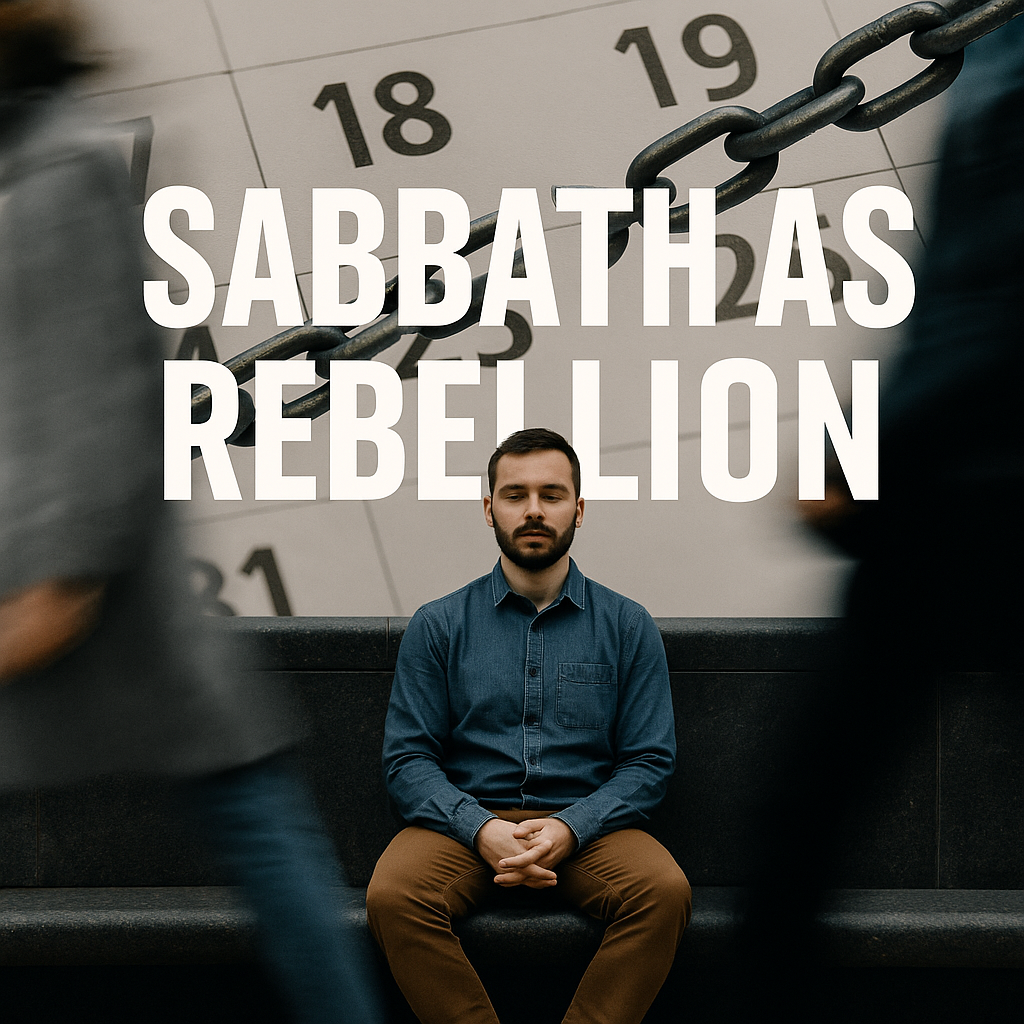
  • Sabbath As Rebellion

    Sabbath As Rebellion

    “The Sabbath was made for man, not man for the Sabbath. So the Son of Man is lord even of the Sabbath.”

    — Mark 2:27–28

    A Subversive Rest

    In a world where your worth is measured by productivity, rest is a rebellion. The Sabbath command isn’t about squeezing in a nap or catching up on Netflix. It is God’s weekly declaration that His people are not slaves to Pharaoh, Wall Street, or Silicon Valley.

    Ponder this overlooked theological truth: When we stop, we resist. We say with our lives: “I am not defined by my output but by the God who redeemed me.”

    The Sabbath as a Weapon Against Pharaoh

    When Moses delivered Israel from Egypt, God’s people were freed from endless quotas and brickmaking. Pharaoh’s economy demanded ceaseless labor. God’s covenant commanded rest. Observing the Sabbath was Israel’s way of saying, “We are not Pharaoh’s slaves anymore. We belong to Yahweh.”

    Whether we recognize it or not, our world has its own Pharaohs. The demand for constant availability, the cult of hustle, the unspoken law of emails at midnight—these are modern brick quotas. Keeping the Sabbath is rebellion against those powers. It’s a declaration of independence from the gods of busyness. It trust that Yahweh supplies what Pharaoh demands. Our rest cries out “Jehovah Jireh,” Yahweh provides.

    The Sabbath as Counter-Cultural Identity

    In an interesting shift from the Exodus law, the Sabbath command in Deuteronomy 5 is rooted not in creation alone but in redemption:

    “You shall remember that you were a slave in the land of Egypt, and the LORD your God brought you out…” (Deut. 5:15)

    To stop working is to remember you’re free—to worship is to remember who set you free.

    For Christians, the Lord’s Day extends this logic into resurrection life. Christ has triumphed over sin and death; therefore, we rest not only from our labor but in His finished work. Sabbath rest proclaims that the victory is already won. It proclaims that rest is the established for His people—as such, we gather in Sabbath worship as a corporate body, not as individuals. He saved His people, not his persons. To be in Christ is to be in the corporate community.

    Why Sabbath Is More Than “Self-Care”

    Our culture loves to market rest as self-care: spa days, Netflix binges, vacations that leave us exhausted. But biblical rest isn’t consumeristic—it’s covenantal. It reorients us to God, His people, and His promises.

    When the church gathers in worship, when families put away their devices, when believers refuse the tyranny of constant emails, that is not mere self-care—it’s spiritual warfare.

    Sabbath as Eschatological Protest

    Every time we keep Sabbath, we proclaim that the kingdoms of this world are not ultimate. Capitalism isn’t ultimate. Politics isn’t ultimate. My own to-do list isn’t ultimate.

    Sabbath is a weekly protest march declaring that Christ reigns and that eternal rest is coming. But even more than that—as wild as this may sound—it’s also evangelistic. To observe the Sabbath is a visible marker of serving Christ instead of Pharaoh. And everyone else who continues to make bricks without straw needs to see you setting the work aside for the true divine Son of God.

    Rest as Rebellion

    Can you imagine how the Egyptians would have responded if the Hebrews in slavery simply stopped? If they set the bricks aside and said “today we worship the true God.” Anyone would identify that action as rebellion. Friends, to observe the Sabbath is to rebel. To rest in Christ is to subvert the false gods of productivity, consumerism, and self-definition.

    So here is the ultimate question: Does your Sabbath reflect bondage to Pharaoh or rest in Yahweh? Who rules your time—Pharaoh, or Christ?

    True freedom is not found in endless hustle or maxed-out schedules—but in holy rest.

  • A Pitch for Fast Change in Church Revitalization

    A Pitch for Fast Change in Church Revitalization

    “No one pours new wine into old wineskins. If he does, the wine will burst the skins—and the skins will be destroyed. But new wine must be put into fresh wineskins.” Luke 5:37–38

    Church revitalization is among the hardest assignments a minister can receive. And while many congregations long for renewal, few actually experience it. Research in organizational behavior shows that 60–70% of all business change efforts fail.1 In ministry, the numbers may be even worse. Thom Rainer (CEO of Lifeway) argues that traditional approaches to revitalization carry very low odds of lasting change—just 2% in many cases.2 Yet failure is not inevitable. How we approach change makes all the difference.

    Traditional wisdom seems to be that slow, incremental adjustments are the safest course. Ease people into new songs. Nudge the governance structure. Introduce mission language gradually. These are slow but methodical culture shifts are geared towards the heart–the hope is that change can be embraced in small bites, whereas wholesale upheaval might cause complete imposion. But more often than not, this “slow fade” approach does not work. The statistcs cited above back this up. The Reformed tradition—and Scripture itself—suggests a better way: decisive, gospel-driven reformation.

    Why Slow Change Fails

    The instinct to move slowly is understandable, but it has a host of areas in which it can backfire.

    1. Nostalgia lingers. The “good ole days” remain within reach, and the congregation never feels cut off from its old identity. You can honor history without clinging to the past. But too often, churches get this formula skewed.
    2. Resistance solidifies. Incrementalism gives opponents time to organize. In many churches, the mindset becomes: “This too shall pass. If we wait long enough, the pastor will move on.”
    3. Change fatigue sets in. Endless tweaks without visible transformation wear people down. Organizational scholars call this change fatigue.3 In church life, it manifests as apathy, disengagement, and cynicism. The congregations experiences change fatiuge by losing energy in new initatives; the leadership experiences it by growing weary of constantly having to make difficlut decisions.

    This is why in the corporate world, only 13% of organizations with weak change management succeed—while those with clear, decisive strategies succeed 88% of the time.4 The principle carries over: timidity does not lead to reformation.

    Why Fast Change Fits the Reformed Vision

    Fast change, done with wisdom and pastoral care, aligns better with both the data and the theology of the Reformed tradition.

    • It creates urgency. John Kotter’s famous “burning platform”5 illustrates how bold change communicates that the status quo is no longer an option. The prophets did the same: “How long will you go limping between two opinions?” (1 Kings 18:21).
    • It resets identity. The church is not called to be a museum of its past but a living body under Christ the Head. Decisive shifts help the congregation see itself not through the lens of nostalgia, but through the lens of its covenant identity in Christ.
    • It closes the back door. Just as sanctification calls us to “put off the old self” (Eph. 4:22–24), revitalization requires a decisive putting away of old habits. Alcoholics Anonymous understands that cutting off is more effective than tapering; the same is true in congregational reform.

    Biblical Models of Decisive Reform

    The pattern in Scripture is not gradual drift but decisive covenant renewal.

    • Nineveh (Jonah 3:6-10): When the Assyrian people of Nineveh heard the news of judgment, they embraced immediate reform. Sackcloth, ashes, mourning—their whole world stopped. While the change did not buy them eternity, it did provide a delay—YHWH’s judgment would wait: they had ceased their wickedness.
    • Josiah’s reforms (2 Kings 23): He tore down high places and smashed idols in one sweeping act of obedience. Reformation meant removal, not slow accommodation. Josiah had no concern for offending Israel–his concern was faithfulness to YHWH.
    • Pentecost (Acts 2): The Spirit constituted the church in one dramatic event, reorienting its identity from fearful disciples to bold witnesses.

    The Reformed tradition has always echoed this. The Reformation was not a tweak of medieval practice; it was a decisive recovery of sola Scriptura and the gospel of justification by faith alone. Calvin called for “the pure preaching of the Word, the right administration of the sacraments, and the faithful exercise of discipline” (Institutes 4.1.9)—marks that require clarity, not gradualism.

    What Fast Change Looks Like in Practice

    In a local church, fast change does not mean recklessness. It means courageous, biblically grounded leadership. It means upopular decisions. It means follow-through. Examples include:

    • Worship: Move decisively to Christ-centered, Word-saturated liturgy, rather than “sneaking in” new songs.
    • Mission: Frame and announce a gospel-driven mission statement that redefines the congregation’s identity in light of the Great Commission.
    • Structures: Replace broken committee models with elder-led polity decisively, not piecemeal. This reflects the New Testament pattern (Titus 1:5).
    • Prayer & Repentance: Call the church to corporate prayer in areas in which personal comfort has been prioritized over Gospel calling and brotherly love.

    In each case, decisive change helps God’s people live in line with their covenant identity.

    The Pastoral Charge

    Fast change will sting. Some may resist. Some may even leave. But the call of the shepherd is to lead God’s people toward health, not to protect nostalgia. If the shepherd sees a wolf, he quickly drives the sheep to safety. If the sheep are headed toward a cliff, the shepher re-directs the sheep–even if the grass on the edge of the cliff is wonderful. The calling of the shepherd is alignemnet with the Great Shepherd–should we draw this out for fear of offense? The Westminster Confession reminds us that Christ alone is Head of the Church (WCF 25.6). Faithful pastors must lead congregations away from cultural captivity and toward Christ’s rule—even if it requires ripping off the band-aid.

    The alternative is slow decline, which leaves Christ’s body weak and malnourished. Or, it is often years of constant conflict, leaving shepherds weary and burnt out. Better to endure the pain of bold reform than the slow death of timidity.

    Conclusion

    Revitalization rarely succeeds through slow, hesitant adjustment. Both research and Scripture point to the same reality: lasting transformation comes through decisive, biblically-grounded change. Our congregations do not need a never-ending project on their hands–they need to be fed the kind of food that is nurturing to their soul. If they are fed well through the change, they will mature and grow, able to show others where to find food that nourishes the soul.

    Pastor, if you are called to revitalize, lead with clarity, urgency, and conviction. Ground every shift in the Word, lean on the Spirit through prayer, and shepherd with love. But do not delay. Some may leave. But in my conversations and experiences through multiple church reforms–those people were probably going to leave anyways. There would eventually be a limit to how much change would be acceptable–be wary of catering to disgruntled sheep who refuse to be fed.

    Rip off the band-aid. Reform for the glory of Christ and the good of His Church.

    “New wine must be put into fresh wineskins” (Luke 5:38).


    1. Beer, Michael & Nohria, Nitin. Breaking the Code of Change. Boston: Harvard Business School Press, 2000. ↩︎
    2. https://replantbootcamp.com/should-we-revitalize-or-replant/ ↩︎
    3. Lewis, Laurie K. Organizational Change: Creating Change Through Strategic Communication. Wiley-Blackwell, 2019. ↩︎
    4. Prosci. Best Practices in Change Management. 11th Edition, 2020. ↩︎
    5. Kotter, John. Leading Change. Boston: Harvard Business School Press, 1996. ↩︎