Category: Theology

  • Why Deuteronomy Is Not A List of Rules

    Why Deuteronomy Is Not A List of Rules

    In American courts, there’s something called case law. That means we don’t just make rules in the abstract; rather, we learn from real and experienced situations. Someone actually did something, there were consequences, and that story becomes a wisdom-pattern for everyone else. James Boyd White says law is basically “a world you learn how to live inside.” In other words — it’s less like reading instructions, and more like being formed by someone else’s real experience.

    What if we read Deuteronomy that way?

    When God says things like: “If you build a new house, put a parapet on the roof…” (Deut 22:8) —
    He isn’t giving random religious dogma — He’s providing case law.

    It’s God saying: someone once got hurt. Learn from their story. Live wisely because of it. Embody the 6th Commandment (preservation of life).

    So when Psalm 1 says “meditate on the law day and night,” it isn’t about memorizing rules — it’s about inhabiting a moral world already shaped by real lives, real consequences, and real covenant history. As such, we can label the law as second-hand experience — laws are meant to consider the steps that led to the law’s installation.

    An Example

    Let’s do a thought experiment with Deut. 22:8.

    When Deuteronomy commands, “When you build a new house, you shall make a parapet for your roof” (22:8), this is not some form of architecual micromanaging for the ancient Near Eastern HOA — it’s God training moral imagination. The Israelite was meant to think backward — “Someone in this community once fell from a roof. A moment of joy (a new house) became a household of grief.” That unrecorded story of avoidable tragedy now lives inside the law. This is how case law works: not abstract principle, but second-hand participation in remembered tragedy and proposed solution. In other words: its experiencial wisdom. As such, the question is not, “What rule must I obey?” but “How do I love my neighbor?” The 6th commandment is not “Do not kill” but “how do I not neglect the conditions that make preventable death likely.” The parapet is more than a fence — it is covenantal foresight. It is how wisdom prevents another funeral.

    In the law, God is training His people through remembered lives and experiences that they didn’t personally live in order to instill a culture of godly wisdom.

    As such, we don’t merely study Deuteronomy: We are meant to enter it — to let someone else’s faithfulness, or failure, disciple us before we ever face it firsthand.

    Think Through Process, Not Just Results

    In short, when we read Deuteronomy or the Sermon on the Mount, we are meant to read it as both derivative and constitutive. The wisdom of the law is learned through its derived reality of covenant past, and forms us constitutively for covenant future. Living with the mind of Christ demands thinking through the process that formed the law, not just the end result of the law.

    This is what the Pharisees missed, and what Jesus exemplified.

  • When God Tests His People with a Prophet

    When God Tests His People with a Prophet

    “If a prophet or a dreamer of dreams arises among you and gives you a sign or a wonder, and the sign or wonder that he tells you comes to pass, and if he says, ‘Let us go after other gods,’ which you have not known, ‘and let us serve them,’ you shall not listen to the words of that prophet or that dreamer of dreams. For the Lord your God is testing you, to know whether you love the Lord your God with all your heart and with all your soul. You shall walk after the Lord your God and fear him and keep his commandments and obey his voice, and you shall serve him and hold fast to him. But that prophet or that dreamer of dreams shall be put to death, because he has taught rebellion against the Lord your God, who brought you out of the land of Egypt and redeemed you out of the house of slavery, to make you leave the way in which the Lord your God commanded you to walk. So you shall purge the evil from your midst (Dt 13:1–5).

    Reflections on Deuteronomy 13:1–5

    There are few passages in Scripture more overlooked than Deuteronomy 13. Here, the LORD does not warn Israel about an obvious, outward pagan threat, but about an insider — a prophet — a man claiming to speak in the name of the LORD — who performs real signs and wonders. And yet the test is not whether the sign is genuine, but whether the voice is loyal. The LORD Himself says He sends such moments “to know whether you love the LORD your God with all your heart and with all your soul” (Deut 13:3).

    This reality is one of Scripture’s most theologically clarifying statements: God is willing to test His people, not by the absence of the supernatural — but by its presence. The miracle alone is not the validation, the message is.

    The Test Is Not About Spiritual Sensation — But Covenant Fidelity

    Moses assumes the sign or wonder might actually come to pass (v. 2). That is to say, this is not a warning against trickery or cheap emotional hype. It is a warning against real, impressive, spiritually compelling moments that subtly detach the heart from the commandments of God.
    Will the people follow the voice that moves them, or will they follow the voice that formed them?

    For this reason Moses immediately commands:
    “You shall walk after the LORD your God and fear Him and keep His commandments and obey His voice” (v. 4).

    Here we hear the theology of Scripture’s sufficiency and finality (WCF 1.6). There is nothing — not even a supernatural sign — that has the right to relativize or destabilize what God has already spoken.

    God’s Tests Reveal What We Love

    When God tests, it is never for Him to learn something about us, but to reveal and refine something in us. Testing is not divine uncertainty — it is divine mercy. A faith untested is a faith unproven. A love untested is a love unrooted.

    The text does not say: “to see if you believe in the LORD” — but “to know whether you love the LORD your God. The issue is not merely orthodoxy, but covenant affection, aka, obedience.

    And thus the test is intensely pastoral in nature — because God will not allow His people to drift into heartfelt idolatry under the banner of spiritual sincerity.

    The Modern Shape of the Same Test

    This test is not a relic of the ancient world. This is the world we live in.

    • Some today speak of a Jesus who affirms what Scripture condemns, in the name of love and progress.
    • Others chase unexamined experiences rather than the Word — interpreting nearness to God by emotional volume rather than by covenant obedience.
    • Others prize novelty as though age were a flaw rather than a safeguard.

    But friends, God has not changed. He still tests His church. Not always by persecution–but by seduction.

    The Call of Deuteronomy 13 Is Loyalty

    This passage is not a call to intellectual cynicism or spiritual hyper-policing. It is a call to love God enough to prefer His voice over every other — even when that voice is quieter, older, slower, or less sensational.

    “You shall serve Him and hold fast to Him…” (v. 4).

    The word “hold fast” is covenantal, adhesive, and marital. It is Ruth clinging to Naomi. It is Israel clinging to YHWH. It is the church clinging to Christ.

    Even when other voices sound more convincing in the moment.

    The Confessional Heart of the Matter

    The Westminster Confession wisely warns that the conscience may never be bound by anything contrary to or beside the Word (WCF 20.2). Deuteronomy 13 is the Old Testament version of that same principle.

    The Word is the test of every experience; not the other way around.

    This is why we guard the public worship of the church (WCF 21). Because “following the Lord” is not an abstract inner disposition. It is covenantal obedience expressed in ordered worship, holy fear, and unbending delight in what He has spoken.

    The Final Word

    The greatest threat to the people of God has never been obvious paganism. It has always been religious speech bearing the name of the LORD but departing from His voice. And God, in mercy, lets these moments come — not to crush His people, but to refine them.

    The miracle alone is not the validation — it must agree with the voice of YHWH. Remember: even the magicians of Pharoah had some ability to mimic the miracles of Moses. But they did not have YHWH — and that made all the difference.

    So we cling to his Word. It is the only way to know the Shepherd’s voice.

  • Heracles Bow, Church Hurt, and the Sin of Communal Isolation

    Heracles Bow, Church Hurt, and the Sin of Communal Isolation

    Heracles’ bow is a strange artifact in mythology. It was a gift of divine strength, once used by a hero to conquer monsters and complete impossible labors. But in the play Philoctetes by Sophocles, the bow has changed hands. It’s no longer in the hands of Heracles, the strong—it’s in the hands of Philoctetes. Philoctetes was wounded in service of his people–a venemous snake bite that festered eternally in his leg. It stank, it revolted, and his very own people set him adrift in exile because the rot was so revolting. This is the man Sophicles centers his play around: Philoctetes, the wounded and exiled.

    Suddenly, the bow is no longer a symbol of power–it’s become a symbol of pain and isolation. The task of Odysseyus is to return the bow to combat–but in doing so, he must first restore the man.

    This story, ancient as it is, speaks powerfully to a modern wound: church hurt. Like Philoctetes, many Christians have found themselves exiled—sometimes quietly, sometimes dramatically—not because they abandoned the church, but because they were abandoned by it. They still carry faith. They still carry spiritual gifts. They still love Jesus. But they are deeply wounded and deeply alone.

    Church Hurt and the Temptation to Isolate

    Church hurt doesn’t always look like betrayal or abuse. Sometimes it’s simply being overlooked. Sometimes it’s rejection. Sometimes it’s the slow ache of not being seen, not being believed, or being treated as disposable.

    The natural reaction to that kind of pain is to retreat. Like Philoctetes, the wound festers—not just physically, but spiritually. We begin to believe lies:

    • “I’m better off alone.”

    • “I’ll never trust the church again.”

    • “My gifts don’t matter anymore.”

    • “God might love me, but His people clearly don’t.”

    And so we hold the “bow”—our strength, our calling, our worship, our insight—but we wield it in exile. We keep the faith… from a distance. We conflate the perfect Christ with the blemished Bride.

    But this is not what God wants for you.

    Isolation Is Not Healing

    Hebrews 10:25 says clearly:

    Do not neglect meeting together, as is the habit of some, but encourage one another…

    This command isn’t a guilt trip—it’s a lifeline. God doesn’t call us into community to control us. He calls us into community to heal us. The tragedy of Philoctetes wasn’t just his injury. It was that he had to suffer it alone. How many believers today are quietly bleeding out from church hurt, convinced that no one would understand—or worse, that no one cares?

    The enemy loves isolated Christians. That’s where he does his best work—where bitterness festers, trust dies, and spiritual gifts grow dusty. But isolation, no matter how justified it may feel, is never the solution.

    The Church That Hurts Can Also Heal

    Let’s be honest: the church can wound. It has. It will. But the church can also heal. Because Christ is still the head of the Church—and He binds up the brokenhearted (Psalm 147:3).

    God’s design has always been a people, not just persons. That’s why the early church devoted themselves not just to prayer and teaching, but to fellowship (Acts 2:42). Because healing rarely happens in private. The place where the wound came from is often the place where the wound must be addressed. Not the exact people, perhaps—but the body of Christ as a whole.

    You don’t need to go back to the place that hurt you. But you do need to come back to the people of God. Not every church is healthy. Not every church is safe.

    But Jesus has not abandoned His church. And He has not abandoned you.

    Wielding the Bow Together

    Your wounds don’t disqualify you. In fact, they might be the very thing God uses to minister to others. The bow—the gifting, the calling, the strength—is still in your hands. But it’s meant to be wielded in the context of community, not in exile.

    Galatians 6:2 says:

    Bear one another’s burdens, and so fulfill the law of Christ.

    This is what the church should be. Not a place that ignores wounds, but a place that shares them. A place where healing happens, where strength returns, where your presence matters. So if you’re sitting on your own island, holding Heracles’ bow, wondering if you’ll ever belong again—hear this:

    You do. You’re needed. And there is still a place for you at the table.

    Not because the church is perfect, but because Christ is.

  • A Call For Discernment

    A Call For Discernment

    In our cultural moment, skepticism toward news media has become second nature. It is common to hear someone dismiss CNN as hopelessly biased, or to claim that Fox News is propaganda. Whatever one’s political persuasion, people instinctively evaluate who is speaking, what their agenda is, and whether they can be trusted. We may disagree on which sources are credible, but few of us naively accept a news broadcast simply because it appears on television.

    Yet, when it comes to Christian voices—books on the bestseller list, podcasts in the “Christian” category, or sermons that circulate online—many believers lower their guard. If something is labeled “Christian,” it is often received without much thought or discernment. Snippets and sound bites are passed to others without thought to the theological trajecory of the pastor, speaker, or writer. We probably wouldn’t like to consider the “Christian” music we consume. But why this discrepancy? Why are we instinctively critical of news outlets but inherently trusting of Christian influencers?

    The “Christian” Label and It’s Assumed Authority

    The term Christian functions today as a kind of brand category. Just as a label like “organic” or “locally sourced” signals a set of expectations in the grocery store, so too the “Christian” label signals (to many) a guarantee of safety and faithfulness. But biblically, the mere use of Christ’s name does not confer authority.

    Jesus warned His disciples that “false prophets will come to you in sheep’s clothing, but inwardly they are ravenous wolves” (Matt. 7:15). The Apostle John likewise instructed, “Beloved, do not believe every spirit, but test the spirits to see whether they are from God” (1 John 4:1). And in Acts 17, the Bereans were commended as noble not because they accepted Paul uncritically, but because “they examined the Scriptures daily to see if these things were so” (Acts 17:11).

    If the early church was called to test prophets and even Apostles, how much more should we test the latest conference speaker or author? John Calvin once remarked that “Satan disguises himself as an angel of light, and his ministers feign the title of pastors” (Institutes IV.3.1). In other words, the danger is not outside the camp alone—it comes clothed in religious garb.

    Why We Drop Our Guard

    1. The Desire for Rest
    News media exhausts us. With constant spin and half-truths, skepticism becomes a daily posture. When believers turn to Christian spaces, they long for trust, safety, and encouragement. It feels burdensome to weigh and test everything when what we crave is comfort. Yet, resting in Christ must not be confused with resting in human teachers. Our comfort is found in the Good Shepherd’s voice, not in every voice that claims to speak for Him.

    2. The Pull of Tribalism
    We often gravitate toward teachers who confirm our existing convictions. Whether theological or political, these “tribes” give us a sense of belonging. Once inside, we lower our guard because critique feels like betrayal. But discernment is not betrayal—it is obedience.

    3. The Halo of Success
    Celebrity pastors, bestselling authors, and well-produced podcasts give the impression of credibility. Yet, history teaches us that popularity and faithfulness rarely go hand in hand. Jeremiah, faithful yet despised, stood against hundreds of prophets who assured Judah of peace (Jer. 6:13–14). In our day, polished platforms often carry more weight than doctrinal fidelity.

    4. Biblical Illiteracy
    Perhaps the most sobering reason we accept nearly any Christian voice is simply this: we do not know our Bibles well enough to spot error when it arises. Hosea’s warning rings true: “My people are destroyed for lack of knowledge” (Hos. 4:6). When we cannot distinguish the voice of Christ in Scripture, every voice that bears His label sounds convincing. A generation of Christians raised on devotionals, soundbites, and inspirational slogans often lacks the grounding in the whole counsel of God necessary to discern truth from half-truth. This is not just a weakness—it is a spiritual danger.

    The Reformed Position On Discernment

    The Reformed tradition has long emphasized the necessity of testing teaching by Scripture alone (sola Scriptura). The Westminster Confession of Faith affirms: “The supreme judge by which all controversies of religion are to be determined… can be no other but the Holy Spirit speaking in the Scripture” (WCF 1.10).

    This means that no matter how compelling a teacher may be—whether Luther or Calvin, Edwards or Piper, Osteen or Furtick—their words must be received only insofar as they are consistent with the Word of God. But not JUST their words: their presuppositions (the assumtions and starting points for how they approach Scripture and what they believe about it). The Reformers themselves modeled this humility. Calvin repeatedly exhorted his hearers: “We must not receive as true whatever may be spoken under the title of religion, unless we are assured that it comes from God” (Institutes IV.8.8).

    A Call To Critical faithfulness

    It is striking that we extend skepticism toward the voices that shape our political opinions, but suspend it toward those that shape our eternal souls. The stakes, however, are infinitely higher in the church. If we should weigh politicians’ words carefully, how much more the words that claim to reveal the gospel?

    This does not call us to cynicism but to biblical discernment. We are called to listen carefully, compare faithfully, and test continually—holding fast to what is good and rejecting what is false (1 Thess. 5:21). The church does not need unthinking consumers of Christian content; it needs discerning disciples of Christ. And the only way to grow in discernment is to grow in biblical literacy. Without deep familiarity with God’s Word, we are left vulnerable to the next “Christian” fad or the most persuasive voice in the room.

    Practical Steps For Growing In Discernment

    1. Read the Whole Bible Regularly
    Don’t only camp in familiar passages or devotionals. Read through the full counsel of God—Old and New Testaments alike—so you gain the breadth and balance of Scripture’s teaching.

    2. Join a Doctrinally Sound Church
    Submitting yourself to ordinary preaching and the accountability of elders is God’s design for guarding against error (Eph. 4:11–14). The local church is a safeguard that YouTube cannot provide.

    3. Study with Confessions and Catechisms
    Tools like the Westminster Confession or Heidelberg Catechism anchor you in historic Christian orthodoxy. They are not replacements for Scripture but summaries of what the church has long confessed to be biblical truth.

    4. Test Popular Voices
    When you hear a sermon or read a book, ask: Is this consistent with the plain teaching of Scripture? Does it exalt Christ or the self? Does it align with the gospel of grace or drift toward moralism, legalism, or self-help?

    5. Pursue Depth, Not Just Inspiration
    Don’t settle for surface-level encouragement. Look for teaching that presses you deeper into God’s Word and challenges you toward holiness and knowledge of Christ.

    Conclusion

    We do not (and should not!) give blanket trust to politicians simply because they bear the title. Why, then, should we give blanket trust to Christian influencers simply because they bear the label? The label does not sanctify the message. Christ does. Our call is to listen with open Bibles, to discern with Spirit-sharpened minds, and to hold fast to the voice of the Shepherd who alone speaks words of eternal life.

    Many studies reveal that we are the most biblically illiterate generation surrounds by more access than any generation of Christians before us. Until the church is once again saturated in the Scriptures—knowing, loving, and wielding the Word of God—we will continue to be swayed by whatever voice calls itself “Christian”–tossed to and fro by the winds of doctrine, as it were. But if we grow in biblical literacy, discernment, and submission to Christ’s Word, we will be equipped not only to reject what is false but to rejoice in what is true.


  • The Prodigal Son and Calvinism: Not A Foil, but A Friend (Part 2)

    The Prodigal Son and Calvinism: Not A Foil, but A Friend (Part 2)

    This post is a continuation of thought from a previous post “The Prodigal Son: It’s Not About You (Or Me)–Part 1.

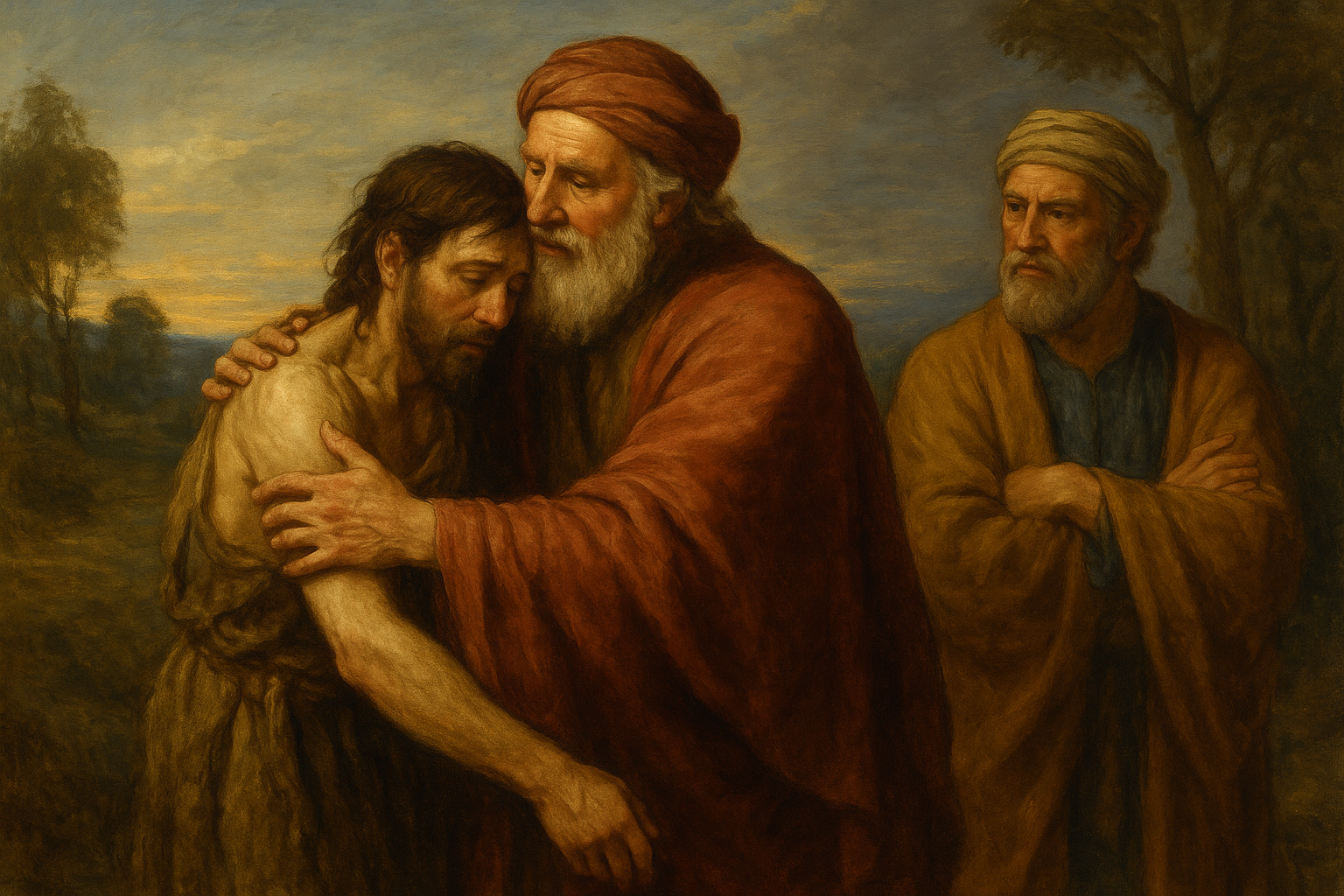
    In Part 1, we explored how the parable of the prodigal son is not just a generic salvation story but a covenant drama. The prodigal represents Israel’s “tax collectors and sinners” (Jews) returning to the fold. The older brother represents the Pharisees, refusing to rejoice at their repentance. And the father embodies God’s extravagant covenant faithfulness.

    But this covenantal frame also resolves a theological puzzle. The prodigal son has often been misread as a foil against Calvinism, as if Jesus were teaching free will over against doctrines of grace. When we restore the parable to its covenantal context, the apparent foil disappears.

    The Common Misuse: A Free-Will Parable?

    Critics of Calvinism sometimes point to the prodigal son as a “proof text” for human free will. Their argument runs something like this:

    • The prodigal “came to his senses” (Luke 15:17). Doesn’t that mean he made the decisive move himself?
    • The father only runs to him after the son decides to return. Doesn’t that suggest prevenient grace or even pure human initiative?
    • The story is about a son “choosing” to come home. Doesn’t that contradict the Calvinist idea of effectual calling or irresistible grace?

    On this reading, the parable functions as Exhibit A for the Arminian: grace may be offered, but the real hinge is human choice.

    The Covenant Frame Clears The Fog

    This way of reading only makes sense if we assume the parable is about how unbelievers get saved. But Part 1 showed that’s not the case. The prodigal son is already a son. The parable is about restoration within the covenant family and the exposure of Pharisaic self-righteousness.

    • Already a son. The prodigal does not become a child by his repentance; he was always a son of the father. His return is about reconciliation, not adoption. This undermines the “free will” argument at the root. The parable never portrays how one becomes a child of God—it presupposes sonship.
    • The Father’s initiative dominates. Even when the son “comes to himself,” his restoration depends entirely on the father’s action: running, embracing, clothing, feasting. As Kenneth Bailey points out, the father’s humiliating sprint down the road would have been a shocking reversal of social norms, emphasizing that reconciliation is his work from beginning to end (Poet and Peasant, pp. 162–165). It was the father’s right to embrace or reject.
    • The older brother unmasks works-righteousness. The real punchline is the elder brother’s refusal to celebrate. As Craig Blomberg notes, “the climactic point of the parable lies not with the prodigal’s repentance but with the elder brother’s refusal to rejoice” (Interpreting the Parables, p. 170). The parable critiques legalism, not Calvinism.

    A Reformed Reading

    When read covenantally, the prodigal son actually illustrates Reformed doctrines of grace rather than contradicting them:

    • Total depravity. The son is destitute, degraded, and feeding pigs—an unclean, helpless image. He has nothing to offer.
    • Unconditional election. His sonship is not revoked by his rebellion. He is restored not because he meets conditions, but because the father has mercy.
    • Effectual grace. The father’s embrace interrupts the son’s rehearsed speech. The decisive act of reconciliation is the father’s, not the son’s.
    • Perseverance of the saints. The son never ceases to be a son, even when estranged. His identity is secured by the father’s covenant faithfulness.

    As N. T. Wright reminds us, the parable is “about Israel coming home from exile,” and the tragedy is that Israel’s leaders refuse to join the party (Jesus and the Victory of God, p. 128). In Calvinist terms, this is the visible covenant community rejecting the grace set before them, while the repentant return is sealed by the Father’s action.

    Why This Matters

    By placing the prodigal son back into its covenantal frame, we not only read the parable more faithfully but also avoid a false theological dilemma. The story does not pit Jesus against Calvinism. Instead, it dramatizes covenant mercy, exposing the folly of self-righteousness and celebrating the Father’s joy in welcoming the wayward home.

    The prodigal son, far from being a foil to Calvinism, becomes one of its richest parables. It shows that God’s grace always precedes, always secures, and always rejoices in the return of His children.

    In Part 3: Coming Home to the Father’s Joy

  • The Prodigal Son: It’s Not About You (Or Me)—Part 1

    The Prodigal Son: It’s Not About You (Or Me)—Part 1

    This is Part 1 of a 3-part blog mini-series.

    When most Christians hear the parable of the prodigal son, they hear a salvation story. A sinner “runs away from God,” squanders his life, hits rock bottom, and finally comes home. The father runs to meet him, embraces him, and restores him. It’s a moving picture of God’s mercy toward repentant individuals. And that’s true—as far as it goes.

    But if we stop there, we risk flattening Jesus’ parable–of removing the context which makes it unique. In reality, this parable is much more deeply rooted in Israel’s covenant history, in Jesus’ ministry to His own people, and in His confrontation with the Pharisees.

    The Setting: Jesus vs. the Pharisees

    Luke 15 begins with a specific confrontation: “Now the tax collectors and sinners were all drawing near to hear him. And the Pharisees and the scribes grumbled, saying, ‘This man receives sinners and eats with them’” (Luke 15:1–2).

    That context matters–Pharisees and scribes upset that Jesus was fellowshipping with rebelling Jews (tax collectors and “sinners”). Jesus tells three parables in response—the lost sheep, the lost coin, and finally the lost son(s). Each ramps up the stakes, from an animal to money to a child. These aren’t random stories about “people getting saved.” They are a direct rebuke of the Pharisees’ attitude toward the “sinners”–fellows Israelites–Jesus was welcoming.

    As N. T. Wright puts it, these parables are not just timeless truths; they are part of Jesus’ campaign, his urgent summons to Israel to come back from exile, to come back to God (Jesus and the Victory of God, p. 127).

    The Prodigal As Israel’s Outcasts

    With this context in view, the parable begins to take shape. The younger son doesn’t represent generic pagans (i.e. Gentiles). He represents those Israelites who had squandered their covenant inheritance—tax collectors, prostitutes, and “sinners” who had abandoned Torah life. They were still sons of the house—Jews—but estranged.

    This mirrors the prophets’ language. Hosea 11:1–4 describes Israel as God’s son, called out of Egypt, yet turning to idols. Deuteronomy 32:18–20 speaks of Israel as a “faithless son” who forgot his Father. The imagery is covenantal, not merely personal.

    Kenneth Bailey, who spent decades teaching in the Middle East, points out that the younger son’s actions—demanding the inheritance early, leaving the family, and wasting it among the nations—fit the Jewish picture of Israel’s wayward children, those who had broken faith with the covenant community (Poet and Peasant, pp. 162–165).

    When the prodigal returns, broken and repentant, the father’s extravagant welcome mirrors what God was doing through Jesus: embracing the covenant outsiders and restoring them as true sons.

    The Older Brother As The Pharisees

    The older brother, meanwhile, embodies the Pharisees and the established religious system. He insists on his obedience, claims merit, and resents grace.

    This, too, has strong covenant echoes. Malachi 1:6–7 shows Israel complaining about God’s treatment, despite their “service.” The older brother is not unlike Israel’s leaders who saw themselves as faithful but refused to rejoice in God’s mercy.

    Craig Blomberg observes that the climactic point of the parable lies not with the prodigal’s repentance but with the elder brother’s refusal to rejoice over the restoration of his sibling (Interpreting the Parables, p. 170).

    The Parable As Israel’s Story

    Read this way, the parable isn’t just about how an individual gets saved. It’s about who truly belongs to Israel. Jesus is redefining the family of God around repentance and mercy, not self-righteousness and pedigree.

    N. T. Wright makes this point sharply: “The return of the prodigal is the return of Israel from exile. But the refusal of the elder brother shows that Israel’s leaders do not want to share in the joy of God’s kingdom” (Jesus and the Victory of God, p. 128).

    The prodigal son is Israel’s story, not ours.

    Why It Still Matters For Us

    Of course, the parable still speaks to individuals. Yes, the parable still speaks to the Church. Every Christian can identify with the prodigal’s repentance and the Father’s embrace. Any church can fall into the older brother’s resentment. But when we recover the Jewish covenantal frame, the story becomes sharper and richer.

    It reminds us that God’s kingdom is not about preserving status or merit, but about rejoicing when the lost return. It’s about restoration and reconciliation. It challenges us to ask: Are we more like the Father, eager to welcome, or more like the older brother, resentful when grace offends our sense of order?

    To be continued in Part 2: The Prodigal Son and Calvinism

  • The Telegraph, Technology, and the Birth of the Therapeutic Age

    The Telegraph, Technology, and the Birth of the Therapeutic Age

    Why Counseling Became Normal

    Why is it that therapy feels as normal today as visiting the dentist? It has not always been so. For most of history, people carried their burdens within family, village, and church, and grief was shared through rituals of mourning, prayer, and confession. Today, however, counseling has almost become a cultural necessity — a rite of passage for college students, an expectation for professionals, and a lifeline for many in a world of constant anxiety.

    This shift cannot be explained by psychology alone. The normalization of counseling correlates with the rise of technologies that overwhelmed us with global suffering. The crucial turning point came not with the internet or even television, but much earlier — with the telegraph. For the first time, human beings could know of calamities thousands of miles away almost instantly, but could do little about them. That gap — between knowledge and agency — produced an unbearable psychic burden. Counseling, in this view, is the social technology we cultivated to survive the information technologies we built.

    The World Before the Telegraph: Local Grief, Local Care

    Before the nineteenth century, news traveled at the speed of the horse or the ship. One might hear of a famine in a neighboring region or the death of a local soldier months after the event. Even wars were often distant rumors. The human nervous system was buffered by slowness.

    In such a world, pastoral and communal structures bore most of the weight of care. Families mourned together. Villages gathered around funerals. Churches provided ritual and language to interpret suffering. John Durham Peters puts it well: pre-modern communication was “situated and embodied.”1 One only bore the griefs one could touch.

    The Telegraph and the Collapse of Space-Time

    Samuel Morse’s invention of the telegraph in the 1840s changed this forever. Suddenly, distance collapsed: a death in Chicago could be reported in New York within hours, a war in Europe could be transmitted across the Atlantic before it was over.

    Neil Postman described this as the invention of “the peek-a-boo world.”2 The telegraph produced a flood of “news from nowhere, addressed to no one in particular, for no reason.”3 Information became detached from context. A local newspaper reader could now be daily confronted with tragedies they could neither avert nor alleviate.

    The result was a new kind of anxiety: the burden of awareness without agency. To know of suffering but be unable to respond is to feel the weight of helplessness. In this sense, the telegraph inaugurated the psychic conditions of the modern therapeutic age.

    From Telegraph to Television: Intensified Exposure

    If the telegraph shrank the world, radio and television immersed us in it. The Second World War was narrated in radio bulletins that reached millions simultaneously. The Vietnam War was fought in American living rooms through nightly broadcasts. Marshall McLuhan’s maxim that “the medium is the message”4 rang true: television didn’t just report suffering, it transmitted emotion.

    Daniel Boorstin warned in The Image that mass media created “pseudo-events” — spectacles that demanded attention without demanding action.5 Each medium intensified exposure, further straining the soul’s capacity to bear grief. By the mid-twentieth century, the average person was not simply a member of a community; they were a spectator to the world’s traumas. This spectator role came with no matching expansion of agency. Again, therapy stepped into the gap.

    The Internet and the Smartphone: Permanent Global Trauma

    If the telegraph brought distant grief into the newspaper, and television brought it into the living room, the smartphone brought it into the palm of the hand — and with it, into the bedroom, the dinner table, the morning commute, and the nightstand.

    The internet transformed information into a constant stream, and smartphones made it inescapable. A war in Ukraine, a wildfire in California, a famine in Sudan — each appears on the same screen as your sister’s wedding photos or your child’s soccer highlights. The world’s crises are collapsed into a single feed, integrated into the same emotional register.

    Sherry Turkle, in Alone Together, describes this paradox: we are hyper-connected, yet lonelier than ever.6 The cost of instant access is emotional exhaustion. Jean Twenge’s iGen goes further, showing a direct correlation between smartphone use and rising rates of anxiety and depression, particularly among teens.7

    The logic of the telegraph has reached its culmination. We not only know of distant grief, we live inside a world where grief is always “breaking.” The psychological result is an ambient anxiety that never resolves. In this climate, counseling ceases to be optional — it becomes a lifeline.

    Counseling as Surrogate for Human Limits

    What pastoral care once bore in local settings, counseling now bears for the globalized soul. Historically, the church provided the language, ritual, and communal solidarity to process suffering. But the church was never designed to carry the full freight of the globe’s pain — nor were families, nor villages.

    Charles Taylor, in A Secular Age, argues that modern life has produced a “buffered self” — an individual sealed off from cosmic and communal meaning, who must navigate crises largely alone.8 In that vacuum, therapy becomes not simply a treatment for mental distress, but a cultural infrastructure for survival.

    Therapy offers what traditional communal structures once did: a place to speak grief aloud, to make meaning out of suffering, and to be told that one is not alone. In a sense, the counseling office has become a secularized confessional booth, a ritual of unburdening in a world that has lost its rituals. This does not mean therapy is fraudulent. It means that therapy arose to meet a very real need: the human attempt to metabolize griefs we were never designed to carry.

    Conclusion: The Telegraph’s Legacy and the Future of Care

    The rise of therapeutic counseling is not an accident of psychology but a consequence of technology. From the telegraph to the smartphone, each communication revolution has widened the gap between knowledge and agency, between exposure and capacity. Humans are now spectators to the world’s traumas — a role for which we are not equipped–and never will be.

    Normative counseling has become normative because it helps us survive in this unnatural role. But its very necessity should alert us to the deeper truth: our technologies have expanded our horizons beyond our limits. If the church does not recover communal forms of care, therapy will remain the default surrogate. The church community must return to a place of priority in the Christian psyche.

    As new technologies emerge — artificial intelligence, virtual reality, immersive media — the human soul will be pressed even further. The question is not whether counseling will remain, but whether it will be enough. Or, perhaps, whether we might yet recover older forms of bearing grief together, refusing the illusion that we must know and feel everything all at once.


    1. Peters, John Durham, Speaking into the Air: A History of the Idea of Communication, (Chicago: University of Chicago Press, 2001), 1-20, 33-62. ↩︎
    2. Neil Postman, Amusing Ourselves to Death, (1985), 63-83. ↩︎
    3. Ibid., 67 ↩︎
    4. McLuhan, Marshall, Understanding Media: The Extensions of Man, (New York: McGraw-Hill, 1964), 7-21. ↩︎
    5. Boorstin, Daniel J, The Image: A Guide to Pseudo-Events in America, (New York: Vintage Books, 1962), 3-12, 35-65. ↩︎
    6. See Turkle, Sherry, Alone Together: Why We Expect More from Technology and Less from Each Other, (New York: Basic Books, 2011), esp. 152-179. ↩︎
    7. Twenge, Jean M., iGen: Why Today’s Super-Connected Kids Are Growing Up Less Rebellious, More Tolerant, Less Happy—and Completely Unprepared for Adulthood, (New York: Atria Books, 2017), 93-118. ↩︎
    8. Taylor, Charles, A Secular Age, (Cambridge: Belknap Press of Harvard University Press, 2007), 539-593. ↩︎
  • Sabbath As Rebellion

    Sabbath As Rebellion

    “The Sabbath was made for man, not man for the Sabbath. So the Son of Man is lord even of the Sabbath.”

    — Mark 2:27–28

    A Subversive Rest

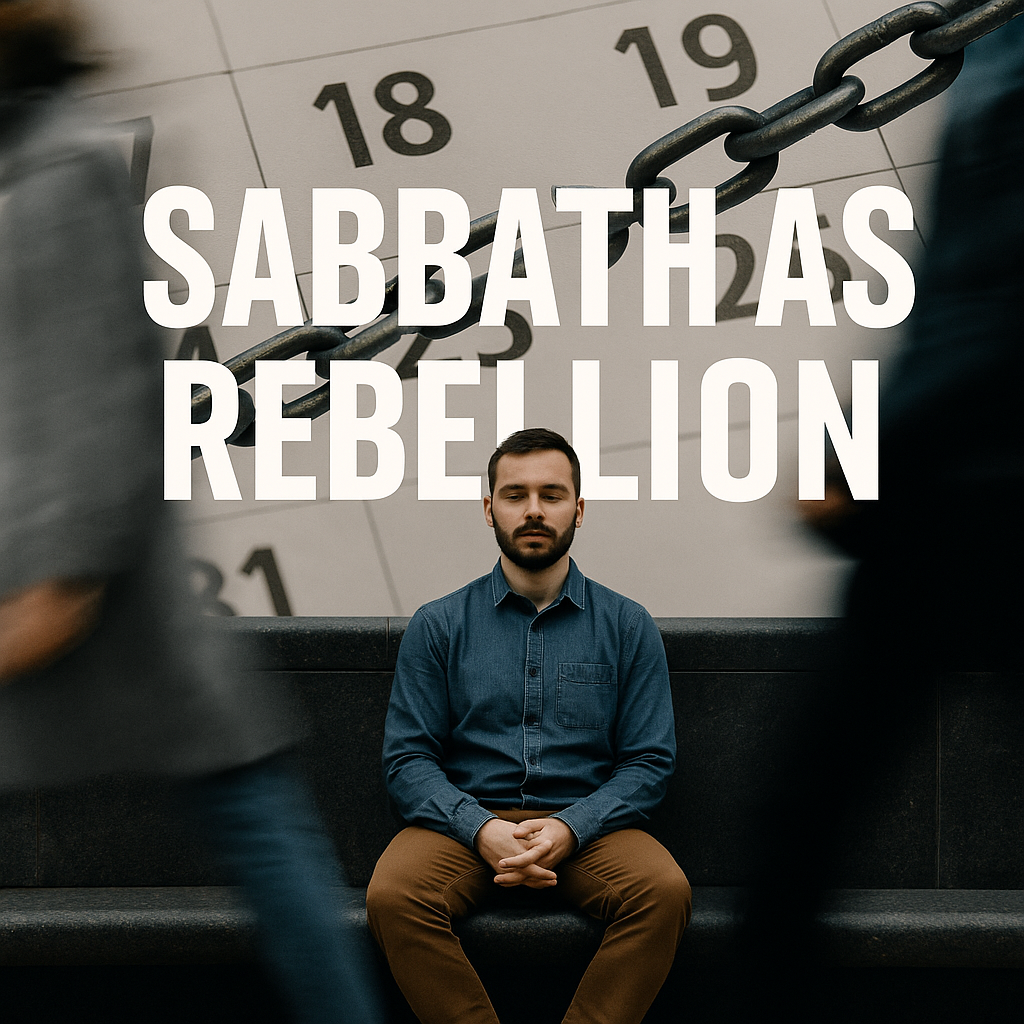
    In a world where your worth is measured by productivity, rest is a rebellion. The Sabbath command isn’t about squeezing in a nap or catching up on Netflix. It is God’s weekly declaration that His people are not slaves to Pharaoh, Wall Street, or Silicon Valley.

    Ponder this overlooked theological truth: When we stop, we resist. We say with our lives: “I am not defined by my output but by the God who redeemed me.”

    The Sabbath as a Weapon Against Pharaoh

    When Moses delivered Israel from Egypt, God’s people were freed from endless quotas and brickmaking. Pharaoh’s economy demanded ceaseless labor. God’s covenant commanded rest. Observing the Sabbath was Israel’s way of saying, “We are not Pharaoh’s slaves anymore. We belong to Yahweh.”

    Whether we recognize it or not, our world has its own Pharaohs. The demand for constant availability, the cult of hustle, the unspoken law of emails at midnight—these are modern brick quotas. Keeping the Sabbath is rebellion against those powers. It’s a declaration of independence from the gods of busyness. It trust that Yahweh supplies what Pharaoh demands. Our rest cries out “Jehovah Jireh,” Yahweh provides.

    The Sabbath as Counter-Cultural Identity

    In an interesting shift from the Exodus law, the Sabbath command in Deuteronomy 5 is rooted not in creation alone but in redemption:

    “You shall remember that you were a slave in the land of Egypt, and the LORD your God brought you out…” (Deut. 5:15)

    To stop working is to remember you’re free—to worship is to remember who set you free.

    For Christians, the Lord’s Day extends this logic into resurrection life. Christ has triumphed over sin and death; therefore, we rest not only from our labor but in His finished work. Sabbath rest proclaims that the victory is already won. It proclaims that rest is the established for His people—as such, we gather in Sabbath worship as a corporate body, not as individuals. He saved His people, not his persons. To be in Christ is to be in the corporate community.

    Why Sabbath Is More Than “Self-Care”

    Our culture loves to market rest as self-care: spa days, Netflix binges, vacations that leave us exhausted. But biblical rest isn’t consumeristic—it’s covenantal. It reorients us to God, His people, and His promises.

    When the church gathers in worship, when families put away their devices, when believers refuse the tyranny of constant emails, that is not mere self-care—it’s spiritual warfare.

    Sabbath as Eschatological Protest

    Every time we keep Sabbath, we proclaim that the kingdoms of this world are not ultimate. Capitalism isn’t ultimate. Politics isn’t ultimate. My own to-do list isn’t ultimate.

    Sabbath is a weekly protest march declaring that Christ reigns and that eternal rest is coming. But even more than that—as wild as this may sound—it’s also evangelistic. To observe the Sabbath is a visible marker of serving Christ instead of Pharaoh. And everyone else who continues to make bricks without straw needs to see you setting the work aside for the true divine Son of God.

    Rest as Rebellion

    Can you imagine how the Egyptians would have responded if the Hebrews in slavery simply stopped? If they set the bricks aside and said “today we worship the true God.” Anyone would identify that action as rebellion. Friends, to observe the Sabbath is to rebel. To rest in Christ is to subvert the false gods of productivity, consumerism, and self-definition.

    So here is the ultimate question: Does your Sabbath reflect bondage to Pharaoh or rest in Yahweh? Who rules your time—Pharaoh, or Christ?

    True freedom is not found in endless hustle or maxed-out schedules—but in holy rest.

  • Jericho Fell, The Temple Fell: God’s Plan for the Nations

    Jericho Fell, The Temple Fell: God’s Plan for the Nations

    Jericho fell so the Seed of promise might be sown. The Temple fell so that Christ’s harvest might be won.

    Sometimes a single line can capture the sweep of the whole Bible. From the walls of Jericho to the stones of the Temple, God has been writing one story: the story of Christ for the nations.

    Jericho Fell: A Seed Planted in the Land

    When Israel marched around Jericho and the walls came crashing down, it wasn’t just a victory for one nation. It was God’s way of planting His people in the land He had promised to Abraham.

    Why? Because God had already promised that through Abraham’s Seed all nations would be blessed (Genesis 12:3; Genesis 22:18). Jericho’s fall wasn’t about Israel’s glory—it was about clearing the ground so the Seed could take root in history. Because the Seed in view is a singular seed–its THE Seed: Christ. The land was never the ultimate goal; it was the soil in which God would grow His greater plan. The soil from which a Seed would become a cosmis tree:

    "I myself will take a sprig from the lofty top of the cedar and will set it out… On the mountain height of Israel I will plant it, that it may bear branches and produce fruit and become a noble cedar. And under it will dwell every kind of bird; in the shade of its branches birds of every sort will nest." (Ezekiel 17:22-24)

    The land was the down-payment. It was the security deposit. It was never the end goal. Jericho must fall so the Seed could be planted.

    The Temple Fell: A Harvest Opened to the World

    Centuries later, another set of stones fell. In A.D. 70, the Temple in Jerusalem was destroyed. For many, it looked like the end of Israel’s story. But in reality, it was the next step in God’s plan.

    The Temple had pointed forward all along: to the once-for-all sacrifice of Christ, the true Lamb of God (John 1:29; Hebrews 10:11–14). When Christ died and rose again, the need for animal sacrifices ended. And when the Temple fell, the gospel was no longer tied to one city, one altar, or one people. The harvest of the nations had begun (John 12:24; Matthew 28:18–20).

    The tree was spreading its branches to cover the whole earth.

    One Story, One Savior, One Mission

    From the fall of Jericho to the fall of the Temple, God was moving history toward the same goal: salvation through Christ for all peoples.

    God’s plan has always been global. Always Christ-centered. Always aimed at a harvest of people from every tribe, tongue, and nation worshiping the Lamb (Revelation 7:9). Just as Jericho fell so the Seed might be planted, so the Temple fell so the branches might extend.

    What This Means for Us

    It means that God’s plan is unstoppable. What looks like ruin in the moment—whether the collapse of Jericho’s walls or the destruction of the Temple—is actually God’s way of moving His story forward. And it means that we, the Church, are caught up in this mission. We are the fruit of the harvest and also the laborers sent into the field (Matthew 9:37–38).

    So when we look back at Jericho and the Temple, we aren’t just reading history—we’re seeing our place in God’s story. Christ is the Seed. Christ is the Temple. Christ is for the nations.

    When you see the ruins of Jericho and the rubble of the Temple, remember: God builds His kingdom, not on human walls, but on Christ alone. And that kingdom has no boundaries.

  • Why Is Saul Naked in 1 Samuel 19?

    Why Is Saul Naked in 1 Samuel 19?

    What Jonathan gave freely, Saul lost by force—and what that teaches us about Christ’s lordship.

    The Naked King
    This is the kind of Bible passage that makes Sunday school teachers squirm. In 1 Samuel 19, Saul—the king of Israel—lies flat on the ground, stripped of his clothes (1 Sam. 19:23–24). It’s a strange and unsettling image and, as such, is the sort of passage we tend to skim past. When this scene appears, the reader’s attention is already drawn to previous unusual details, like the household idols in David’s house (1 Sam. 19:13), the company of prophets around Samuel (1 Sam. 19:18-20), or Saul’s violent pursuit of David (1 Sam. 19:8-10). But the narrator lingers on Saul’s nakedness—and he does so for a very important reason. However, the key to understanding why comes from the broader narrative: just one chapter earlier, Saul’s son Jonathan also removes his royal robe. When placed side by side, the contrast between these two episodes couldn’t be sharper.

    Jonathan’s Voluntary Surrender
    In 1 Samuel 18:3–4, Jonathan takes off his robe and gives it to David. This is no small act. In the ancient world, clothing symbolized identity and status. Jonathan’s robe wasn’t just fabric; it represented his position as crown prince. To give it away was to yield his claim to the throne. Jonathan’s gesture is covenantal and deliberate. It’s an act of humility, a recognition that God’s hand rests on David. He decreases so that David may increase. His submission is voluntary, born of faith and love.

    Jonathan’s actions anticipate the New Testament pattern of discipleship. To follow Christ is to “put off the old self” and “put on the new” (Eph. 4:22–24). To be his disciple is to “hate” father, mother, wife, children, brother, sister—even his own life (Luke 14:26). Jonathan prefigures this dynamic by laying aside his own honor and clothing another with it. He voluntarily casts his crown at the feet of the anointed one of YHWH (Rev. 4:10-11).

    Saul’s Forced Humiliation
    By contrast, Saul’s disrobing is not chosen but compelled. In 1 Samuel 19:23–24, the Spirit of God overwhelms him, and Saul strips off his clothes and lies helpless throughout the day and night. What Jonathan surrendered in covenant love, Saul loses in humiliation. Far from a heroic prophetic moment, Saul’s nakedness symbolizes his undoing. The king who resists God’s anointed is forcibly stripped of his dignity—the one who would not yield is brought low.

    The Bible often uses clothing as a sign of honor or shame. Joseph is given a magnificent coat of honor (Gen. 37:3). The Prodigal Son is covered in his father’s best robe (Luke 15:32). In contrast, Adam and Eve hide in shame once they realize their nakedness (Gen. 3:7). Job tears his robe when undone by grief (Job 1:20). Isaiah walks naked as a prophetic sign of judgment (Isa. 20:2–4). To be clothed is to be honored, but to be stripped bare is to be exposed, powerless, and humiliated. Saul’s unraveling fits this biblical pattern.

    Commentators agree on this basic understanding but highlight different angles. Robert Alter describes Saul’s condition as “the grotesque abasement of the king.”1 David Tsumura emphasizes that the removal of garments likely signified the loss of royal dignity.2 Dale Ralph Davis underscores the humiliation of a king undone by God’s Spirit.3 Walter Brueggemann notes the biting irony: Saul, who sought to destroy God’s anointed, finds himself unmade by God’s power.4 In general, scholars tend to agree that Saul’s nakedness symbolizes a loss of royal status. Yet the irony is sharper when read alongside Jonathan’s robe-giving: what Jonathan does willingly, Saul experiences unwillingly.

    Reading the Forest, Not Just the Trees
    If one read these episodes in isolation, the rhetorical contrast might be overlooked. Jonathan’s robe-giving simply seems like a tender story of friendship. Saul’s nakedness looks like a bizarre prophetic frenzy. Read as disjointed stories results in merely moralized illustrations for the church. But when read together, they form a deliberate juxtaposition—two paths of submission.

    This is why it is so valuable to read large swaths of Scripture at once. The Bible’s authors were master storytellers. When we zoom in too tightly, we risk missing the broader patterns. Jonathan and Saul’s contrasting acts make sense not as stand-alone vignettes but as side-by-side portraits of willing surrender versus forced humiliation.

    Every Knee Will Bow
    This contrast points us forward to a deeper reality. Paul writes in Philippians 2:10–11 that one day “at the name of Jesus every knee should bow, in heaven and on earth and under the earth, and every tongue confess that Jesus Christ is Lord.”

    Some, like Jonathan, will bow gladly—casting down their crowns in joyful submission.
    Others, like Saul, will be brought low despite themselves.
    Either way, Christ will be confessed as King.

    Encouragement for the Church
    So why is Saul naked in 1 Samuel 19? Because Jonathan was naked in 1 Samuel 18. One disrobed in covenant love, the other in divine humiliation. One bowed gladly, the other was brought low.
    The contrast isn’t only about two men in Israel’s history; it’s about two ways all people respond to God’s Anointed. One day, every knee will bow—some with joy like Jonathan, others in judgment like Saul. Either way, Christ will be confessed as King.

    That’s why the church can take courage today. Those who humble themselves now are not left exposed but are clothed in the righteousness of Christ. The question is not whether Jesus will be confessed as Lord, but how. Will it be the willing surrender of faith—or the forced acknowledgment of defeat?

    Jonathan shows us the path of covenant loyalty, humility, and joy. Saul shows us the path of resistance, pride, and humiliation. Both remind us that the Lord will not be mocked: his anointed King will be honored.

    How Might We Practice “Forest Before Trees” Bible Reading Today?
    A few suggestions:

    1. Read whole books in one sitting. Just as letters weren’t meant to be piecemeal, neither were Samuel or Acts. Try reading through an entire Gospel or prophetic scroll in a single afternoon.
    2. Trace repeated themes. Look for how clothing, covenant, exile, or temple imagery develops across the text.
    3. Ask narrative questions. How does one scene echo or contrast with another? How does this section prepare for what follows?
    4. Then zoom in. Once the big picture is clear, dig into word studies, cross-references, and applications.

    By reading broadly, we not only see the forest—we start to understand why each tree was planted where it is.

    1. Robert Alter, The David Story, (New York: W.W. Norton & Company, 1999), 118–19 ↩︎
    2. David Tsumura, The First Book of Samuel, NICOT (Grand Rapids: Eerdmans, 2007), 508–9 ↩︎
    3. Dale Ralph David, 1 Samuel: Looking on the Heart, (Glasgow: Christian Focus, 2000), 196–202 ↩︎
    4. Walter Brueggemann, First and Second Samuel, (Louisville: Westminster John Knox Press, 1990), 138–39 ↩︎