Tag: attendance

  • Sabbath As Rebellion

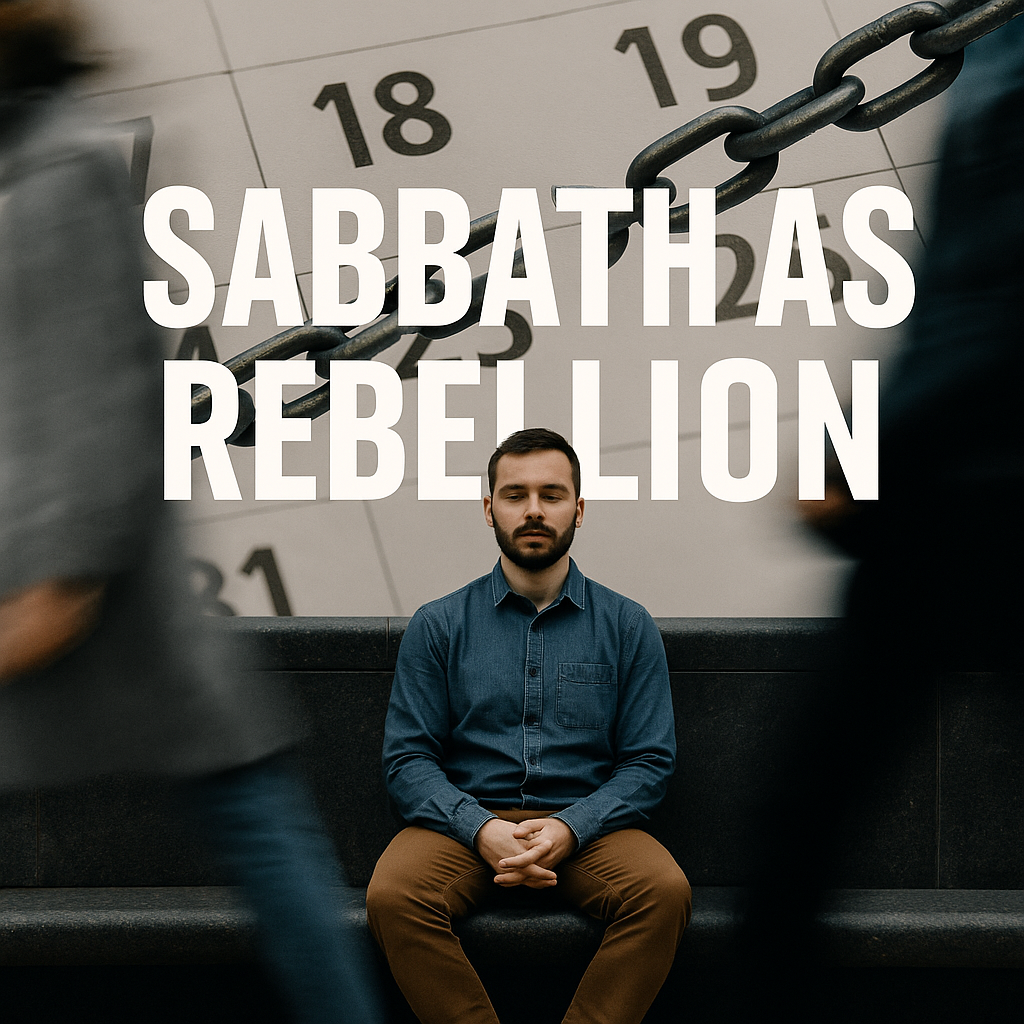
    Sabbath As Rebellion

    “The Sabbath was made for man, not man for the Sabbath. So the Son of Man is lord even of the Sabbath.”

    — Mark 2:27–28

    A Subversive Rest

    In a world where your worth is measured by productivity, rest is a rebellion. The Sabbath command isn’t about squeezing in a nap or catching up on Netflix. It is God’s weekly declaration that His people are not slaves to Pharaoh, Wall Street, or Silicon Valley.

    Ponder this overlooked theological truth: When we stop, we resist. We say with our lives: “I am not defined by my output but by the God who redeemed me.”

    The Sabbath as a Weapon Against Pharaoh

    When Moses delivered Israel from Egypt, God’s people were freed from endless quotas and brickmaking. Pharaoh’s economy demanded ceaseless labor. God’s covenant commanded rest. Observing the Sabbath was Israel’s way of saying, “We are not Pharaoh’s slaves anymore. We belong to Yahweh.”

    Whether we recognize it or not, our world has its own Pharaohs. The demand for constant availability, the cult of hustle, the unspoken law of emails at midnight—these are modern brick quotas. Keeping the Sabbath is rebellion against those powers. It’s a declaration of independence from the gods of busyness. It trust that Yahweh supplies what Pharaoh demands. Our rest cries out “Jehovah Jireh,” Yahweh provides.

    The Sabbath as Counter-Cultural Identity

    In an interesting shift from the Exodus law, the Sabbath command in Deuteronomy 5 is rooted not in creation alone but in redemption:

    “You shall remember that you were a slave in the land of Egypt, and the LORD your God brought you out…” (Deut. 5:15)

    To stop working is to remember you’re free—to worship is to remember who set you free.

    For Christians, the Lord’s Day extends this logic into resurrection life. Christ has triumphed over sin and death; therefore, we rest not only from our labor but in His finished work. Sabbath rest proclaims that the victory is already won. It proclaims that rest is the established for His people—as such, we gather in Sabbath worship as a corporate body, not as individuals. He saved His people, not his persons. To be in Christ is to be in the corporate community.

    Why Sabbath Is More Than “Self-Care”

    Our culture loves to market rest as self-care: spa days, Netflix binges, vacations that leave us exhausted. But biblical rest isn’t consumeristic—it’s covenantal. It reorients us to God, His people, and His promises.

    When the church gathers in worship, when families put away their devices, when believers refuse the tyranny of constant emails, that is not mere self-care—it’s spiritual warfare.

    Sabbath as Eschatological Protest

    Every time we keep Sabbath, we proclaim that the kingdoms of this world are not ultimate. Capitalism isn’t ultimate. Politics isn’t ultimate. My own to-do list isn’t ultimate.

    Sabbath is a weekly protest march declaring that Christ reigns and that eternal rest is coming. But even more than that—as wild as this may sound—it’s also evangelistic. To observe the Sabbath is a visible marker of serving Christ instead of Pharaoh. And everyone else who continues to make bricks without straw needs to see you setting the work aside for the true divine Son of God.

    Rest as Rebellion

    Can you imagine how the Egyptians would have responded if the Hebrews in slavery simply stopped? If they set the bricks aside and said “today we worship the true God.” Anyone would identify that action as rebellion. Friends, to observe the Sabbath is to rebel. To rest in Christ is to subvert the false gods of productivity, consumerism, and self-definition.

    So here is the ultimate question: Does your Sabbath reflect bondage to Pharaoh or rest in Yahweh? Who rules your time—Pharaoh, or Christ?

    True freedom is not found in endless hustle or maxed-out schedules—but in holy rest.

  • Go, And Be Fed

    Go, And Be Fed

    It is often said of pastors that “a shepherd must know his sheep.” And this is very true. But therein lies a warning to the sheep: the sheep must know the shepherd’s voice. If pastors are to know their flock, what responsibility does the flock have to know the pastor’s voice? How can Peter feed sheep that won’t be fed? How can pastors similarly feed a flock that will not come to the dinner bell? The imagery of sheep and shepherd shows that both have responsibilities in the relationship. It is the shepherd’s responsibility to feed, and it is the sheep’s duty to come and be fed.

    Unhealthy Diets

    Do we see the gathering of the saints as our duty to come and be fed? As our responsibility? Or is it simply the pastor’s duty to preach while we seek food–maybe even tastier food!–elsewhere? Whether that be through:

    1. Online pastors who can’t personally know you (this disrupts shepherds knowing their sheep)
    2. On a deer stand (this interferes with your coming to be fed)
    3. Or at your house (this says that you are too tired and lazy to be bothered to be fed)

    Veggie Tales

    Remember vegetables? Remember being a child and crying at the table because you couldn’t leave until you ate them? That was me. But a few years back, I realized that I actually now like vegetables. My taste had matured, and my appetite had changed.

    Often, immature Christianity manifests itself as rejecting what is good for us: like a healthy diet of the Means of Grace (Prayer, Preaching, and the Sacraments). Mature Christianity is growing to love the Means of Grace that God has established to feed his sheep.

    Friends, we don’t go to church because we have to; we go to church because we get to; we gather because it provides just the diet the Great Shepherd calls his sheep to feast upon.

    This Sunday, go and be fed.

  • SCADS

    SCADS

    SCADs may be an unfamiliar term. That is because I believe I coined it myself, although I am sure there is an obscure definition for it somewhere. For our purposes, it stands for: Seasonal Church Attendance Disorder. Even though you have never heard the term, I would wager that you know precisely what it means.

    The Problem:

    According to recent Barna research, the percentage of “practicing Christians” has dwindled by 50% since 2000. Barna defines “practicing Christians” as:

    “Those who identify as Christian, agree strongly that faith is very important in their lives and have attended church within the past month.”

    In 20 years, half of these “practicing Christians” have vanished. Why? According to Barna, part of the explanation for this decline is something that many would deem to be moderately harmless:

    “Where did these practicing Christians go? The data indicate that their shift was evenly split. Half of them fell away from consistent faith engagement, essentially becoming non-practicing Christians, while the other half moved into the non-Christian segment.”

    From January of 2000 to March 4, 2020, 25% of “practicing Christians” are no longer such because they “fell away from consistent faith engagement.” In other words, they ceased attending church.

    The other 25% turned to non-Christian systems (other religions, atheism). I believe that these two avenues are connected, not isolated. Regardless, when church attendance is optional or secondary regarding other activities in life, we reach the diagnosis of SCADs: Seasonal Church Attendance Disorder.

    Before 2000, regular church attendance was typically assumed. The majority of politicians on both sides ran campaigns based on Christian values. Church was where people were on Sunday mornings, particularly in the South. As this social expectation began to diminish, so did the follow-through of actually attending.

    By the time we reach 2020, we can notice a trend of a rapidly increasing population of practicing Christians who seem to have reduced the value of faithful church attendance. Other things have taken pre-eminence, whether it be sports, leisure, or profession. If you frequently fall into this category, then you may be diagnosed with SCADs.

    The Danger of SCADs:

    SCADs primarily threatens the church and its members in three ways.

    1. The myth of self-sufficiency.

    As seen in the Barna study, half of those who fall away from the faith do so because they disconnect from the church. This should come as no surprise considering that man’s heart is dishonest and inclined to lean on its own understanding (Proverbs 3:5). The author of Hebrews, fully aware of this natural disposition, writes:

    “23 Let us hold fast the confession of our hope without wavering, for he who promised is faithful. 24 And let us consider how to stir up one another to love and good works, 25 not neglecting to meet together, as is the habit of some, but encouraging one another, and all the more as you see the Day drawing near” (Hebrews 10:23-25).

    1. The myth of a merely individual impact.

    SCADs trains our children to view church as opportunity-based. In other words, they grow up in a practicing Christian home that relegates the collective worship of God to that of a lower priority than other opportunities. Our children learn to keep the Sabbath holy by observing how we observe the Sabbath. Remembering the Sabbath Day is more extensive than an individual concern.

    12 “Observe the Sabbath day, to keep it holy, as the LORD your God commanded you. 13 Six days you shall labor and do all your work, 14 but the seventh day is a Sabbath to the LORD your God” (Deut. 5:12-14).

    1. The myth of being dependent on God.

    Worshipping God in the community of the saints is a critical ingredient of spiritual health. SCADs significantly impairs spiritual health by building a wall between daily living and dependence on God. If you only attend church for special services or when your family is coping with a tragedy, you may be subconsciously utilizing church and God as situational necessities. Thus, you may only attend church when it’s convenient or when you need God to help you through life’s storms. Either way, be wary of believing in the myth of being dependent on God in your daily walk while neglecting worship with the body of Christ.

    Tips for Treating SCADs:

    1. Make church a priority.

    It will not always be easy. I am very aware of the pandemic and for some, that it makes this more difficult or even impossible. Parents must consider the safety of their families. However, this Barna data was collected BEFORE the pandemic. If it was a significant problem before, do you think the past two years of habits will bolster attendance or add to the declining trend?

    1. Find a church to visit while on the road.

    Whether it is a sports tournament or vacation, “google” a good church and visit. I remember attending random churches on family vacations while growing up. Some were great, and some were not. However, it impressed in me the importance of corporate worship.

    1. If physical church attendance isn’t possible, make virtual church attendance a family event.

    Turn off phones, put away breakfast, change out of PJ’s, and sit as a family through the whole service. Set this time apart from other screen-centered activities.

    Conclusion:

    Cyprian, who died in 258 AD, wrote, “No one can have God for his Father, who does not have the Church for his mother.” I look forward to seeing you at church on Sunday!