Tag: christianity

  • Legacy Dies in the Hands of a Corpse

    Legacy Dies in the Hands of a Corpse

    Legacy is a funny word because it means different things to different people. And not everyone agrees on how to define one’s “legacy.” Yet in the end, there are really only two kinds of legacy: a legacy of faithfulness and a legacy of pride.

    A legacy of pride seeks to preserve itself. It is built around personalities, memories, accomplishments, and the desire to remain the center of the story. It asks, How do we protect what we have built? It is ultimately anchored to people, and because people pass away, it cannot endure.

    A legacy of faithfulness is different. It understands that God’s kingdom is bigger than any individual, any generation, or any particular season of ministry. It asks a different question: How do we faithfully hand forward what God has entrusted to us? It is willing to sacrifice comfort for mission, familiarity for fruitfulness, and personal preference for the good of those who come after.

    The difference can be seen throughout Scripture. Consider King Nebuchadnezzar standing atop Babylon declaring, “Is not this great Babylon, which I have built?” His concern was preserving and celebrating his own greatness. Then consider David. David’s greatest contribution was not building a kingdom that depended upon David. His greatest contribution was preparing for a kingdom that would continue after David was gone. He gathered resources he would never personally use. He made preparations for a temple he would never see. He spent his final years investing in a future generation because he understood that God’s purposes were larger than his own lifetime.

    Most importantly, a God-honoring legacy is always a legacy that is passed on. The goal is never our name. The goal is Christ’s name. The goal is never preserving our comfort. The goal is advancing His kingdom.

    As I reflect on my pastorate at Grace Fellowship, the word legacy keeps returning to my mind. Yet, it is not my legacy that concerns me most. It is the church’s.

    Over the last four years, Grace Fellowship has repeatedly chosen faith over fear. She called a pastor when it was not obvious the finances could sustain it. She expanded ministry staff to meet the needs of a growing congregation. She embraced a name change, refreshed her identity, and welcomed wave after wave of new faces into the fellowship. None of those decisions were easy. Every one of them required trust. Every one of them required sacrifice. Every one of them demanded faith that God was doing something bigger than preserving the status quo.

    That is why I keep returning to the parable of the talents.

    Three servants were entrusted with resources that belonged to their master. Two took what had been entrusted to them and put it to work. They faced uncertainty. They assumed risk. They accepted the possibility of failure. Yet when the master returned, they were commended because they understood that what they possessed was never ultimately theirs. Their responsibility was not merely to preserve the master’s resources but to employ them in service to the master’s purposes.

    The third servant thought differently. He buried the talent. He protected it. He preserved it. He returned exactly what had been entrusted to him.

    And yet he was rebuked.

    Not because he squandered the master’s resources, but because fear had become more important than faithfulness. Preservation had replaced mission. Safety had replaced stewardship.

    The church faces that same temptation in every generation.

    Every congregation eventually reaches a moment when it must decide whether it will become a museum or a mission. Whether it will devote itself to protecting what previous generations built or investing those gifts so that future generations might flourish. Whether it will cling tightly to what God has entrusted or open its hands and pass it forward.

    That is the question of legacy.

    The future legacy of Grace Fellowship will not ultimately be determined by Weston Blaha or by the next pastor. Pastors come and go. Every shepherd eventually hands the staff to another—or worse, a shepherd hangs up the staff because there are no longer any sheep to tend.

    The legacy of Grace Fellowship will be determined by her people.

    Will future generations look back and say that this church faithfully invested everything God entrusted to her for the sake of Christ’s kingdom? Will they thank God that an earlier generation was willing to sacrifice, risk, and dream beyond its own lifetime? Will they inherit a church that was always looking outward rather than backward? Those are the questions that now stand before us.

    My friends, faithful legacies are never built by holding on. They are built by handing off. And no good legacy ever ends clutched in the hands of a corpse.


  • In Defense of Mother’s Day

    In Defense of Mother’s Day

    Sadly, Mother’s Day has become another casualty of our culture’s obsession with victimhood. Every year I hear the same chorus warning:

    “What about women who can’t have children?”

    “What about women who lost babies?”

    “What about painful family situations?”

    And I would ask that a careful ear is leaned my way: those pains are real. Barrenness is painful. Miscarriage is painful. Loneliness is painful. Scripture itself recognizes that grief. But fifteen years of pastoral ministry have taught me that this complaint, however sincere, is also consistently wrong. Here’s the problem that we need to address: we have begun treating personal sorrow as a veto against public celebration.

    A woman being unable to bear children is deeply tragic. There is a reason barrenness plays such a central role in the biblical theme of redemption. But it is not a reason to stop honoring faithful mothers any more than a funeral is a reason to cancel weddings. As Christians, we do not respond to God’s blessings by silencing celebration because someone else did not receive the same gift. When Scripture speaks of children, it does not apologize for calling them a blessing:

    Behold, children are a heritage from the Lord, the fruit of the womb a reward.” — Psalm 127:3

    Modern culture trains people to interpret every celebration through the lens of personal deprivation: “If I do not have it, then you should not publicly rejoice in it.” That is not a sign of Christian maturity—that is an expression of cultivated resentment.

    The Christian response to another person’s blessing should always be thanksgiving to God for His goodness, even when His providence toward us is different. Romans 12 commands us:

    “Rejoice with those who rejoice; weep with those who weep.”

    Notice: Scripture commands both. We should absolutely weep with grieving women. We should counsel the hurting. We should love the lonely. But we should not flatten every joyful occasion into an exercise in emotional risk management. Mother’s Day is not cruel because motherhood reminds some women of loss. By that logic, Father’s Day harms orphans and weddings harm the unmarried. Baby showers harm the infertile. And every “believer’s baptism” wounds the prodigal parent.

    A society governed by grievance eventually loses the ability to celebrate anything at all. The Church should resist this impulse. We honor mothers because motherhood is good. We celebrate children because children are blessings. And we thank God publicly for His gifts without embarrassment.

    It’s important to recognize a hard truth: Not every person receives every gift. But Christians are called to worship God for His goodness anyway. So, we celebrate our mothers. We honor them. We remember them. But we do not use our grief or trials to demand that other men and women do not get to praise God for his goodness. 

    This Sunday, honor your wives/mothers. Remind them of how good God is to give them the unmatched responsibility of raising arrows in the quiver. Celebrate them and celebrate with them—this is the only appropriate Christian posture.

    But do hear this: I am not asking hurting women to perform happiness. I’m asking them not to demand that joy be silenced because they are hurting.

    The body of Christ is edified when joy is celebrated and grief is lamented. Mother’s Day is a day of joy—let us edify one another on it.

  • The Empty Tomb as the Mercy Seat: What John Wants Us to See on Easter Morning

    The Empty Tomb as the Mercy Seat: What John Wants Us to See on Easter Morning

    On Easter Sunday, Christians around the world celebrate a simple but earth-shaking truth:
    Christ is risen. While all the gospels recount the resurrection, the Gospel of John includes details that, at first glance, may seem small or incidental. Details that, in our excitement, we rush past. Yet when we slow down and pay attention, we begin to see that these details are doing something profound. One of those details appears in John 20:12:

    She saw two angels in white, sitting where the body of Jesus had lain, one at the head and one at the feet.

    Why does John tell us this? Why mention where the angels are sitting? The answer may take us all the way back to the Old Testament: to the mercy seat.

    The Mercy Seat: The Place of Atonement

    To understand what John may be showing us, we need to revisit the Ark of the Covenant. At the center of Israel’s worship was the ark, and on top of the ark was what Scripture calls the mercy seat (Exodus 25:17–22). This lid was the place where atonement was made.

    Once a year, on the Day of Atonement, the high priest would enter the Holy of Holies and sprinkle blood on the mercy seat for the sins of the people. And what stood on either side of that mercy seat? Two cherubim—angelic figures—positioned at either end.

    So the image Leviticus paints is this:

    • A sacred space (the mercy seat)
    • Blood for atonement (from the sacrifical lamb)
    • Two angels, one on each side (guarding the space)

    This was the place where God dealt with sin and met with His people.

    The Tomb: A New Mercy Seat

    Now return to the resurrection account in John 20. Mary Magdalene looks into the tomb and sees:

    • Two angels
    • One at the head
    • One at the feet
    • And between them—the place where Jesus’ broken, bleeding body had been laid

    This is more than a throw-away detail. John could have simply said, “there were angels.” But instead, he gives us their exact positioning. Why? Because he wants us to see something. The empty tomb is being presented as a kind of new mercy seat.

    • The place where Christ’s body lay is the place where atonement has been accomplished
    • The angels stand as witnesses, just as the cherubim did
    • The sacrifice has already been made—not repeatedly, but once for all

    The mercy seat of the Old Covenant required ongoing sacrifice. The “mercy seat” of the tomb declares that the perfect lamb has been sacrificed.

    Not Just the Cross—The Resurrection Reveals It

    We often (rightly) focus on the cross as the place where atonement was accomplished. But John’s Gospel pushes us to see something more: The resurrection is the public vindication of that atonement. The cross is where Christ says, “It is finished.” The resurrection is where God declares, “It is accepted.” Thus, the empty tomb is indeed proof that Jesus is alive, but it is also the declaration that:

    • Sin has been dealt with
    • Death has been defeated
    • The sacrifice has been received
    • The old covenantal system is no longer needed

    In other words, the resurrection is not a separate or ancillary aspect of the atonement—it is the confirmation of it.

    Why John Shows Us This

    Throughout his Gospel, John consistently presents Jesus as the fulfillment of Old Testament realities:

    • Jesus is the true temple (John 2:19–21)
    • Jesus is the true Passover Lamb (John 19:36)
    • Jesus is the true source of living water (John 7:37–38)

    So it should not surprise us that here, at the resurrection, John is showing us: Jesus is the true and final mercy seat. No longer is atonement found on a golden lid in the Holy of Holies. Now it is found in a risen Savior.

    A Finished Work

    The imagery of the mercy seat reminds us of something essential to the Christian faith: Atonement is not ongoing; it is a completed work. The high priest of Israel had to return year after year. Christ offered Himself once, and the work is done. There is no more sacrifice to be made; there is no more blood to be offered. Instead, the empty tomb stands as a witness:

    • The debt has been paid.
    • The wrath has been satisfied.
    • The work is finished.

    What This Means for Us

    The danger for us is leaving this theolgical truth as merely that: a theological truth. But it should be much more than that. If Christ has truly made atonement for sin, and if that atonement has been accepted and confirmed in the resurrection, then:

    • You do not need to earn God’s favor
    • You do not need to carry your guilt
    • You do not need to wonder if enough has been done

    Everything necessary for your salvation has already been accomplished. The question is not:

    Has enough been done?”

    But:

    Do you believe it?”

    Seeing What John Saw

    John tells us that when he entered the tomb: “He saw and believed.” (John 20:8) He probably didn’t yet understand everything. He likely didn’t yet have a fully developed theology of the resurrection.

    But he saw enough.

    And John’s Gospel invites us to do the same. To look at the empty tomb; to see what it reveals; And to believe.

    Easter Is the Announcement

    As such, Easter is more than a celebration, it is an announcement:

    • The true mercy seat has been revealed.
    • The final sacrifice has been accepted.
    • The risen Christ now stands as the only ground of our salvation.

    And that means there is nothing left to add. Only something to receive.

    Final Question

    So the question this Easter is simple:

    Do you believe?

    Do you see what John is showing you? Do you trust that Christ has done everything necessary to bring you to God? Because the empty tomb is not empty: It is full of meaning.

    And it declares, even now: Christ is risen. He is risen indeed.

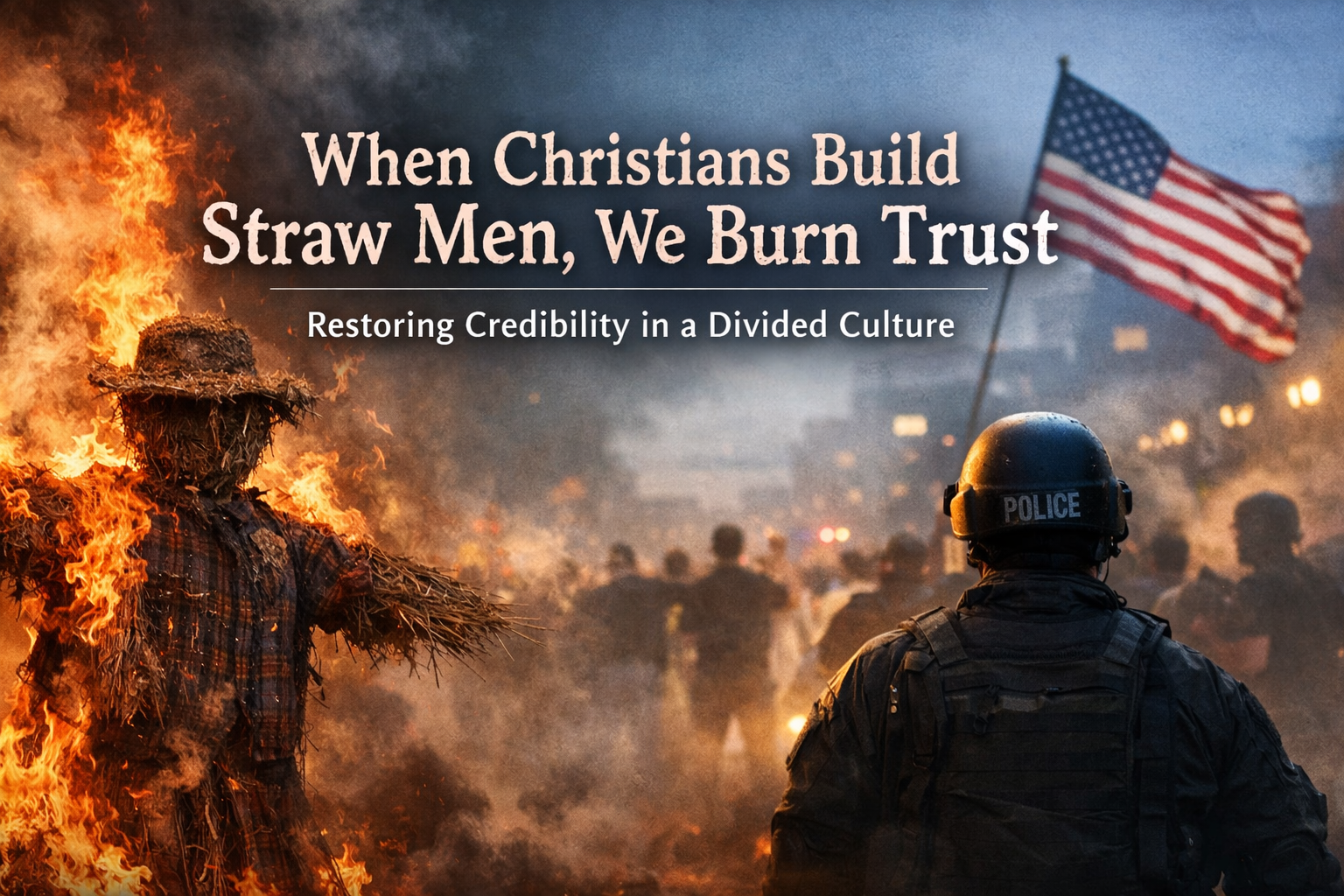
  • Straw Men Are Great Kindling For House Fires

    Straw Men Are Great Kindling For House Fires

    I tend to be slow to respond to cultural crises, not because I lack an opinion, but because I often lack clarity. And when a professing Christian—be that a pastor, deacon, politician, military, or “ordinary” citizen—makes accusations, comparisons, or arguments from a position which lacks clarity, the result often causes more damage than healing. False facts routinely take the elevator while truth takes the stairs. The downstream effect of this is that Christian credibility has become a casualty of our cultural era.

    In other words, the credibility of the Christian witness often loses its trustworthiness in areas of the Gospel because it first lost its trustworthiness in the secular arena. Too many Christians have forgotten that when Christians speak, we are to be careful, fair, and committed to reality rather than tribal victory. And when that credibility erodes, our witness to Christ erodes with it.

    The Cost of False Equivalency

    A recent example has made this painfully clear. In the past week, I’ve seen many Christians equate Alex Pretti (who was shot in Minnesota this week) with Kyle Rittenhouse. The argument goes something like this: “Both were armed. Both were present during unrest. Therefore, both situations are the same.” But that is not careful reasoning. It is allowing emotions to shortcut the nuance, becoming a classic case of false equivalency, often propped up by straw-man reasoning.

    Thus, whatever conclusions one ultimately reaches about either case, the situations are not equivalent. The Pretti incident involved an armed confrontation with law enforcement. Rittenhouse, by contrast, famously held his hands up, complied with police, and did not initiate confrontation with authorities.

    To flatten these events into the same moral category is false equivalency. And when Christians do this, we communicate that facts matter less than the outcomes we prefer. That shifts the sphere of debate from questions of justice and righteousness to that of rhetoric.

    The Other Side’s Inconsistency

    But honesty requires we say more. For years—especially since COVID—some Christians have loudly argued for civil resistance, even armed resistance, against perceived tyranny. Rhetoric about standing firm, refusing compliance, “don’t tread on me,” and resisting unjust authority has been widespread in Christian circles. Given that history, those same voices should be slow and careful when condemning someone simply for being armed in a tense situation.

    If we champion resistance in theory but denounce it reflexively when it becomes uncomfortable or politically inconvenient, we reveal that our commitments are not morally principled, rather they’re selective and flexible. Truth cuts both directions. And Christians must be willing to let it do so.

    Straw Men Hurt More Than Arguments

    And this brings us to the deeper issue. When Christians misrepresent situations—whether by exaggeration, oversimplification, or selective comparison—we aren’t merely making bad arguments. We are training the watching world to distrust us. And once people stop trusting our words about justice, law, or truth, they will not suddenly trust us when we speak about sin, grace, or Christ. The gospel does not need spin. It does not need inconsistent rhetoric. It needs credible messengers.

    Scripture places a premium on truthful speech—not just sincere speech, but accurate, measured, fair speech. Wisdom literature repeatedly warns against hasty judgment. The New Testament ties our witness directly to our conduct and speech. When Christians become known for emotionalism rather than clarity, we stop being signposts. We become white noise, numbing culture to the uncomfortable sounds of sin and death unto their own destruction. Loving one’s neighbor means that truth—even if it means waiting for the stairs—trumps an emotional response of solidarity.

    Consistency Of Principle Matters

    Remember how many Christians pushed back against perceived government overreach during the COVID-19 era — asking governors, mayors, and other civil authorities to resist restrictions perceived as disproportionate or unlawful? That appeal to lesser magistrates (lower authorities) was rooted in a conviction that government must be held accountable to justice and the common good, even if it must move from the bottom-up instead of the top-down.

    Now, in Minnesota, many citizens are asking Gov. Tim Walz and other state leaders to push back against what they see as federal overreach in immigration enforcement operations — including recent confrontations between civilians and federal agents that have led to the fatal shootings of Minneapolis residents. My honest observation at this point is that failures exist on more than one side—some rhetoric has encouraged civilians toward physical confrontation with government officers, while officers operating in high-stress environments appear increasingly reactive. The result can be (and has been) tragic and, in many cases, avoidable.

    We don’t have to agree on every point of policy to sympathize with the principle — that government power should be exercised responsibly, transparently, and justly. And Christians who once demanded civilian restraint during pandemic responses should be slow to applaud violence now, simply because the political actors have changed.

    Just as the answer to mask mandates was not to approach law enforcement officers with a gun, neither is the answer to perceived federal misconduct to celebrate or escalate violence in the streets. There are avenues for proper discourse: legal challenges, public advocacy, peaceful protest, requests for investigation, and sustained civic engagement. No matter the issue, Christians on either side of the aisle must remember that we stand together demanding accountability from those in power—because we are people of the Truth: united to Christ, who is the Truth. As people shaped by Him, there can be no room for deceit in us.

    That reality ought to check our emotions and lead us toward public, open discourse rooted in truth — not cheering on violence, flattening situations into equivalency as if one turn deserves the other, or changing our tune when it no longer fits our agendas. When we lose that discipline of truth, we lose not just credibility but the very posture of Christlike witness that calls people to peace and justice.

    What Faithfulness Requires

    Faithfulness does not require us to have instant opinions on every breaking story. In fact, I would wager that we are much more likely to find agreeable solutions when we don’t. Sometimes the most Christian thing we can say is:

    “I don’t know enough yet.”

    Or:

    “These situations are not the same, and pretending they are doesn’t help anyone.”

    Or even:

    “There may be failures on more than one side, and we should be honest about all of them.”

    That posture signals maturity, wisdom, and teachability—not weakness or fear. The Church should be the place where truth-seeking outruns cultural outrage, where facts are handled carefully, and where moral clarity is grounded in reality rather than reaction. And this means: slow to speak, quick to pray, willing to talk.

    A Better Witness

    Christians are called to be a people shaped by truth—truth that exposes error on both sides of the political aisle. That will sometimes frustrate allies and disappoint critics. The odds are, your politicians or political party is not going to align with the principles of Kingdom of God. I know this, because the Bible tells me so. But holding for and to truth will restore something to the Christian witness that is desperately needed: trust.

    And trust is not a small thing.

    Because when people believe that Christians tell the truth—even when it costs them—they are far more likely to listen when we tell them about Christ.

  • Why Christians Should Think Twice About Celebrating Hanukkah

    Why Christians Should Think Twice About Celebrating Hanukkah

    Every December, I see Christians posting menorahs, lighting candles, or saying things like, “Jesus celebrated Hanukkah, so I do too!” And on the face, it sounds histroical, thoughtful and reverent. But the history behind Hanukkah is far more complicated than most Christians realize. And if we take Scripture seriously (as we all should!), the festival raises some theological concerns that make Christian celebration “iffy,” if not inappropriate.

    Let’s walk through the real story.

    Hanukkah Is Not a Biblical Festival

    Hanukkah does not come from Moses, David, the Prophets, or any Old Testament command. It comes from the Maccabean/Hasmonean revolt in the 2nd century BC—a revolt that freed Judea from Seleucid (essentially Greek) oppression but produced its own theological and political problems.

    1. The Hasmoneans Were Not from Judah

    The Maccabees were Levites from the priestly family of Jehoiarib—not from the royal line of David. After the Maccabean revolt:

    • They did not restore the Davidic monarchy.
    • They crowned themselves rulers.
    • They merged priestly and kingly authority in a single family—something Scripture forbids.

    In the Scriptures, the kingship belongs to Judah (Gen 49:10), the high priesthood belongs to the line of Zadok (Ezek 40–48), and the prophets are sent by God. Hanukkah celebrates the moment when a priestly family took the throne that belonged to David’s line.

    2. Hanukkah Celebrates the Overthrow of the Zadokite High Priesthood

    In addition to seizing civil authority—the Hasmoneans took the high priesthood too, appointing themselves high priests despite not being from the line of Zadok. This is why the Qumran/Essene community (Dead Sea Scrolls) rejected Hanukkah entirely. They saw the Hasmonean high priests as illegitimate usurpers. In other words: A major Jewish sect in Jesus’ day rejected Hanukkah for the exact reasons Christians overlook today.

    3. Hanukkah Represents the Suppression of the Davidic Line

    By the time we get to Joseph and Mary, David’s royal family is politically sidelined, economically marginalized, and living in obscure working-class conditions. This is not an accident nor a coincidence. The Hasmoneans consolidated wealth and power around themselves, leaving David’s sons in the shadows. In short: Hanukkah celebrates the political arrangement that kept the true king’s family—Joseph’s family—off the throne.

    “But Jesus Celebrated Hanukkah!” — Did He Really?

    Many appeal to John 10:22: “At that time the Feast of Dedication took place in Jerusalem.” But notice what the text does not say. It does not say:

    • Jesus attended the festival
    • Jesus lit candles
    • Jesus observed rituals
    • Jesus endorsed the celebration

    John simply notes the time of year using the feastal calendar that Israel would have been familiar with. Jesus is walking and teaching in Solomon’s Portico—something He did constantly. And what does He do at Hanukkah?

    • He rebukes the temple leaders (John 10:26–30).
    • He confronts the very authorities who claimed legitimacy through the Hasmonean system that Hanukkah celebrates.

    If anything, John 10 is a rejection of Hanukkah’s claims, not an endorsement. As far as Scripture speaks, Jesus never celebrated Hanukkah. Instead, He used the occasion to declare Himself the true Shepherd-King—the Son of David —in opposition to the Hasmoneans.

    What About the Miracle of the Oil?

    We are often told the story of Hanukkah as it is found in it final form—the miracle of the oil that burned for eight days. But here’s the true background to that story:

    • The earliest sources (1 and 2 Maccabees) mention no oil miracle.
    • Josephus (1st century AD) mentions no oil miracle.
    • The Dead Sea Scrolls mention no oil miracle.
    • The earliest accounts describe an eight-day festival because they didn’t have time to celebrate the Feast of Booths earlier.

    So when does the oil story appear? In the Babylonian Talmud in the 5th Century AD.

    That’s roughly 700 years after the events! In other words, it is a later rabbinic legend—an attempt to spiritually reframe a holiday that originally celebrated a dynasty later viewed as corrupt.

    Which means: The most beloved part of Hanukkah wasn’t even part of Hanukkah until centuries after Jesus.

    Who Celebrated Hanukkah in Jesus’ Day?

    In Jesus’ time, Hanukkah was politically charged, and as such, not universally embraced.

    • The Pharisees largely supported it.
    • The Sadducees/Hasmonean priests embraced it—because it justified their power.
    • Many common Jews observed it culturally.
    • The Essenes/Qumran rejected it outright as an illegitimate festival.

    Judaism was not unified on Hanukkah, and neither was the early church.

    So Should a Christian Celebrate Hanukkah?

    A Christian may:

    • study Hanukkah historically
    • understand its role in Second Temple Judaism
    • teach how it sets the stage for Christ’s arrival

    But a Christian should not:

    • treat it as a spiritual or religious holiday
    • light menorahs devotionally
    • merge it with Advent
    • imitate rituals that historically celebrate illegitimate priest-kings

    Here’s why: Hanukkah celebrates the wrong king, the wrong priest, and the wrong restoration. Advent celebrates the arrival of the right King, the right Priest, and the true Temple. Hanukkah points to the failure of human rulers while Advent points to the triumph of Christ. Hanukkah shines a temporary, human light. Advent reveals “the true Light who gives light to everyone” (John 1:9). Hanukkah is longing for restoration. Advent is restoration arrived.

    Conclusion

    Christians do not need Hanukkah because Hanukkah needed Christ. The Maccabean revolt produced a dynasty that subverted David’s throne and Zadok’s priesthood—precisely the corruption Jesus came to confront. The “Festival of Lights” is ultimately a celebration of misplaced hope. Advent is the celebration of fulfilled hope. Hanukkah celebrates earthly attempts at empire, Advent remembers the true Kingdom established by Christ.

    Friends, the child born in Bethlehem—descended from a forgotten line of kings—came to take back the throne every other dynasty stole.

  • Peace and Purity: Why the Church Cannot Have One Without the Other

    Peace and Purity: Why the Church Cannot Have One Without the Other

    In the EPC, every new member makes a simple but weighty promise: “Do you promise to promote the unity, peace, and purity of the church?” It’s easy to treat unity, peace and purity as three separate directions—as though we could prioritize one without jeopardizing the other. But Scripture and the Reformed tradition (especially the Westminster Standards) insist that peace flows from purity, not the other way around. Lose purity, and you lose peace. Seek peace at the expense of purity, and you get neither.

    Biblical Peace is the Fruit of Truth, Not the Absence of Conflict

    “Peace” in Scripture is not about absence of conflict. It is shalom—order, wholeness, integrity. And this cannot exist apart from truth. Jesus prayed, “Sanctify them in the truth; Your Word is truth” (John 17:17). Paul joins peace and purity repeatedly (2 Tim. 1:13; Titus 2:1–2). The early church enjoyed deep unity after anchoring themselves in “’the apostles’ teaching” (Acts 2:42–47). The Westminster Confession agrees: the church’s holiness and peace are a mark of the Spirit’s work, not human diplomacy.

    The purest Churches under heaven are subject both to mixture and error…(WCF 25.5)

    Purity is not perfection (though Christ will eventually perfect his Bride)—but it is the sincere pursuit of doctrinal and moral faithfulness. And this pursuit is what guards the church’s peace.

    Pursuing Peace at the Expense of Purity Always Harms the Flock

    Many churches avoid conflict by refusing to confront false teaching or unrepentant sin. That instinct feels peaceful and mercy-filled, but Scripture calls it dangerous. Paul warns that wolves will come “from among your own selves” (Acts 20:29–30). In 1 Corinthians 5:6-7 we read, “Do you not know that a little leaven leavens the whole lump? Cleanse out the old leaven…” In Ephesians he writes, “There must not even be a hint of impurity among you” (Eph. 5:3). Paul’s instruction is to guard the flock and address impurity within the church. This is accomplished through discipline. The Confession recognizes discipline as a means of grace:

    Church censures are necessary for reclaiming and gaining of offending brethren, for deterring of others… and for preventing the wrath of God… upon the whole Church.(WCF 30.3)

    In other words: Failing to guard purity is failing to guard people.

    A peace-at-all-costs church allows falsehood to spread, leaves the spiritually vulnerable unprotected and, most visibly, breeds deeper division later. The irony is evident: a church that seeks peace without purity ends up with neither peace nor safety.

    Purity Creates Peace Because Purity Keeps Christ at the Center

    In the Reformed tradition, “the purity of the church” has always centered on:

    • faithfulness to Scripture
    • right preaching of the gospel
    • proper administration of the sacraments
    • the loving, biblical exercise of discipline

    These are Christ’s appointed means of preserving peace.

    The Lord Jesus… hath instituted in His Church… ordinances, for the gathering and perfecting of the saints. (WCF 25.3)

    Purity safeguards those ordinances, and purified doctrine leads to peaceful relationships. Where truth is clear, consciences can rest. Where sin is addressed, reconciliation will grow. And, where boundaries are honored, unity flourishes.

    Purity does not threaten peace–purity produces peace. Just as pruning what is diseased enables healthly growth, so purity allows for health in the Body of Christ.

    The EPC Vow Is Not Two Values but One Integrated Commitment

    The EPC membership vow is not a balancing act of give and take. Too often the EPC motto “in essentials unity, in non-essentials liberty, and in all things charity” unintentionally becomes a Trojan Horse which allows impurity to fester in the body. But we must remember: The vow to pursue the peace and purity of the church is a single, indivisible covenantal promise, grounded in the unity of truth and love.

    All synods or councils… are to handle, determine, and conclude nothing, but that which is agreeable to the Word of God.” (WCF 31.3)

    That is purity–and that alone brings peace. The purpose of such purity is always the peace and edification of the church (Eph. 4:11–16). To pursue “peace” by avoiding Scripture is to abandon both Scripture and peace. To pursue “purity” with a harsh spirit is to forget the Lord of peace. But joined properly, peace and purity protect Christ’s people and reflect Christ’s character.

    A Pastoral Word

    We live in an age where tolerance is prized above truth, and conflict avoidance is mistaken for biblical peace. But the church’s call is higher and healthier. When peace is sought at the expense of purity, the church will be in crisis. Thankfully, Christ loves His church too much to allow her to sacrifice purity for quiet.

    • A pure church will be a peaceful church.
    • A peaceful church will be a protected church.
    • And a protected church will be a joyful church.

    So when we take the vow to pursue “the unity, peace, and purity of the church,” we are not promising three things—we are promising one thing in three parts: To uphold the truth in love, so that Christ’s people may flourish in peace.

    When a church tolerates false teaching or unrepentant sin, it violates the very conditions necessary for peace. It’s like ignoring infection in the name of “keeping the body calm.” Sooner or later, the whole body suffers.

  • Why Deuteronomy Is Not A List of Rules

    Why Deuteronomy Is Not A List of Rules

    In American courts, there’s something called case law. That means we don’t just make rules in the abstract; rather, we learn from real and experienced situations. Someone actually did something, there were consequences, and that story becomes a wisdom-pattern for everyone else. James Boyd White says law is basically “a world you learn how to live inside.” In other words — it’s less like reading instructions, and more like being formed by someone else’s real experience.

    What if we read Deuteronomy that way?

    When God says things like: “If you build a new house, put a parapet on the roof…” (Deut 22:8) —
    He isn’t giving random religious dogma — He’s providing case law.

    It’s God saying: someone once got hurt. Learn from their story. Live wisely because of it. Embody the 6th Commandment (preservation of life).

    So when Psalm 1 says “meditate on the law day and night,” it isn’t about memorizing rules — it’s about inhabiting a moral world already shaped by real lives, real consequences, and real covenant history. As such, we can label the law as second-hand experience — laws are meant to consider the steps that led to the law’s installation.

    An Example

    Let’s do a thought experiment with Deut. 22:8.

    When Deuteronomy commands, “When you build a new house, you shall make a parapet for your roof” (22:8), this is not some form of architecual micromanaging for the ancient Near Eastern HOA — it’s God training moral imagination. The Israelite was meant to think backward — “Someone in this community once fell from a roof. A moment of joy (a new house) became a household of grief.” That unrecorded story of avoidable tragedy now lives inside the law. This is how case law works: not abstract principle, but second-hand participation in remembered tragedy and proposed solution. In other words: its experiencial wisdom. As such, the question is not, “What rule must I obey?” but “How do I love my neighbor?” The 6th commandment is not “Do not kill” but “how do I not neglect the conditions that make preventable death likely.” The parapet is more than a fence — it is covenantal foresight. It is how wisdom prevents another funeral.

    In the law, God is training His people through remembered lives and experiences that they didn’t personally live in order to instill a culture of godly wisdom.

    As such, we don’t merely study Deuteronomy: We are meant to enter it — to let someone else’s faithfulness, or failure, disciple us before we ever face it firsthand.

    Think Through Process, Not Just Results

    In short, when we read Deuteronomy or the Sermon on the Mount, we are meant to read it as both derivative and constitutive. The wisdom of the law is learned through its derived reality of covenant past, and forms us constitutively for covenant future. Living with the mind of Christ demands thinking through the process that formed the law, not just the end result of the law.

    This is what the Pharisees missed, and what Jesus exemplified.

  • When God Tests His People with a Prophet

    When God Tests His People with a Prophet

    “If a prophet or a dreamer of dreams arises among you and gives you a sign or a wonder, and the sign or wonder that he tells you comes to pass, and if he says, ‘Let us go after other gods,’ which you have not known, ‘and let us serve them,’ you shall not listen to the words of that prophet or that dreamer of dreams. For the Lord your God is testing you, to know whether you love the Lord your God with all your heart and with all your soul. You shall walk after the Lord your God and fear him and keep his commandments and obey his voice, and you shall serve him and hold fast to him. But that prophet or that dreamer of dreams shall be put to death, because he has taught rebellion against the Lord your God, who brought you out of the land of Egypt and redeemed you out of the house of slavery, to make you leave the way in which the Lord your God commanded you to walk. So you shall purge the evil from your midst (Dt 13:1–5).

    Reflections on Deuteronomy 13:1–5

    There are few passages in Scripture more overlooked than Deuteronomy 13. Here, the LORD does not warn Israel about an obvious, outward pagan threat, but about an insider — a prophet — a man claiming to speak in the name of the LORD — who performs real signs and wonders. And yet the test is not whether the sign is genuine, but whether the voice is loyal. The LORD Himself says He sends such moments “to know whether you love the LORD your God with all your heart and with all your soul” (Deut 13:3).

    This reality is one of Scripture’s most theologically clarifying statements: God is willing to test His people, not by the absence of the supernatural — but by its presence. The miracle alone is not the validation, the message is.

    The Test Is Not About Spiritual Sensation — But Covenant Fidelity

    Moses assumes the sign or wonder might actually come to pass (v. 2). That is to say, this is not a warning against trickery or cheap emotional hype. It is a warning against real, impressive, spiritually compelling moments that subtly detach the heart from the commandments of God.
    Will the people follow the voice that moves them, or will they follow the voice that formed them?

    For this reason Moses immediately commands:
    “You shall walk after the LORD your God and fear Him and keep His commandments and obey His voice” (v. 4).

    Here we hear the theology of Scripture’s sufficiency and finality (WCF 1.6). There is nothing — not even a supernatural sign — that has the right to relativize or destabilize what God has already spoken.

    God’s Tests Reveal What We Love

    When God tests, it is never for Him to learn something about us, but to reveal and refine something in us. Testing is not divine uncertainty — it is divine mercy. A faith untested is a faith unproven. A love untested is a love unrooted.

    The text does not say: “to see if you believe in the LORD” — but “to know whether you love the LORD your God. The issue is not merely orthodoxy, but covenant affection, aka, obedience.

    And thus the test is intensely pastoral in nature — because God will not allow His people to drift into heartfelt idolatry under the banner of spiritual sincerity.

    The Modern Shape of the Same Test

    This test is not a relic of the ancient world. This is the world we live in.

    • Some today speak of a Jesus who affirms what Scripture condemns, in the name of love and progress.
    • Others chase unexamined experiences rather than the Word — interpreting nearness to God by emotional volume rather than by covenant obedience.
    • Others prize novelty as though age were a flaw rather than a safeguard.

    But friends, God has not changed. He still tests His church. Not always by persecution–but by seduction.

    The Call of Deuteronomy 13 Is Loyalty

    This passage is not a call to intellectual cynicism or spiritual hyper-policing. It is a call to love God enough to prefer His voice over every other — even when that voice is quieter, older, slower, or less sensational.

    “You shall serve Him and hold fast to Him…” (v. 4).

    The word “hold fast” is covenantal, adhesive, and marital. It is Ruth clinging to Naomi. It is Israel clinging to YHWH. It is the church clinging to Christ.

    Even when other voices sound more convincing in the moment.

    The Confessional Heart of the Matter

    The Westminster Confession wisely warns that the conscience may never be bound by anything contrary to or beside the Word (WCF 20.2). Deuteronomy 13 is the Old Testament version of that same principle.

    The Word is the test of every experience; not the other way around.

    This is why we guard the public worship of the church (WCF 21). Because “following the Lord” is not an abstract inner disposition. It is covenantal obedience expressed in ordered worship, holy fear, and unbending delight in what He has spoken.

    The Final Word

    The greatest threat to the people of God has never been obvious paganism. It has always been religious speech bearing the name of the LORD but departing from His voice. And God, in mercy, lets these moments come — not to crush His people, but to refine them.

    The miracle alone is not the validation — it must agree with the voice of YHWH. Remember: even the magicians of Pharoah had some ability to mimic the miracles of Moses. But they did not have YHWH — and that made all the difference.

    So we cling to his Word. It is the only way to know the Shepherd’s voice.

  • Heracles Bow, Church Hurt, and the Sin of Communal Isolation

    Heracles Bow, Church Hurt, and the Sin of Communal Isolation

    Heracles’ bow is a strange artifact in mythology. It was a gift of divine strength, once used by a hero to conquer monsters and complete impossible labors. But in the play Philoctetes by Sophocles, the bow has changed hands. It’s no longer in the hands of Heracles, the strong—it’s in the hands of Philoctetes. Philoctetes was wounded in service of his people–a venemous snake bite that festered eternally in his leg. It stank, it revolted, and his very own people set him adrift in exile because the rot was so revolting. This is the man Sophicles centers his play around: Philoctetes, the wounded and exiled.

    Suddenly, the bow is no longer a symbol of power–it’s become a symbol of pain and isolation. The task of Odysseyus is to return the bow to combat–but in doing so, he must first restore the man.

    This story, ancient as it is, speaks powerfully to a modern wound: church hurt. Like Philoctetes, many Christians have found themselves exiled—sometimes quietly, sometimes dramatically—not because they abandoned the church, but because they were abandoned by it. They still carry faith. They still carry spiritual gifts. They still love Jesus. But they are deeply wounded and deeply alone.

    Church Hurt and the Temptation to Isolate

    Church hurt doesn’t always look like betrayal or abuse. Sometimes it’s simply being overlooked. Sometimes it’s rejection. Sometimes it’s the slow ache of not being seen, not being believed, or being treated as disposable.

    The natural reaction to that kind of pain is to retreat. Like Philoctetes, the wound festers—not just physically, but spiritually. We begin to believe lies:

    • “I’m better off alone.”

    • “I’ll never trust the church again.”

    • “My gifts don’t matter anymore.”

    • “God might love me, but His people clearly don’t.”

    And so we hold the “bow”—our strength, our calling, our worship, our insight—but we wield it in exile. We keep the faith… from a distance. We conflate the perfect Christ with the blemished Bride.

    But this is not what God wants for you.

    Isolation Is Not Healing

    Hebrews 10:25 says clearly:

    Do not neglect meeting together, as is the habit of some, but encourage one another…

    This command isn’t a guilt trip—it’s a lifeline. God doesn’t call us into community to control us. He calls us into community to heal us. The tragedy of Philoctetes wasn’t just his injury. It was that he had to suffer it alone. How many believers today are quietly bleeding out from church hurt, convinced that no one would understand—or worse, that no one cares?

    The enemy loves isolated Christians. That’s where he does his best work—where bitterness festers, trust dies, and spiritual gifts grow dusty. But isolation, no matter how justified it may feel, is never the solution.

    The Church That Hurts Can Also Heal

    Let’s be honest: the church can wound. It has. It will. But the church can also heal. Because Christ is still the head of the Church—and He binds up the brokenhearted (Psalm 147:3).

    God’s design has always been a people, not just persons. That’s why the early church devoted themselves not just to prayer and teaching, but to fellowship (Acts 2:42). Because healing rarely happens in private. The place where the wound came from is often the place where the wound must be addressed. Not the exact people, perhaps—but the body of Christ as a whole.

    You don’t need to go back to the place that hurt you. But you do need to come back to the people of God. Not every church is healthy. Not every church is safe.

    But Jesus has not abandoned His church. And He has not abandoned you.

    Wielding the Bow Together

    Your wounds don’t disqualify you. In fact, they might be the very thing God uses to minister to others. The bow—the gifting, the calling, the strength—is still in your hands. But it’s meant to be wielded in the context of community, not in exile.

    Galatians 6:2 says:

    Bear one another’s burdens, and so fulfill the law of Christ.

    This is what the church should be. Not a place that ignores wounds, but a place that shares them. A place where healing happens, where strength returns, where your presence matters. So if you’re sitting on your own island, holding Heracles’ bow, wondering if you’ll ever belong again—hear this:

    You do. You’re needed. And there is still a place for you at the table.

    Not because the church is perfect, but because Christ is.

  • A Call For Discernment

    A Call For Discernment

    In our cultural moment, skepticism toward news media has become second nature. It is common to hear someone dismiss CNN as hopelessly biased, or to claim that Fox News is propaganda. Whatever one’s political persuasion, people instinctively evaluate who is speaking, what their agenda is, and whether they can be trusted. We may disagree on which sources are credible, but few of us naively accept a news broadcast simply because it appears on television.

    Yet, when it comes to Christian voices—books on the bestseller list, podcasts in the “Christian” category, or sermons that circulate online—many believers lower their guard. If something is labeled “Christian,” it is often received without much thought or discernment. Snippets and sound bites are passed to others without thought to the theological trajecory of the pastor, speaker, or writer. We probably wouldn’t like to consider the “Christian” music we consume. But why this discrepancy? Why are we instinctively critical of news outlets but inherently trusting of Christian influencers?

    The “Christian” Label and It’s Assumed Authority

    The term Christian functions today as a kind of brand category. Just as a label like “organic” or “locally sourced” signals a set of expectations in the grocery store, so too the “Christian” label signals (to many) a guarantee of safety and faithfulness. But biblically, the mere use of Christ’s name does not confer authority.

    Jesus warned His disciples that “false prophets will come to you in sheep’s clothing, but inwardly they are ravenous wolves” (Matt. 7:15). The Apostle John likewise instructed, “Beloved, do not believe every spirit, but test the spirits to see whether they are from God” (1 John 4:1). And in Acts 17, the Bereans were commended as noble not because they accepted Paul uncritically, but because “they examined the Scriptures daily to see if these things were so” (Acts 17:11).

    If the early church was called to test prophets and even Apostles, how much more should we test the latest conference speaker or author? John Calvin once remarked that “Satan disguises himself as an angel of light, and his ministers feign the title of pastors” (Institutes IV.3.1). In other words, the danger is not outside the camp alone—it comes clothed in religious garb.

    Why We Drop Our Guard

    1. The Desire for Rest
    News media exhausts us. With constant spin and half-truths, skepticism becomes a daily posture. When believers turn to Christian spaces, they long for trust, safety, and encouragement. It feels burdensome to weigh and test everything when what we crave is comfort. Yet, resting in Christ must not be confused with resting in human teachers. Our comfort is found in the Good Shepherd’s voice, not in every voice that claims to speak for Him.

    2. The Pull of Tribalism
    We often gravitate toward teachers who confirm our existing convictions. Whether theological or political, these “tribes” give us a sense of belonging. Once inside, we lower our guard because critique feels like betrayal. But discernment is not betrayal—it is obedience.

    3. The Halo of Success
    Celebrity pastors, bestselling authors, and well-produced podcasts give the impression of credibility. Yet, history teaches us that popularity and faithfulness rarely go hand in hand. Jeremiah, faithful yet despised, stood against hundreds of prophets who assured Judah of peace (Jer. 6:13–14). In our day, polished platforms often carry more weight than doctrinal fidelity.

    4. Biblical Illiteracy
    Perhaps the most sobering reason we accept nearly any Christian voice is simply this: we do not know our Bibles well enough to spot error when it arises. Hosea’s warning rings true: “My people are destroyed for lack of knowledge” (Hos. 4:6). When we cannot distinguish the voice of Christ in Scripture, every voice that bears His label sounds convincing. A generation of Christians raised on devotionals, soundbites, and inspirational slogans often lacks the grounding in the whole counsel of God necessary to discern truth from half-truth. This is not just a weakness—it is a spiritual danger.

    The Reformed Position On Discernment

    The Reformed tradition has long emphasized the necessity of testing teaching by Scripture alone (sola Scriptura). The Westminster Confession of Faith affirms: “The supreme judge by which all controversies of religion are to be determined… can be no other but the Holy Spirit speaking in the Scripture” (WCF 1.10).

    This means that no matter how compelling a teacher may be—whether Luther or Calvin, Edwards or Piper, Osteen or Furtick—their words must be received only insofar as they are consistent with the Word of God. But not JUST their words: their presuppositions (the assumtions and starting points for how they approach Scripture and what they believe about it). The Reformers themselves modeled this humility. Calvin repeatedly exhorted his hearers: “We must not receive as true whatever may be spoken under the title of religion, unless we are assured that it comes from God” (Institutes IV.8.8).

    A Call To Critical faithfulness

    It is striking that we extend skepticism toward the voices that shape our political opinions, but suspend it toward those that shape our eternal souls. The stakes, however, are infinitely higher in the church. If we should weigh politicians’ words carefully, how much more the words that claim to reveal the gospel?

    This does not call us to cynicism but to biblical discernment. We are called to listen carefully, compare faithfully, and test continually—holding fast to what is good and rejecting what is false (1 Thess. 5:21). The church does not need unthinking consumers of Christian content; it needs discerning disciples of Christ. And the only way to grow in discernment is to grow in biblical literacy. Without deep familiarity with God’s Word, we are left vulnerable to the next “Christian” fad or the most persuasive voice in the room.

    Practical Steps For Growing In Discernment

    1. Read the Whole Bible Regularly
    Don’t only camp in familiar passages or devotionals. Read through the full counsel of God—Old and New Testaments alike—so you gain the breadth and balance of Scripture’s teaching.

    2. Join a Doctrinally Sound Church
    Submitting yourself to ordinary preaching and the accountability of elders is God’s design for guarding against error (Eph. 4:11–14). The local church is a safeguard that YouTube cannot provide.

    3. Study with Confessions and Catechisms
    Tools like the Westminster Confession or Heidelberg Catechism anchor you in historic Christian orthodoxy. They are not replacements for Scripture but summaries of what the church has long confessed to be biblical truth.

    4. Test Popular Voices
    When you hear a sermon or read a book, ask: Is this consistent with the plain teaching of Scripture? Does it exalt Christ or the self? Does it align with the gospel of grace or drift toward moralism, legalism, or self-help?

    5. Pursue Depth, Not Just Inspiration
    Don’t settle for surface-level encouragement. Look for teaching that presses you deeper into God’s Word and challenges you toward holiness and knowledge of Christ.

    Conclusion

    We do not (and should not!) give blanket trust to politicians simply because they bear the title. Why, then, should we give blanket trust to Christian influencers simply because they bear the label? The label does not sanctify the message. Christ does. Our call is to listen with open Bibles, to discern with Spirit-sharpened minds, and to hold fast to the voice of the Shepherd who alone speaks words of eternal life.

    Many studies reveal that we are the most biblically illiterate generation surrounds by more access than any generation of Christians before us. Until the church is once again saturated in the Scriptures—knowing, loving, and wielding the Word of God—we will continue to be swayed by whatever voice calls itself “Christian”–tossed to and fro by the winds of doctrine, as it were. But if we grow in biblical literacy, discernment, and submission to Christ’s Word, we will be equipped not only to reject what is false but to rejoice in what is true.