Category: Sermon Summaries

  • When the Kingdom Came in Power: Filling in the Gaps of Mark 8:38-9:1

    When the Kingdom Came in Power: Filling in the Gaps of Mark 8:38-9:1

    In Sunday’s sermon, we explored the sobering and triumphant declaration of Jesus in Mark 8:38–9:1. There, Jesus calls His followers to costly discipleship, warns of judgment, and makes a striking promise: that some standing there would not taste death until they saw the kingdom of God come with power.

    That closing line (9:1) is one of the most debated statements in the New Testament. What did Jesus mean? And did it really come to pass? If not, is it a future event yet to occur? Or could Jesus have been mistaken? This blog post is meant to fill in some of the historical and theological gaps from the sermon and to reaffirm the heart of the message: Jesus was not mistaken. He meant what He said. And His words were fulfilled within a generation.

    The Covenant Context of “Coming”

    In the ancient world, a god “coming” was often a metaphor for divine intervention in history—especially in judgment. This concept saturates the Old Testament. YHWH came in the cloud at Sinai (Ex. 19), in judgment on Egypt (Isa. 19), and through the armies of Babylon against Judah (Hab. 1:6). Significantly, to say that “God is coming” didn’t always mean a physical, visible appearance; it meant His presence would be made known in real and often terrifying ways.

    Jesus picks up that same covenantal framework (He is YHWH, after all–see “Is Jesus YHWH” for more on that). When He says that the Son of Man will come “in the glory of His Father with the holy angels” (8:38), He is invoking Daniel 7—a vision of the Son of Man receiving dominion and judgment authority. This “coming” is judicial, not geographical. In other words, it is expressly covenantal.

    Deuteronomy 28 and the Pattern of Judgment

    In Deuteronomy 28, Israel was warned that if they broke covenant, God would bring foreign nations as judgment: “The Lord will bring a nation against you from far away… like an eagle swooping down” (v. 49). This is the language of divine coming through historical agents. When Jesus predicted Jerusalem’s destruction (cf. Mark 13), He wasn’t imagining some distant apocalypse—He was announcing that the covenant curses were about to fall. And in AD 70, they did—Rome came like a flood.

    Why Not the Transfiguration?

    Some argue that Mark 9:1 refers to the Transfiguration, which happens just six days later. While there are connections—the glory, the divine voice, the cloud—the time-frame of the promise feels exaggerated if it only meant one week later. Additionally, Jesus says that “some standing here will not taste death.” That implies that most would die before this event—hardly a fitting way to describe something happening six days later. With his death, resurrection, ascension, and Pentecost only months away, the fall of Jerusalem nearly 40 years later fits the language better.

    Theological Support

    R.C. Sproul wrote, “The ‘coming’ of Christ in judgment was a real and visible event for those who lived through the fall of the city… not merely a future return.” N.T. Wright likewise argues that Jerusalem’s fall was the public vindication of Jesus’ kingdom mission. Even Matthew Henry notes that Christ’s prediction in Mark 9:1 was fulfilled within that generation.

    So What?

    Jesus’ words came true. Some of those standing there—perhaps John, perhaps others—lived to see the kingdom come in power through judgment. It was not the end of the world, but it was the end of an age. The temple fell, the old covenant was judged and fulfilled, the Church expanded, and Christ was vindicated as Lord.

    For us today, this means Jesus’ words are trustworthy. His kingdom is real. And when He speaks of discipleship, judgment, and glory, He is not playing with vague metaphors, rather, He is proclaiming covenant truth. So take up your cross. Don’t be ashamed of Him. The kingdom has come in power—and it’s still advancing today.

  • Is Jesus YHWH?

    Is Jesus YHWH?

    Imagine a town that’s spent generations crossing a beautiful old stone bridge. It was built centuries ago—carefully engineered, deeply grounded, weathered but strong. But over time, the townspeople begin to forget why it was built the way it was. New generations don’t remember what each stone is for. Some even begin removing parts of the foundation–making room for bigger boats to pass under, widening the path to accommodate more people–and all along assuming that the upper structure will stand on its own. But soon the bridge begins to sag, then crack, and people are left wondering why what used to carry so much weight can no longer bear anything at all.

    This is what happens when Christians forget their theological roots—especially when it comes to who Jesus is.

    One of the most essential, and perhaps most misunderstood, claims of the New Testament is this: Jesus is YHWH. He is not merely a messenger from God or a reflection of God’s character. He is the LORD himself—the covenant God of Israel—come in the flesh. This is not an optional theological add-on. It’s the bedrock of Christian faith. And when that foundation is lost, we not only misread Scripture, we lose our ability to connect the promises of the Old Testament with the fulfillment in the New.

    So let’s walk carefully and clearly through this claim: what does it mean to say “Jesus is YHWH? How did the early church come to this conviction? And why must we hold to it today?

    What Do We Mean By “Jesus is YHWH?”

    Let’s be clear: when Christians say “Jesus is YHWH,” we do not mean that Jesus is the same person as the Father. We mean that Jesus shares the divine identity—that he is fully and truly God, along with the Father and the Holy Spirit.

    YHWH (sometimes written “Yahweh”) is the divine name revealed to Moses at the burning bush (Exod 3:14–15). It’s the covenant name of Israel’s God—the great “I AM.” When Christians say Jesus is YHWH, we are saying that he is not just a messenger of God, not just a great teacher or prophet, but the LORD himself in human flesh. This is at the very heart of Christian faith:

    “In the beginning was the Word, and the Word was with God, and the Word was God… And the Word became flesh.” (John 1:1, 14)

    The New Testament Applies YHWH Texts to Jesus

    The New Testament doesn’t just call Jesus “God” in a vague sense—it regularly applies Old Testament YHWH passages directly to him. Consider:

    1. Hebrews 1:10–12 quotes Psalm 102:25, a psalm of worship to YHWH, and applies it to Jesus:

      “You, YHWH, laid the foundation of the earth in the beginning…”

    2. Philippians 2:9–11 quotes Isaiah 45:23, where YHWH declares, “To me every knee shall bow,” and says this will happen before “Jesus”:

     “Every knee will bow… and every tongue confess that Jesus Christ is Lord.”

    3. Romans 10:13 says:

    “Everyone who calls on the name of the Lord will be saved, quoting Joel 2:32—which clearly refers to YHWH.

    4. John 12:41 comments on Isaiah’s vision of the Lord in Isaiah 6 (where angels cry “Holy, holy, holy is YHWH of hosts”) and says:

    “Isaiah said these things because he saw [Jesus’] glory and spoke of him.”

    The claim that Jesus is YHWH isn’t some theological sleight of hand–this is the apostles teaching us who Jesus really is.

    Jesus Takes the Divine Name

    In John 8, Jesus himself make a shocking claims using the divine name:

    “Before Abraham was, I AM.” (John 8:58)

    The crowd knew exactly what he was claiming—they picked up stones to kill him for blasphemy (John 8:59). In Jewish context, “I AM” (“ego eimi“) is a direct reference to Exodus 3:14. Jesus wasn’t just saying he was old—he was identifying himself with YHWH.

    But Isn’t Jesus the Son? How Can He Be YHWH?

    Christian theology has always affirmed the doctrine of the Trinity: one God in three persons—Father, Son, and Holy Spirit. The Father is YHWH, the Son is YHWH, and the Spirit is YHWH. Not three gods, but one God, united in essence and purpose, eternally existing in three persons. There are many gods (“elohim” in Hebrew), but no other elohim is YHWH elohim. YHWH our elohim, is one elohim (Deut. 6:4)—Father, Son, and Holy Spirit.

    This isn’t something the church made up in the fourth century. It’s grounded in Scripture itself. The early church believed it, worshiped Jesus accordingly, and died confessing it.

    Why It Matters?

    If Jesus is not YHWH, then Christianity collapses.

    • Only YHWH can save. If Jesus is not God, he cannot be the Savior.
    • Only YHWH deserves worship. Yet the New Testament church worships Jesus.
    • Only YHWH is eternal and unchanging. And Hebrews 13:8 says, “Jesus Christ is the same yesterday and today and forever.”

    To deny that Jesus is YHWH is not to disagree on a side issue—it is to reject the Gospel itself.

    Conclusion

    It can be jarring to realize just how radical Christianity’s claim about Jesus really is. He is not just God’s representative—he is “God with us” (Matt 1:23). He is not just sent by the LORD—he is the LORD.

    The early church didn’t come to the conviction that Jesus is YHWH out of abstract speculation or political convenience. They came to it because the Scriptures demanded it, because the Spirit revealed it, and because the resurrection vindicated it. Jesus is not just the messenger—he is the Message made flesh. He is the I AM who spoke to Moses, the Lord whom Isaiah saw high and lifted up, the Shepherd of Israel, the Alpha and the Omega.

    To deny that Jesus is YHWH is not a small theological misstep—it’s a foundational collapse. And when that foundation erodes, the bridge that once carried the weight of God’s promises into our present moment begins to fail. The church’s ability to connect the God of Sinai with the Christ of the cross, the Psalms with the Gospels, the worship of Israel with the worship of the Church—all of it crumbles when we chip away at the stones our forefathers laid with sweat and blood and prayer.

    We don’t need to modernize the bridge. We need to remember why it was built the way it was—and trust that it is a path as narrow as it should be, as strong at it must be, and spans from death to life as promised.

    So yes, the church is a city on a hill for Christ, just as Israel was for YHWH—because they are not rivals or replacements, but one and the same. Jesus is YHWH in the flesh. And that’s not heresy–that’s Christianity.

    Because Jesus is not merely like YHWH.

    He is YHWH.

    And in him, the covenant holds fast.

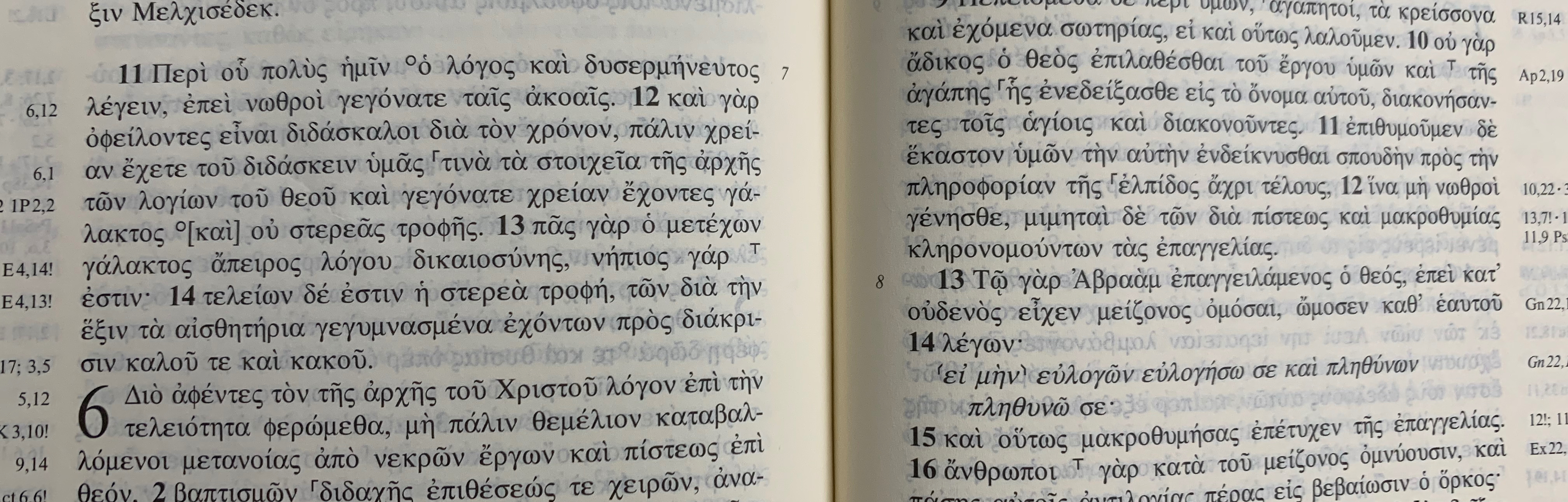
  • Sunday Sermon 8/15/21 Recap (Hebrews 5:11-6:12)

    Sunday Sermon 8/15/21 Recap (Hebrews 5:11-6:12)

    Hebrews 5:11-14: The Diagnosis
    At this point in the epistle, the author of Hebrews must take a detour. His intent was to continue speaking about the connection between Jesus and Melchizedek, but he has run into a problem: the audience is suffering from a “dull” faith (5:11), and they cannot understand what comes next. Thus, an excursus is in order.

    Important to note, this dull faith is an acquired situation because the Christians had become lazy, or sluggish, in their faith. While they should not only be able to comprehend where the author desires to go, by now they should also be mature enough to teach others. Instead, they require the elementary things of Christ to be taught to them again and again (5:12). They are living on spiritual milk, and do not have a diet of the Word and practice of faith that will allow them to mature properly. Their condition is most evident in their inability to “discern good from evil” (5:14). They have two responses: remain on milk or make a diet change.

    Hebrews 6:4-8: The Wrong Response—Continue to Drift
    First, despite what John Wesley believed, this is not a passage that debunks the doctrine of the “Perseverance of the Saints.” There are too many other verses that affirm this doctrine (John 10:28-30, 6:37-38; Romans 8:38-39, etc).

    Second, context is king. The author has built his entire case thus far from the Old Testament, so we should look to the Old Testament to explain this confusing text. This can be accomplished by reading Numbers 14:2-4, in which the Israelites request someone to “lead them back to Egypt” (Num. 14:4). Despite all that they had seen God do, they did not trust him because their faith was intellectual and not internalized. Thus, all Israel is not true Israel. The visible church is not necessarily the invisible church. Just as not every Israelite was saved, even though they experienced the blessings of Yahweh as a nation, everyone who claims Christ is not either. The logical end of someone who chooses to remain on milk is apostasy, whether that be returning to Egypt, Babylon, or Judaism.

    They went out from us, but they were not of us; for if they had been of us, they would have continued with us. But they went out, that it might become plain that they all are not of us.” -1 John 2:19

    Bringing this all back to the diagnosis of weak faith in 5:11-14: the wrong response is to remain on milk, to refuse to internalize the Gospel, and be sluggish in our faith.

    Hebrews 6:9-12: The Right Response—Practice.
    If the wrong response is the remain complacent and drift away from holiness, then the right answer is to practice your faith. This is done by loving others and serving the saints (6:10). The result of this practiced faith is fruit. And this fruit brings assurance.

    You will be known by your fruit (Matt. 7:16).