Tag: Faith

  • The Prodigal Son: It’s Not About You (Or Me)—Part 1

    The Prodigal Son: It’s Not About You (Or Me)—Part 1

    This is Part 1 of a 3-part blog mini-series.

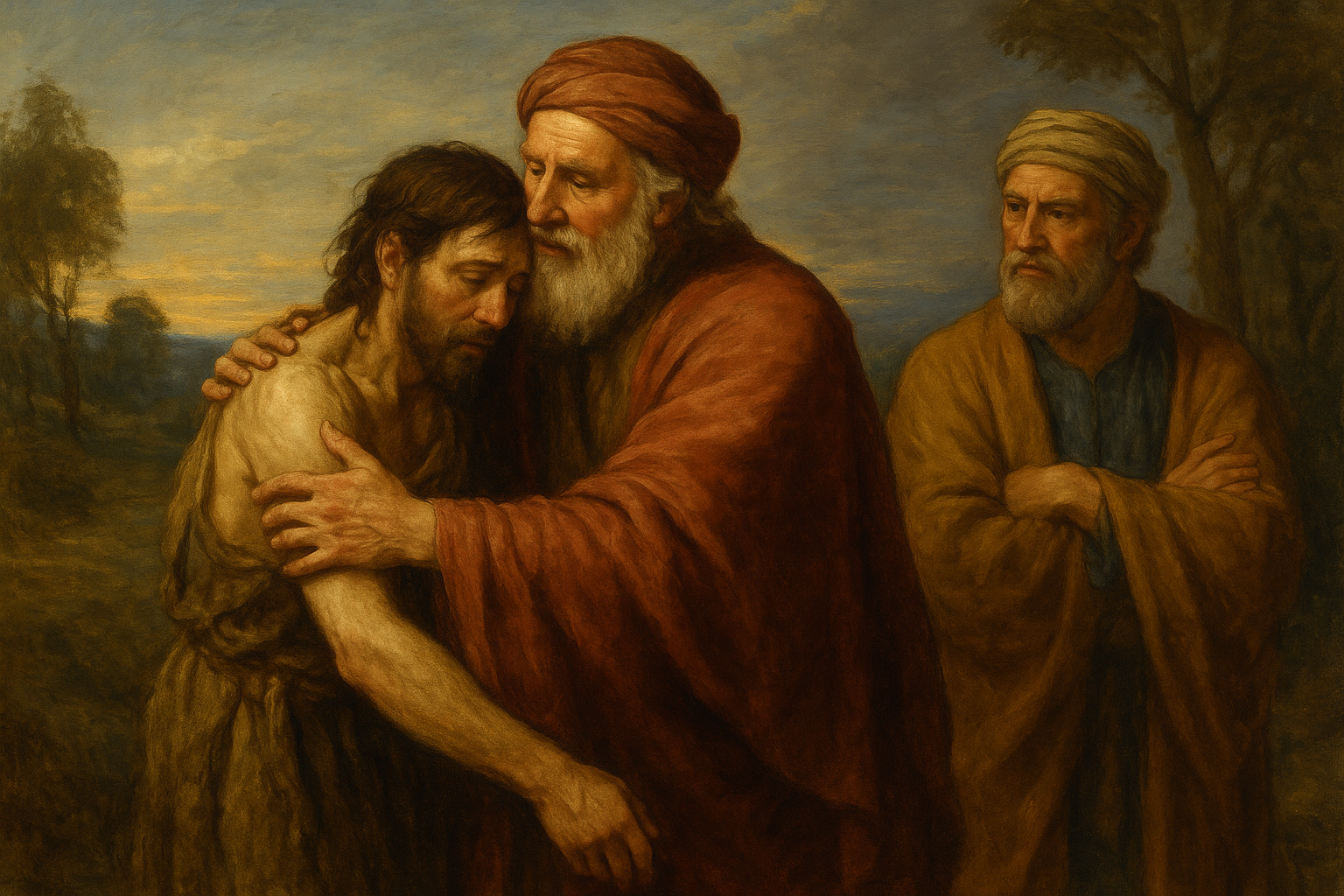
    When most Christians hear the parable of the prodigal son, they hear a salvation story. A sinner “runs away from God,” squanders his life, hits rock bottom, and finally comes home. The father runs to meet him, embraces him, and restores him. It’s a moving picture of God’s mercy toward repentant individuals. And that’s true—as far as it goes.

    But if we stop there, we risk flattening Jesus’ parable–of removing the context which makes it unique. In reality, this parable is much more deeply rooted in Israel’s covenant history, in Jesus’ ministry to His own people, and in His confrontation with the Pharisees.

    The Setting: Jesus vs. the Pharisees

    Luke 15 begins with a specific confrontation: “Now the tax collectors and sinners were all drawing near to hear him. And the Pharisees and the scribes grumbled, saying, ‘This man receives sinners and eats with them’” (Luke 15:1–2).

    That context matters–Pharisees and scribes upset that Jesus was fellowshipping with rebelling Jews (tax collectors and “sinners”). Jesus tells three parables in response—the lost sheep, the lost coin, and finally the lost son(s). Each ramps up the stakes, from an animal to money to a child. These aren’t random stories about “people getting saved.” They are a direct rebuke of the Pharisees’ attitude toward the “sinners”–fellows Israelites–Jesus was welcoming.

    As N. T. Wright puts it, these parables are not just timeless truths; they are part of Jesus’ campaign, his urgent summons to Israel to come back from exile, to come back to God (Jesus and the Victory of God, p. 127).

    The Prodigal As Israel’s Outcasts

    With this context in view, the parable begins to take shape. The younger son doesn’t represent generic pagans (i.e. Gentiles). He represents those Israelites who had squandered their covenant inheritance—tax collectors, prostitutes, and “sinners” who had abandoned Torah life. They were still sons of the house—Jews—but estranged.

    This mirrors the prophets’ language. Hosea 11:1–4 describes Israel as God’s son, called out of Egypt, yet turning to idols. Deuteronomy 32:18–20 speaks of Israel as a “faithless son” who forgot his Father. The imagery is covenantal, not merely personal.

    Kenneth Bailey, who spent decades teaching in the Middle East, points out that the younger son’s actions—demanding the inheritance early, leaving the family, and wasting it among the nations—fit the Jewish picture of Israel’s wayward children, those who had broken faith with the covenant community (Poet and Peasant, pp. 162–165).

    When the prodigal returns, broken and repentant, the father’s extravagant welcome mirrors what God was doing through Jesus: embracing the covenant outsiders and restoring them as true sons.

    The Older Brother As The Pharisees

    The older brother, meanwhile, embodies the Pharisees and the established religious system. He insists on his obedience, claims merit, and resents grace.

    This, too, has strong covenant echoes. Malachi 1:6–7 shows Israel complaining about God’s treatment, despite their “service.” The older brother is not unlike Israel’s leaders who saw themselves as faithful but refused to rejoice in God’s mercy.

    Craig Blomberg observes that the climactic point of the parable lies not with the prodigal’s repentance but with the elder brother’s refusal to rejoice over the restoration of his sibling (Interpreting the Parables, p. 170).

    The Parable As Israel’s Story

    Read this way, the parable isn’t just about how an individual gets saved. It’s about who truly belongs to Israel. Jesus is redefining the family of God around repentance and mercy, not self-righteousness and pedigree.

    N. T. Wright makes this point sharply: “The return of the prodigal is the return of Israel from exile. But the refusal of the elder brother shows that Israel’s leaders do not want to share in the joy of God’s kingdom” (Jesus and the Victory of God, p. 128).

    The prodigal son is Israel’s story, not ours.

    Why It Still Matters For Us

    Of course, the parable still speaks to individuals. Yes, the parable still speaks to the Church. Every Christian can identify with the prodigal’s repentance and the Father’s embrace. Any church can fall into the older brother’s resentment. But when we recover the Jewish covenantal frame, the story becomes sharper and richer.

    It reminds us that God’s kingdom is not about preserving status or merit, but about rejoicing when the lost return. It’s about restoration and reconciliation. It challenges us to ask: Are we more like the Father, eager to welcome, or more like the older brother, resentful when grace offends our sense of order?

    To be continued in Part 2: The Prodigal Son and Calvinism
  • Sabbath As Rebellion

    Sabbath As Rebellion

    “The Sabbath was made for man, not man for the Sabbath. So the Son of Man is lord even of the Sabbath.”

    — Mark 2:27–28

    A Subversive Rest

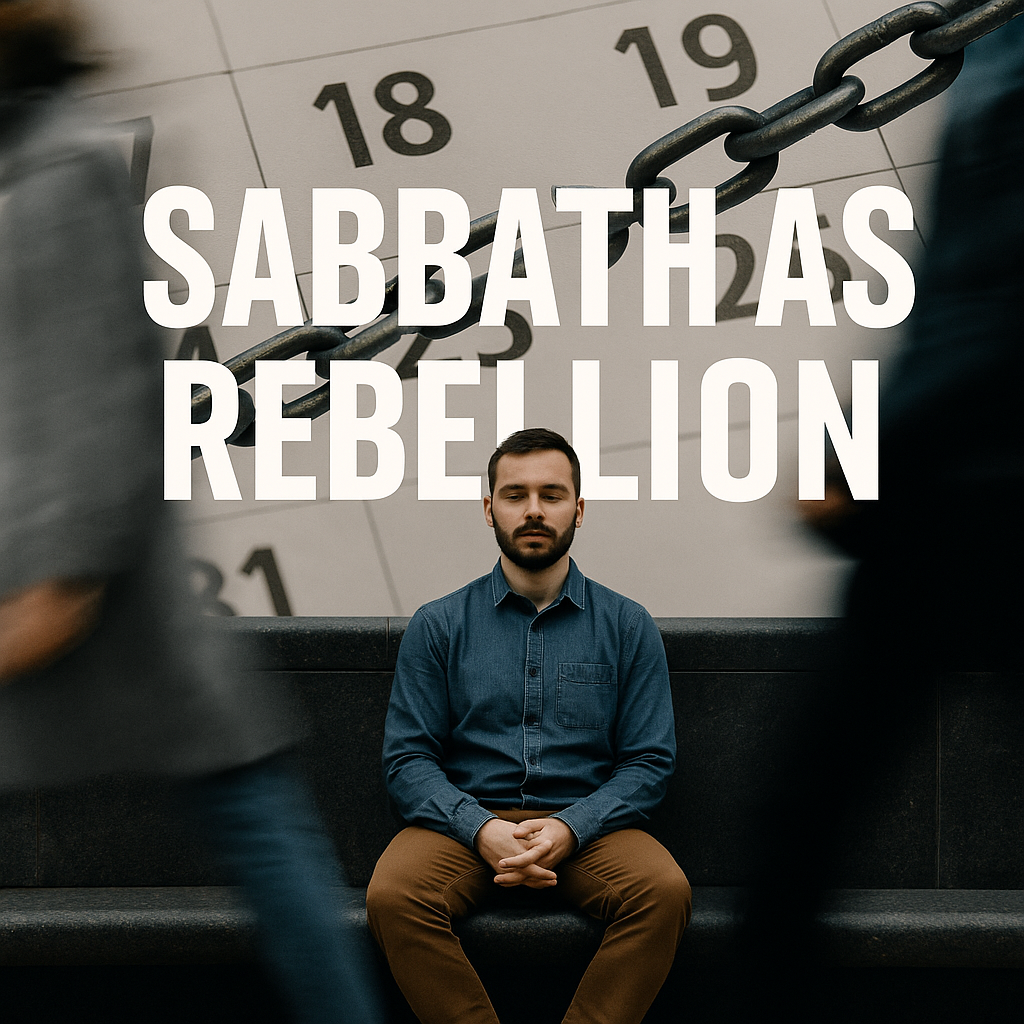
    In a world where your worth is measured by productivity, rest is a rebellion. The Sabbath command isn’t about squeezing in a nap or catching up on Netflix. It is God’s weekly declaration that His people are not slaves to Pharaoh, Wall Street, or Silicon Valley.

    Ponder this overlooked theological truth: When we stop, we resist. We say with our lives: “I am not defined by my output but by the God who redeemed me.”

    The Sabbath as a Weapon Against Pharaoh

    When Moses delivered Israel from Egypt, God’s people were freed from endless quotas and brickmaking. Pharaoh’s economy demanded ceaseless labor. God’s covenant commanded rest. Observing the Sabbath was Israel’s way of saying, “We are not Pharaoh’s slaves anymore. We belong to Yahweh.”

    Whether we recognize it or not, our world has its own Pharaohs. The demand for constant availability, the cult of hustle, the unspoken law of emails at midnight—these are modern brick quotas. Keeping the Sabbath is rebellion against those powers. It’s a declaration of independence from the gods of busyness. It trust that Yahweh supplies what Pharaoh demands. Our rest cries out “Jehovah Jireh,” Yahweh provides.

    The Sabbath as Counter-Cultural Identity

    In an interesting shift from the Exodus law, the Sabbath command in Deuteronomy 5 is rooted not in creation alone but in redemption:

    “You shall remember that you were a slave in the land of Egypt, and the LORD your God brought you out…” (Deut. 5:15)

    To stop working is to remember you’re free—to worship is to remember who set you free.

    For Christians, the Lord’s Day extends this logic into resurrection life. Christ has triumphed over sin and death; therefore, we rest not only from our labor but in His finished work. Sabbath rest proclaims that the victory is already won. It proclaims that rest is the established for His people—as such, we gather in Sabbath worship as a corporate body, not as individuals. He saved His people, not his persons. To be in Christ is to be in the corporate community.

    Why Sabbath Is More Than “Self-Care”

    Our culture loves to market rest as self-care: spa days, Netflix binges, vacations that leave us exhausted. But biblical rest isn’t consumeristic—it’s covenantal. It reorients us to God, His people, and His promises.

    When the church gathers in worship, when families put away their devices, when believers refuse the tyranny of constant emails, that is not mere self-care—it’s spiritual warfare.

    Sabbath as Eschatological Protest

    Every time we keep Sabbath, we proclaim that the kingdoms of this world are not ultimate. Capitalism isn’t ultimate. Politics isn’t ultimate. My own to-do list isn’t ultimate.

    Sabbath is a weekly protest march declaring that Christ reigns and that eternal rest is coming. But even more than that—as wild as this may sound—it’s also evangelistic. To observe the Sabbath is a visible marker of serving Christ instead of Pharaoh. And everyone else who continues to make bricks without straw needs to see you setting the work aside for the true divine Son of God.

    Rest as Rebellion

    Can you imagine how the Egyptians would have responded if the Hebrews in slavery simply stopped? If they set the bricks aside and said “today we worship the true God.” Anyone would identify that action as rebellion. Friends, to observe the Sabbath is to rebel. To rest in Christ is to subvert the false gods of productivity, consumerism, and self-definition.

    So here is the ultimate question: Does your Sabbath reflect bondage to Pharaoh or rest in Yahweh? Who rules your time—Pharaoh, or Christ?

    True freedom is not found in endless hustle or maxed-out schedules—but in holy rest.

  • Jericho Fell, The Temple Fell: God’s Plan for the Nations

    Jericho Fell, The Temple Fell: God’s Plan for the Nations

    Jericho fell so the Seed of promise might be sown. The Temple fell so that Christ’s harvest might be won.

    Sometimes a single line can capture the sweep of the whole Bible. From the walls of Jericho to the stones of the Temple, God has been writing one story: the story of Christ for the nations.

    Jericho Fell: A Seed Planted in the Land

    When Israel marched around Jericho and the walls came crashing down, it wasn’t just a victory for one nation. It was God’s way of planting His people in the land He had promised to Abraham.

    Why? Because God had already promised that through Abraham’s Seed all nations would be blessed (Genesis 12:3; Genesis 22:18). Jericho’s fall wasn’t about Israel’s glory—it was about clearing the ground so the Seed could take root in history. Because the Seed in view is a singular seed–its THE Seed: Christ. The land was never the ultimate goal; it was the soil in which God would grow His greater plan. The soil from which a Seed would become a cosmis tree:

    "I myself will take a sprig from the lofty top of the cedar and will set it out… On the mountain height of Israel I will plant it, that it may bear branches and produce fruit and become a noble cedar. And under it will dwell every kind of bird; in the shade of its branches birds of every sort will nest." (Ezekiel 17:22-24)

    The land was the down-payment. It was the security deposit. It was never the end goal. Jericho must fall so the Seed could be planted.

    The Temple Fell: A Harvest Opened to the World

    Centuries later, another set of stones fell. In A.D. 70, the Temple in Jerusalem was destroyed. For many, it looked like the end of Israel’s story. But in reality, it was the next step in God’s plan.

    The Temple had pointed forward all along: to the once-for-all sacrifice of Christ, the true Lamb of God (John 1:29; Hebrews 10:11–14). When Christ died and rose again, the need for animal sacrifices ended. And when the Temple fell, the gospel was no longer tied to one city, one altar, or one people. The harvest of the nations had begun (John 12:24; Matthew 28:18–20).

    The tree was spreading its branches to cover the whole earth.

    One Story, One Savior, One Mission

    From the fall of Jericho to the fall of the Temple, God was moving history toward the same goal: salvation through Christ for all peoples.

    God’s plan has always been global. Always Christ-centered. Always aimed at a harvest of people from every tribe, tongue, and nation worshiping the Lamb (Revelation 7:9). Just as Jericho fell so the Seed might be planted, so the Temple fell so the branches might extend.

    What This Means for Us

    It means that God’s plan is unstoppable. What looks like ruin in the moment—whether the collapse of Jericho’s walls or the destruction of the Temple—is actually God’s way of moving His story forward. And it means that we, the Church, are caught up in this mission. We are the fruit of the harvest and also the laborers sent into the field (Matthew 9:37–38).

    So when we look back at Jericho and the Temple, we aren’t just reading history—we’re seeing our place in God’s story. Christ is the Seed. Christ is the Temple. Christ is for the nations.

    When you see the ruins of Jericho and the rubble of the Temple, remember: God builds His kingdom, not on human walls, but on Christ alone. And that kingdom has no boundaries.

  • The American Eyes Are Tunnel Visioned

    The American Eyes Are Tunnel Visioned

    “If one member suffers, all suffer together; if one member is honored, all rejoice together. Now you are the body of Christ and individually members of it.”
    — 1 Corinthians 12:26–27

    American evangelicalism has a strange blind spot–and its one not really shared with Christendom outside of America. With one eye fixed firmly on Israel and the other seemingly closed to the persecuted church around the world, we’ve developed what can only be called tunnel vision. We raise our voices in prayer for the geopolitical survival of a secular nation—while our brothers and sisters in Christ are being beheaded by radical Islamists in Africa.

    Where is the urgency for the actual body of Christ?


    Praying for a Pagan Nation While Ignoring the Persecuted Church

    Let’s be clear: modern Israel is a secular nation. While it retains immense biblical significance as the historical homeland of God’s covenant people, the current state of Israel is not a theocracy under Yahweh. In fact, Israel ranks as one of the most unreached nations in the world as well as one of the most theologically liberal nations, with fewer than 0.3% of the population identifying as evangelical Christian (Joshua Project, 2025). Missionary efforts are often actively opposed by Israeli authorities.

    By contrast, over 360 million Christians today live under high levels of persecution, many of them in Muslim-majority regions (Open Doors USA, World Watch List 2024). In Nigeria alone, more than 4,100 Christians were killed for their faith in 2023—most at the hands of Islamist groups like Boko Haram or Fulani militants .

    These are our brothers and sisters in Christ. Yet American churches are largely silent.


    A Misplaced Missional Focus

    There is also an enormous gap between where God is working and where the American church is looking.

    While missions to the Jewish people are important, statistical data suggests that Muslims are converting to Christianity at vastly higher rates than ethnic Jews. According to one peer-reviewed study by Duane Alexander Miller and Patrick Johnstone:

    “The number of Muslim-background believers (MBBs) worldwide has grown from around 200,000 in 1960 to over 10 million today.”
    (The World’s Muslim Population and the Growth of the Church, IJFM Vol. 31:1, 2014)

    That’s a 50-fold increase in just over 60 years. Compare that to estimates of Jewish believers in Jesus worldwide—around 300,000 globally, according to Jews for Jesus (2022) .

    Statistically, this means Muslims are coming to Christ at over 30x the rate—and some estimates put it even higher, depending on region. God is moving powerfully in the Muslim world. So why aren’t we paying attention?


    Christ in His Body, Not in a Flag

    To care about Israel is not wrong. To prioritize a political state at the expense of the global church is. Paul says clearly that “not all who are descended from Israel belong to Israel” (Rom. 9:6), and again, that “if you are Christ’s, then you are Abraham’s offspring, heirs according to promise” (Gal. 3:29).

    In the New Covenant, the church is called “the Israel of God” (Gal. 6:16). Christ died for His bride—the Church—not for a political entity or ethnic group. He now dwells not in temples or geographic borders, but in His people by the Spirit (Eph. 2:19–22).

    To fixate on modern Israel while ignoring Christian martyrdom is to betray the very body of Christ.


    What Should We Do?

    1. Pray for the persecuted church: Resources like Voice of the Martyrs and Open Doors provide regular updates and prayer guides.
    2. Recalibrate your eschatology: If your eschatology blinds you to the Body of Christ, its time to re-evaluate it. Covenant theology rightly emphasizes the unity of God’s people throughout redemptive history.
    3. Support missions among Muslims: Ministries like Frontiers, Global Gates, and Elam Ministries are seeing unprecedented gospel fruit in the Muslim world.
    4. Repent of nationalism masquerading as Christianity: The kingdom of God knows no earthly borders and flies no earthly flag.

    Final Word

    Jesus is not coming back for a nation-state. He is coming for His bride, the Church. And that bride is bleeding in the shadows of Nigeria, Afghanistan, and Indonesia. When American Christians cry out for Israel but fall silent at the sound of the martyr’s blade, something is deeply wrong.

    Let us fix our eyes on Christ—and on His body. The gospel is not a foreign policy tool. It is the power of God unto salvation. And it is spreading—not in headlines, but in hidden places. Let us see rightly.


    A Pastoral Note to My Brothers and Sisters

    I know these words may feel weighty—perhaps even uncomfortable. But they are written with love, not condemnation. I write not as someone who has it all figured out, but as one who has been convicted by the very blindness I describe. This is not a call to abandon concern for Israel or to neglect prayer for any people group. Rather, it’s a plea to remember the Church. To lift our eyes and see the whole Body of Christ—suffering, growing, advancing—in places we’ve often overlooked.

    Let us be people of truth and compassion. People shaped more by the Word than by the news. People whose hearts beat in rhythm with our Savior, who laid down His life for the church.

    And let us pray—deeply, earnestly—for our brothers and sisters who bear that cross every day.


    Sources

    1. Joshua Project. “Country: Israel.” https://joshuaproject.net/countries/IS
    2. Open Doors USA. World Watch List 2024 Report. https://www.opendoorsusa.org
    3. Duane Alexander Miller and Patrick Johnstone, “Believers in Christ from a Muslim Background: A Global Census,” International Journal of Research and Ministry Vol. 31:1, 2014.
    4. Jews for Jesus. “How Many Jewish Believers Are There?” https://jewsforjesus.org

  • Keeping the Fire Alive: Parenting Beyond Camp

    Keeping the Fire Alive: Parenting Beyond Camp

    For fifteen years, I walked alongside teenagers in youth ministry. This week, I have the privilege of leading a youth camp that gathers students in our presbytery for a week of worship, the Word, and wild games. I’ve witnessed the mountaintop moments over the years of summer camp—the tearful confessions, the arms lifted in praise, and hearts awakened to the beauty of Christ and his work on our behalf.

    But I’ve also seen what happens two weeks later. What was burning becomes dim. What was fresh fades into habit. Parents (and often the students) ask, “What happened? Camp was so powerful—why didn’t it last?”

    Here’s the hard truth: summer camp was never meant to last on its own.

    “Mountaintops are for views and inspiration, but fruit is grown in the valley.”
    —Billy Graham

    The Campfire Needs a Fireplace

    In Deuteronomy, Moses stands on the edge of the Promised Land and speaks to a generation who had not been at Sinai. They hadn’t seen the plagues. They hadn’t walked through the sea. And yet, Moses doesn’t lower the bar or appeal to sentiment. He calls them to covenantal faithfulness rooted in doctrinal clarity and community accountability.

    “These words that I command you today shall be on your heart. You shall teach them diligently to your children…” (Deut. 6:6–7)

    The command is not first to the elders or “pastors.” It is to the parents. Israel was not told to rely on charismatic prophets or emotional gatherings. The Word was to be engraved in the home.

    And the surrounding chapters make this clear: doctrine is not a list of abstract ideas—it’s the story of God’s faithfulness, taught and embodied daily. Deuteronomy is thick with covenantal rhythm: teaching at meals, binding Scripture on hands and foreheads, writing it on doorposts (6:8–9), reenacting it in liturgical ceremony (ch. 27), and calling the whole community to live in view of blessings and curses.

    In short: Christian formation was never meant to be outsourced.

    Truth Witout Roots Will Wilt

    Let’s borrow one of Jesus’ favorite illustrations, and use it in a slightly different context: At camps and conferences, we plant and water seeds. Sometimes they sprout fast. Sometimes they sprout slow. But unless they take root in the soil of the local church and the water of Word-saturated homes, they will wither.

    Research confirms this: according to studies from Lifeway and Barna, nearly two-thirds of teens who are active in church during high school will walk away from the church in their twenties—most of them beginning that drift during late high school and early college. The drop-off doesn’t happen after graduation—it begins long before.

    Why? Often it’s not because they reject Christianity outright. It’s because they were never deeply rooted in the first place. They had inspiration but lacked integration. They were moved but not formed.

    A Fireplace for the Fire

    Your students need more than campfire worship–they need a fireplace to keep the flame hot. When fire is kept in a fireplace, it is easy to stoke, revive, or increase in temperature. It is when you pull it out of the fireplace that the fire begins to struggle. It loses heat quicker. It’s exposed to outside elements. Once the flame loses its heat, we end up doing weird and foreign things to keep it going. We stop putting in wood. We hit it with a 5-second squirt of lighter fluid. We toss in paper trash. In short, we use abnormal means to revive the flame so it can burn at an acceptable level. But the only true and lasting remedy is simple: Put the fire back in the fireplace.

    So, the question becomes: is your home a fireplace? What about your church? Or do you find yoursleves constantly doing weird things to keep your child interested in their spiritual walk? Your student needs more than campfire worship a couple times each year. They need:

    • Doctrinal instruction at both home and the church that connects their identity to the story of redemption (Deut. 5–11)
    • Moral worldview shaped by God’s law as wisdom and life (Deut. 4:6; 30:19)
    • Ritual rhythms that habituate faith—church attendance, communion, prayer, confession (Deut. 12; 26)
    • Covenant community that calls them back when they stray (Deut. 29)

    You don’t have to be a Bible scholar to do this. But you do need to be present. The Word of God is not just a Sunday event—it’s a way of life. And the home is the primary stage.

    A Word to Parents

    If you’ve sent your kid to camp, thank you. Seriously. It matters.

    But please don’t see camp as the climax of their spiritual year. See it as a spark. A moment to build on. A reminder that your child is being invited into something deeper than a one-week experience—they are being summoned into a lifelong covenant with the living God.

    And in that covenant, you have a vital role. The same God who said, “I will be your God, and you shall be my people,” also said, “Teach them diligently to your children.” Camp can light the fire. But the fireplace—that’s your home. Your church. Your rhythms.

    Let’s not give our kids an emotional high and then abandon them to spiritual cold–that’s just “lighter-fluid Christianity.” Let’s give them doctrine. Let’s give them covenant. Let’s give them Christ, again and again.

  • Stop Calling It ‘Legalism’: Why Obedience Isn’t the Enemy of Grace

    Stop Calling It ‘Legalism’: Why Obedience Isn’t the Enemy of Grace

    “Know therefore that the LORD your God is God, the faithful God who keeps covenant and steadfast love with those who love him and keep his commandments.”
    — Deuteronomy 7:9

    Somewhere along the way, we decided that “obedience” was a dirty word. In much of modern evangelical discourse, any serious talk of God’s commands is met with suspicion. If you suggest that Christians are called not only to believe but to obey, someone will inevitably cry, “Legalism!” And so, slowly and subtly, a generation of well-meaning believers has learned to recoil from the language of covenant loyalty—as if obedience were a threat to grace, rather than the fruit of it. But Scripture doesn’t share our hesitation. Especially not in Deuteronomy.

    Covenant Love Demands Covenant Loyalty

    Deuteronomy is a book of covenant—a re-preaching of God’s law at the edge of the Promised Land. But it’s not cold legislation. It’s a call to relational faithfulness. It is a document of catechesis, hoping to convince Israel that everything has moral applications–there is no neutral. Over and over, Moses pleads with Israel to love the Lord their God by walking in His ways, keeping His commandments, and living in the land under His blessing (Deut 10:12–13; 30:15–20).

    This is not legalism. It’s covenant logic.

    Because you are His, therefore walk in His ways.”
    Because He brought you out of Egypt, therefore obey His voice.”
    Because He loves you, therefore love Him with all your heart.”

    Deuteronomy teaches that obedience flows out of prior redemption. This is why there is so much historical background packed into the book. The law doesn’t earn Israel’s place in the covenant; it expresses it. It is how a people redeemed from the bondage of Egypt live with their Redeemer in a land that belongs to Him.

    Grace Is Not Passivity

    There’s a dangerous modern reflex to pit grace and effort against each other, as if they were theological enemies. But the Bible doesn’t hesitate to call redeemed people to strive (Heb 12:14), to make every effort (2 Pet 1:5–10), and to work out their salvation with fear and trembling (Phil 2:12).

    That’s not works-righteousness. That’s grace-empowered obedience.

    And if the law is written on our hearts (Jer 31:33), if God’s Spirit causes us to walk in His statutes (Ezek 36:27), then obeying God is not opposed to grace—it’s grace in motion. We don’t keep commandments to get into the covenant; we keep them because we are in it. To refuse obedience is not freedom—it’s infidelity.

    The Rhetoric of Faithfulness

    My own research in Deuteronomy focuses on how Moses uses rhetoric—not just commands—to shape Israel’s heart. The commands are liturgical, embodied, communal. They’re not just rules to follow; they’re rhythms to form a people.

    Deuteronomy 27–30, for example, is not merely law—it is liturgy. It frames obedience as worship, as covenant renewal, as a public enactment of loyalty before God and one another. There’s no cold morality here—there’s persuasive covenantal love. And that makes obedience not only possible, but beautiful.

    When we flatten obedience into a checklist or reject it as legalism, we miss the whole heart of the covenant.

    The Real Enemy of Grace

    Here’s the irony: the church’s fear of legalism has often led it into the arms of a subtler and deadlier enemy—antinomianism. The refusal to name sin, the unwillingness to call people to holy living, the rebranding of worldliness as authenticity—all of this is not grace. It’s neglect.

    It’s not loving to tell someone Jesus is Savior and never call them to follow Him as Lord.

    Legalism says, “Obey and God will love you.”
    Antinomianism says, “God loves you, so obedience doesn’t matter.”
    But the gospel says, “God loves you in Christ, therefore walk in a manner worthy of the calling you have received.”

    Pastoral Plea

    As a pastor, I want people to know the God who saves freely—and who calls us to follow Him wholly. I want to be a people that treasures grace so deeply that we gladly obey the One who gave it. Not to earn love, but because we already have it.

    So let’s stop calling covenant obedience “legalism.” Let’s stop apologizing for holiness.

    Let’s stop confusing freedom with autonomy.

    Instead, let’s rediscover the grace-fueled joy of living as a people who belong to God, in every moment and every motive.

  • Gospels vs. Epistles: Key Differences Explained

    Gospels vs. Epistles: Key Differences Explained

    Introduction

    Genre, when studing the Scriptures, is an often ignored piece of the contextual puzzle. In today’s culture, we are (mostly) adept at distinguishing between what is satire, poetry, news, opinion, etc. We are able (hopefully!) to discern a work’s genre intutitvely as we read, sometimes changing out perception of the genre as more information is gathered along the way. However, when 2,000 years separates the text from the reader, genre may not be so easily identifiable. This post offers some hermeneutical considerations for a New Testament reader in the 21st century.

    Ramification vs. Application

    While the Gospels (Matthew, Mark, Luke, John) do contain ethical teaching, their primary purpose is Christological revelation, not moral instruction. They are designed to answer “Who is this Jesus?” and present the ramifications of his identity and work. Luke tells us that his Gospel is written “that you may have certainty concerning the things you have been taught” (Luke 1:4). John states, “but these things are written so that you may believe that Jesus is the Christ, the Son of God, and that by believing you may have life in his name” (John 20:31). In short, the Gospels seek to produce a work of justification–opening our eyes to who Jesus is and what he has done.

    The Epistles, by contrast, answer “What does it mean to live in light of who Jesus is?” and are filled with applications for the church. The Epistles are the “wisdom literature” of the New Testament. It is here that the focus shifts generally from justification to sanctification (though neither are absent from Gospels or Epistles). Thus, with the knowledge of the Gospels, how is one now to live?

    It must be clearly stated up front: the Gospels are not written at the expense of instruction, however the primary concern is identification. Thus, we may find more ramifications in the Gospels than applications, though they are by no means mutually exclusive. A ramification is something that has implications, follows from the truth, is indirect, analytical, and answers the question “What does this imply?” An application has practical outworkings, tells us what to do with the truth, is direct and concrete, pastoral, and answers the question “How should we respond?” As one can see, ramifications and applications overlap, but are, at the same time, distinct. Just as justicifation is distict from sanctification, they cannot exist without the other. Thus, the Gospels are justification-focused, with significant ramifications. The Epistles are sanctification-focused, with significant applications. To summarize the argument in a phrase: the Gospels major in ramification, the Epistles major in application.

    1. The Gospels: Ramifications of the Christ Event

    Genre Orientation:

    The Gospels function in the tradition of Greco-Roman bios—not as moral manuals, but as identity-defining narratives. They reveal Jesus’ nature through action, fulfillment of prophecy, confrontation, and ultimately his passion and resurrection.

    Key Ramifications:

    • Christological: Jesus is the Son of God, Messiah, fulfillment of Israel’s hopes.
      • Ramification: The kingdom of God has come (Mark 1:15).
    • Cosmic: His resurrection signals the in-breaking of the new creation.
      • Ramification: Death is defeated (John 11:25–26).
    • Political: Jesus is Lord, not Caesar.
      • Ramification: Allegiance to Jesus may cost everything (Matt. 10:34–39).
    • Covenantal: Jesus reconstitutes Israel around himself.
      • Ramification: The people of God are defined by relation to him, not to Abraham (Matt. 12:48–50).

    The Gospels confront the reader not primarily with a command but with a claim—that Jesus is who he says he is. This reality is what elicits faith: do you believe this claim?

    2. The Epistles: Application of the Christ Event

    Genre Orientation:

    Epistles are occasional writings—pastoral, theological, and didactic—written to communities already convinced that Jesus is Lord. Their function is to encourage, clarify, explain and apply what it means to live in light of the Gospel.

    Key Applications:

    • Ethical: “Put off the old self… put on the new” (Eph. 4:22–24).
    • Ecclesial: “Bear one another’s burdens” (Gal. 6:2); unity in Christ (Phil. 2).
    • Missional: “Be ambassadors for Christ” (2 Cor. 5:20).
    • Doctrinal-Pastoral: “If Christ is raised… your labor is not in vain” (1 Cor. 15:58).

    The Epistles turn the theological ramifications revealed in the Gospels into practical applications for community life, ethics, worship, and mission.

    3. Theological Implication: Genre Shapes Interpretation

    By maintaining this distinction:

    • We protect the Gospels from being moralized into “how-to” manuals that reduce Jesus to a mere example–this is one of the signifcant errors of theolgical liberalism.
    • We honor the Epistles’ function as Spirit-inspired apostolic instruction for believers learning to embody the new reality inaugurated in Christ.
    • We orient readers properly: the Gospels are revelatory and confrontational; the Epistles are formative and instructive.

    Conclusion:

    The Gospels primarily give us the ramifications of Christ’s person and work—they reveal who he is and what that means for the world. The Epistles provide the applications of that reality—they teach us how to live in a world where Jesus is Lord. Both genres are essential, both genres overlap into the other’s sphere, but confusing their purposes can lead to shallow moralism on one hand, legalism on the other, or disconnected theology altogether.

  • Always Reforming: Eschatology and the Call of Scripture

    Always Reforming: Eschatology and the Call of Scripture

    “Ecclesia reformata, semper reformanda secundum verbum Dei”—

    “The church reformed, always being reformed according to the Word of God.”

    This ancient-sounding phrase didn’t come from the 16th-century Reformers themselves, but it has become one of the most enduring expressions of the Reformed tradition. It captures a critical and humbling reality: even a theologically “reformed” church is always in need of further reformation—not according to cultural trends or human systems, but according to the Word of God.

    The Origin of the Phrase

    The phrase semper reformanda—”always reforming”—originated not with Luther or Calvin, but with Jodocus van Lodenstein, a 17th-century Dutch Reformed pastor associated with the Nadere Reformatie (“Further Reformation”) movement in the Netherlands. He saw that while the Reformation had recovered much biblical truth, the hearts and lives of God’s people were still in need of reform. His cry was not for doctrinal innovation but for personal and corporate sanctification rooted in Scripture.

    Over the centuries, this phrase has been both treasured and misused. In some contexts, it has been distorted into a license for constant novelty or theological deconstruction. But rightly understood, semper reformanda calls us to a deeper, more faithful submission to Scripture. It urges us to return again and again to the Bible—to let God’s Word reform our hearts, our practices, and yes, even our theological systems.

    Letting Scripture Reform Our Eschatology

    This brings us to a present concern: eschatology—our doctrine of the last things. In many Christian circles today, particularly in the American context, dispensationalism has become the default (and often unknowingly adopted) framework for understanding prophecy, the end times, and Israel. It is presented as biblical, sometimes even as the only faithful way to read the Bible. But dispensationalism, as a system, is relatively recent, emerging in the 19th century through figures like John Nelson Darby and gaining popular traction through the Scofield Reference Bible and later popular media.

    Here’s the danger: whenever we inherit a fully-formed system—whether dispensational, amillennial, postmillennial, or otherwise—we are tempted to fit the text of Scripture into our eschatology, rather than letting Scripture shape or challenge our views. We run the risk of reading the Bible through the lens of our system, instead of submitting our system to the scrutiny of the Bible.

    This is not a problem unique to dispensationalism; it’s a human problem. But it becomes especially pressing when one system becomes dominant in popular teaching and church culture.

    But the Reformed tradition calls us to be always reforming. This means we must constantly bring our presuppositions and systems back to Scripture (Acts 17:11), testing all things and holding fast to what is good (1 Thessalonians 5:21).

    All Scripture is breathed out by God and profitable for teaching, for reproof, for correction, and for training in righteousness…” — 2 Timothy 3:16

    The sum of your word is truth, and every one of your righteous rules endures forever.” — Psalm 119:160

    If our theological system cannot bear that scrutiny, then it needs to be reformed. If it prevents us from hearing what Scripture clearly says, then it has become an idol.

    Always Reforming Means Always Submitting

    Semper reformanda reminds us that we must never hold our theological frameworks with greater authority than the text of Scripture itself. The moment we defend our views more fiercely than we test them, we’ve stopped reforming. The moment our eschatology becomes untouchable, we’ve replaced biblical authority with theological pride.

    A Reformed posture is not merely about affirming the Five Solas or the Westminster Standards. It’s about a heart that is always willing to be corrected by God’s Word, even when it costs us—especially when it costs us our comfort, our systems, or our traditions.

    Preaching the Whole Counsel of God

    Semper reformanda also means that we do not gloss over or ignore uncomfortable passages of Scripture. We are not free to mute the voice of God when it challenges our categories or unsettles our traditions. As Paul said to the Ephesian elders:

    I did not shrink from declaring to you the whole counsel of God.” — Acts 20:27

    Faithfulness requires preaching and teaching all of Scripture—not just the passages that align neatly with our frameworks. This includes difficult prophetic texts, apocalyptic literature, and themes of judgment and restoration. It means searching out the eschatological implications of the text and understanding how the original audience would have understood it. This is difficult and convicting work that challenge our presuppositions. However, pastors are not called to protect the flock from discomfort; we are called to form them by truth, even when that truth provokes hard questions or opposition (2 Timothy 4:2–4).

    Reforming Toward Christ

    Eschatology is not a secondary matter—it shapes how we view redemption, history, mission, suffering, and hope. But our views must be shaped by what the Bible actually says, not what our charts or traditions assume. Semper reformanda, therefore, is not about discarding tradition, but about testing it. Traditions can bolster, but not determine. Theological traditions let us know the company we keep–and it is important that we pay attention to such things. But semper reformanda, at the heart, is about being reforming people—not just reformed in name.

    Let us be committed to this: that our eschatology, like all our theology, stands under the judgment and light of Scripture. And where we find that we have built upon assumptions rather than exegesis, let us return—not to our comfort zones, but to the Word of God. For the church reformed is a church still reforming, under the gracious rule of Christ and the authority of His Word.

    Sanctify them in the truth; your word is truth.” — John 17:17

  • Understanding John 1:51: Jesus as Our Connection to Heaven

    Understanding John 1:51: Jesus as Our Connection to Heaven

    “And he said to him, ‘Truly, truly, I say to you, you will see heaven opened, and the angels of God ascending and descending on the Son of Man.’”

    John 1: 51

    Context

    The Gospel of John opens with a grand, cosmic prologue that introduces Jesus as the Word who was with God in the beginning and who is God (John 1:1-2). We are told that the Word is both Creator and life (John 1:3-4). This life shines through the darkness, and the darkness has not overcome it (John 1:4). It is with this cosmic and powerful prologue that John sets the stage for the entire gospel, presenting Jesus not just as a teacher or prophet but as the eternal Logos, the Word made flesh, who brings light and life to the world.

    In John 1:35-51, we see Jesus beginning to gather His first disciples. John the Baptist, having recognized Jesus as the “Lamb of God,” (John 1:29) points two of his own disciples to Jesus. These disciples, Andrew and an unnamed disciple, follow Jesus, and Andrew quickly brings his brother, Simon Peter, to meet Him. The next day, Jesus calls Philip, who then finds Nathanael and tells him that they have found the one “of whom Moses in the Law and also the prophets wrote, Jesus of Nazareth, the son of Joseph” (John 1:45).

    Nathanael is skeptical at first, famously asking, “Can anything good come out of Nazareth?” But when he meets Jesus, Nathanael is astonished at Jesus’ knowledge of him, even before they meet. Jesus tells Nathanael that He saw him under the fig tree before Philip called him, leading Nathanael to declare, “Rabbi, you are the Son of God! You are the King of Israel!” (John 1:49). Jesus responds to Nathanael’s confession of faith with the profound statement in John 1:51, indicating that Nathanael will see even greater things, specifically “heaven opened, and the angels of God ascending and descending on the Son of Man.”

    Exegetical Reflection

    The phrase “truly truly,” employed for the first time here in John’s Gospel, comes from the Greek words “amen amen.” The original Hebrew word for “amen” comes from a root denoting certainty and steadfastness. When someone other than Jesus says these words, it voices hearty agreement. But when Jesus, Creator of all things uses these words, they confirm and emphasize trustworthiness and importance. In other words, Jesus’ “truly truly” is more than hope, it is certainty.

    Devotional Reflection

    John 1:51 is a powerful and prophetic verse that echoes the story of Jacob’s ladder in Genesis 28:12, where Jacob dreams of a ladder stretching from earth to heaven with angels ascending and descending on it. In this dream, God reaffirms His covenant with Jacob, promising him land, descendants, and His continued presence. Jacob awakes and declares that the place is “the gate of heaven.”

    By referencing this story, Jesus reveals something extraordinary about His identity. He is the trueladder, the connection between heaven and earth, the mediator between God and humanity. The angels ascending and descending on the Son of Man signify that Jesus is the focal point of God’s activity in the world. He is the bridge through which God’s blessings flow to humanity and through which humanity has access to God.

    This revelation would have been staggering for Nathanael, and it remains profound for us today. Jesus is not merely a teacher or a prophet; He is the divine Son of Man, the one who opens the way to heaven. He is both Bethel, the House of God, and the pathway to heaven. In Him, the separation between God and man is bridged, and through Him, we have access to the fullness of God’s presence.

    Application

    In our daily lives, it’s easy to lose sight of the reality that Jesus is our connection to God. We may become consumed with the challenges and distractions of the world, forgetting that in Christ, heaven is open to us. This passage invites us to live with the awareness that Jesus is always with us, that He is our mediator and the one who brings the presence of God into our lives.

    Consider where you might feel distant from God or where you need His presence today. Remember that Jesus has already bridged the gap. The door to heaven is open, and through Jesus, you have direct access to God’s love, grace, and mercy. Take time today to thank God for the gift of Jesus, and ask Him to help you live with a greater awareness of His presence. Let this awareness shape your thoughts, actions, and interactions, knowing that you walk with the One who connects heaven and earth.

  • Understanding Joshua 1: Courage and Obedience

    Understanding Joshua 1: Courage and Obedience

    7 Only be strong and very courageous, being careful to do according to all the law that Moses my servant commanded you. Do not turn from it to the right hand or to the left, that you may have good success wherever you go. 8 This Book of the Law shall not depart from your mouth, but you shall meditate on it day and night, so that you may be careful to do according to all that is written in it. For then you will make your way prosperous, and then you will have good success.

    I’ve heard this passage preached more than you might guess. It is a common slogan, encouraging verse, and a call to bravery. Joshua’s call to courage is a common text used by youth conference speakers who are hoping to instill confidence to a room full of confidence-averse teenagers. And that is helpful as far as it goes. But the mistake is made when the application of this passage focuses on perseverance of action rather than steadfastness of thought.
    Don’t fear your upcoming football game—be strong and courageous.
    Be confident as you take your exams—be strong and courageous.
    Don’t be ashamed that people know that you are a Christian—be strong and courageous.
    What tends to happen is that Joshua 1:6-7 becomes the Old Testament version of Philippians 4:13, “I can do all things through him who strengthens me.” And while there may be nothing egregiously “wrong” with these applications, they fall short of driving to the heart of the text. Sometimes, (maybe even often!), our best intentions get in the way of dependable application. So, let’s briefly revisit this text and see what it communicates about courage.

    The Recipient

    The recipient of these verses isn’t Israel, its Joshua. Joshua was the man chosen by YHWH to follow in Moses’ footsteps. Can you imagine? I was once given a piece of wisdom from a friend, “Never follow a legend at a job.” We see this concept the clearest in the sports arena. What are the chances you will prove your worth if you follow Nick Saban at Alabama? Or Phil Jackson in Chicago or LA? Even if you manage to win a championship, at best you are simply as good as the last guy. You’ve reached the expectations–there is often nowhere to go but down. But here is Joshua, following the legend. You can imagine how he must have felt. Joshua’s emotions must have been all over the place. Remember, this isn’t something as trivial as a sports championship—in view is the life or death of a nation and Joshua is to lead the way.

    The Message

    The message to Joshua is clear: be strong and courageous. But this is where we tend to drift from the meaning of the text. The charge and encouragement isn’t “be strong and courageous in conquest” the charge is “be strong and courageous to do all the Torah that Moses my servant commanded you.” In other words, victory in conquest isn’t based upon courage in warfare, but courage to obey the Torah, the law.

    Do you see the subtle but important shift from how we normally understand this passage? Its not about passing the test, landing the job, winning the game, or even winning a war—even faithful Christians will often fail at all of these things. The message to Joshua is that having courage and strength isn’t about the conquest—its about obeying the Torah in the midst of the conquest. Its about what the conquest will cause you to think and do; its about how the conquest will tempt you. You see, what takes courage and strength isn’t the war, rather, its about obedience to God while fighting in the war.

    Application

    With these things in view, the application of Joshua 1:7-8 begins to take shape. The charge to Joshua is less about the war and more about how he reacts to the war. Strength and courage are judged upon obedience to God’s law, not the trials set before us. Strength and courage are not about conquest but obedience—if we get that backwards then life can become very confusing.

    Friends, the call for the Church is to recognize that sometimes Christians rule nations and sometimes we are food for lions. Regardless of the result, the paths are faced the same way: strength and courage to obey all of God’s commands.