Tag: Faithfulness

  • Mission, Strategy, and Tactics: Why Churches Fight the Wrong Battles

    Mission, Strategy, and Tactics: Why Churches Fight the Wrong Battles

    You may want to sit down for this, but believe it or not, churches often fight over the wrong things. Wild, right?

    Rarely do churches divide over the Great Commission itself. Few Christians disagree that the church exists to make disciples, proclaim the gospel, administer the sacraments, and teach believers to obey all that Christ has commanded. Most churches affirm the what we call “the mission.” The conflict usually arises somewhere lower down the chain.

    Church conflict primarily arises when tactics become confused with strategy, and strategy becomes confused with mission. Consider a simple illustration:

    Imagine a group of hunters attempting to corner a bear. The objective is clear: corner the bear. That objective determines the strategy. Perhaps the hunters decide to drive the bear toward a narrow canyon where escape routes are limited.

    Once the strategy is established, a host of tactical decisions follow. Where should each hunter stand? Which route should be blocked? When should the advance begin? What signals should be used? No experienced hunter confuses these categories. Significantly, theobjective is not the strategy and the strategy is not the tactics.

    Yet churches frequently blur these distinctions. Ministry methods that once served the church well slowly become identified with faithfulness itself. Over time, people begin defending tactics as though they were doctrine and protecting traditions as though they were the mission of Christ.

    Healthy churches understand the difference between mission, strategy, and tactics.

    The Mission Never Changes

    It must always be remembered that the church does not determine its mission—Christ does. Before ascending into heaven, Jesus declared:

    “Go therefore and make disciples of all nations, baptizing them in the name of the Father and of the Son and of the Holy Spirit, teaching them to observe all that I have commanded you.” (Matthew 28:19–20)

    This mission is not ours to modify. A church in Jerusalem during the first century possessed the same mission as a church in rural America today. A congregation of twenty members possesses the same mission as a congregation of two thousand. The mission remains fixed because it originates with Christ.

    This is an important truth for churches to remember. Faithfulness is not measured by how well we preserve the preferences of previous generations. Faithfulness is measured by our commitment to Christ’s mission. The mission is permanent, universal, and does not change.

    Strategy Answers the Question: How Will We Pursue the Mission Here?

    Thus, while the mission remains fixed, the context does not. Every church exists among a particular people, in a particular place, facing particular opportunities and challenges. Therefore strategy asks a different question:

    How will we pursue Christ’s mission in this specific context?

    A church in a university town may develop a strategy centered on reaching students. A church in a rural community may focus on long-term relationships and family discipleship. A church in a growing suburb may emphasize hospitality and community integration. None of these strategies alter the mission. They merely represent wise attempts to accomplish the same mission in different fields.

    Farmers understand this principle instinctively. The objective is the harvest. Yet the methods used by a farmer in Scotland may differ significantly from those used by a farmer in Texas. Different soil, weather, and terrain require different approaches. Different strategies do not imply different goals. In fact, they imply wisdom. The same is true in ministry.

    Tactics Are the Tools

    If strategy answers the question, “How will we pursue the mission here?” then tactics answer the question, “What specific actions will we take?” Tactics are the practical tools that implement strategy.

    Examples include:

    • Door-to-door visitation
    • Home Bible studies
    • Vacation Bible School
    • Community events
    • Social media outreach
    • Small groups
    • Printed mailers
    • Neighborhood cookouts
    • Mercy ministries
    • Personal evangelism initiatives

    None of these are the mission. None of these are even strategies. They are tactics.

    But do not miss this: A tactic may be effective for a season and ineffective in another. It may work wonderfully in one community and fail completely in another. That does not make the tactic good or bad. It simply means tactics must always remain subordinate to strategy and mission.

    The proper question is never: “Have we always done this?” The proper question is: “Does this tactic help us accomplish our strategy in service to Christ’s mission?”

    When Tactics Become Sacred

    This is where many churches get into trouble. A tactic that once served the church effectively begins to acquire theological significance it was never intended to possess.

    A visitation program becomes synonymous with evangelism. A building becomes synonymous with ministry. A schedule becomes synonymous with faithfulness. A budget item becomes synonymous with stewardship. And over time, the conversation changes: People stop asking whether a ministry still serves the mission. Instead, they begin defending the ministry simply because it exists.

    The method becomes untouchable. The tradition becomes unquestionable. The tactic becomes sacred. The church becomes ineffective. The people become stuck.

    Ironically, this often occurs because the tactic once worked exceptionally well. A previous generation used it effectively. God blessed it and lives were changed. But faithfulness does not require us to preserve every tool God used in the past. Faithfulness requires us to remain committed to the mission Christ has given us in the present.

    A hammer may be a wonderful tool—that does not mean every problem is a nail. One of the dangers of the church is that tactics cease being servants and become masters. At that point, the church begins preserving methods rather than pursuing mission.

    The Reformed Distinction: Means and Methods

    From a Reformed perspective, an additional distinction is necessary: God has prescribed means, though.He has not prescribed every method. The ordinary means of grace remain fixed:

    • The preaching of the Word
    • The administration of the sacraments
    • Prayer

    These are not optional, cultural, nor subject to revision. Christ has appointed them for the nourishment and growth of His church. Yet Scripture does not prescribe every practical method by which a church brings people into contact with those means.

    Scripture does not require a particular building design, particular visitation model, church website, or specific discipleship curriculum. The means are fixed but the methods are flexible—so long as they support the mission.

    Failing to distinguish between the two often leads churches into one of two opposite errors. The first is traditionalism. Traditionalism canonizes old methods and refuses to let ineffective strategies and tactics go. The second is pragmatism. Pragmatism canonizes successful methods since “they worked before and they will work again.”

    One assumes a method is right because it is old. The other assumes a method is right because it worked. Both forget that only God’s ordained means possess divine authority.

    A Legacy of Faithfulness

    Every generation inherits tactics from the generations that came before it. Some should be retained, others revised, and still others abandoned. The question is never whether a tactic is old or new. Its whether it serves Christ’s mission.

    Faithful churches do not preserve methods simply because they are familiar, nor do they discard methods simply because they are old. They evaluate every strategy and every tactic according to a higher standard:

    Does this help us fulfill Christ’s mission through Christ’s appointed means in the current context in which we live?

    The church’s task is not to preserve yesterday. It is to steward the gospel today so that it may be handed faithfully to tomorrow.

    A church’s greatest legacy is not that its methods survive—its greatest legacy is that Christ’s mission does.
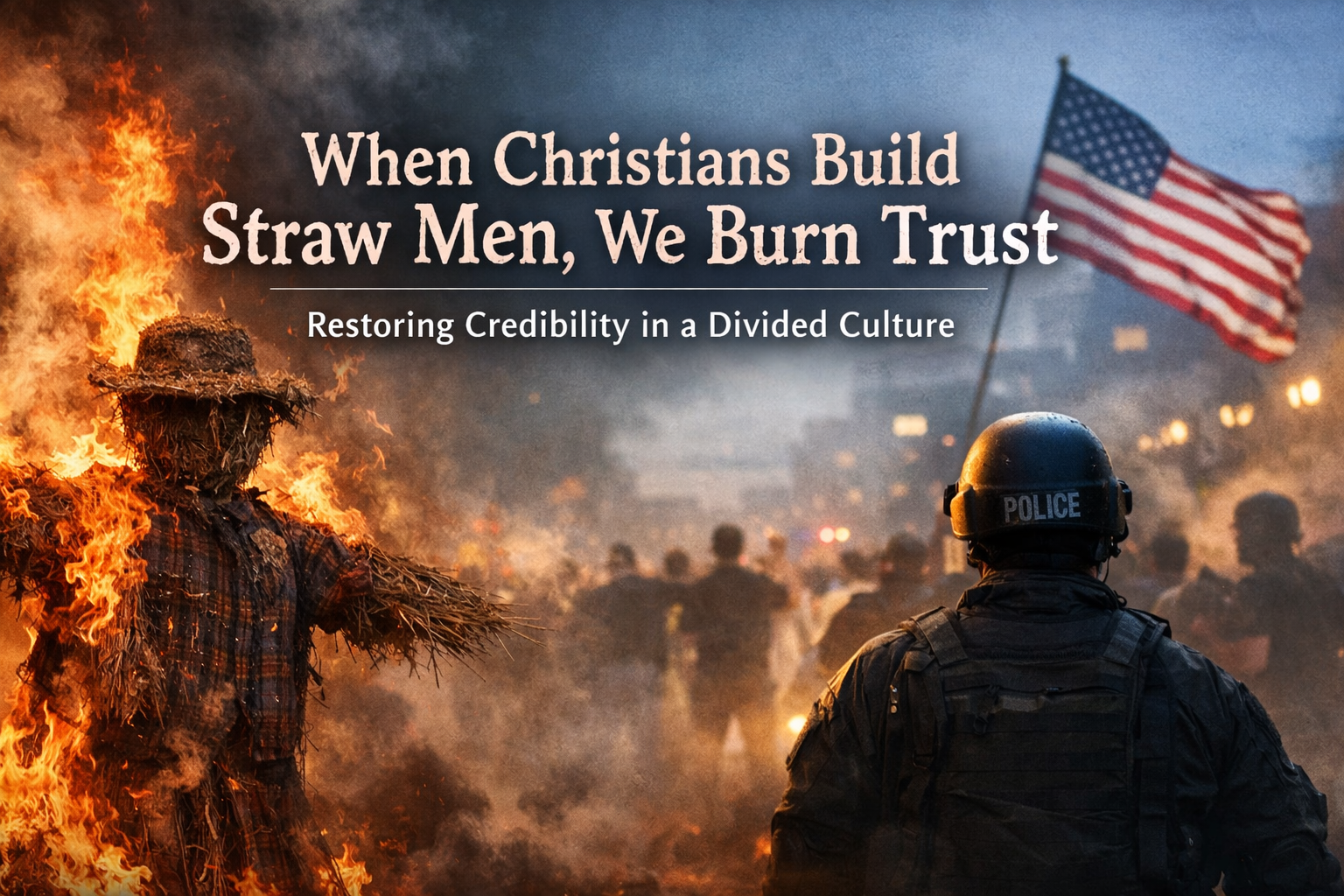

  • Straw Men Are Great Kindling For House Fires

    Straw Men Are Great Kindling For House Fires

    I tend to be slow to respond to cultural crises, not because I lack an opinion, but because I often lack clarity. And when a professing Christian—be that a pastor, deacon, politician, military, or “ordinary” citizen—makes accusations, comparisons, or arguments from a position which lacks clarity, the result often causes more damage than healing. False facts routinely take the elevator while truth takes the stairs. The downstream effect of this is that Christian credibility has become a casualty of our cultural era.

    In other words, the credibility of the Christian witness often loses its trustworthiness in areas of the Gospel because it first lost its trustworthiness in the secular arena. Too many Christians have forgotten that when Christians speak, we are to be careful, fair, and committed to reality rather than tribal victory. And when that credibility erodes, our witness to Christ erodes with it.

    The Cost of False Equivalency

    A recent example has made this painfully clear. In the past week, I’ve seen many Christians equate Alex Pretti (who was shot in Minnesota this week) with Kyle Rittenhouse. The argument goes something like this: “Both were armed. Both were present during unrest. Therefore, both situations are the same.” But that is not careful reasoning. It is allowing emotions to shortcut the nuance, becoming a classic case of false equivalency, often propped up by straw-man reasoning.

    Thus, whatever conclusions one ultimately reaches about either case, the situations are not equivalent. The Pretti incident involved an armed confrontation with law enforcement. Rittenhouse, by contrast, famously held his hands up, complied with police, and did not initiate confrontation with authorities.

    To flatten these events into the same moral category is false equivalency. And when Christians do this, we communicate that facts matter less than the outcomes we prefer. That shifts the sphere of debate from questions of justice and righteousness to that of rhetoric.

    The Other Side’s Inconsistency

    But honesty requires we say more. For years—especially since COVID—some Christians have loudly argued for civil resistance, even armed resistance, against perceived tyranny. Rhetoric about standing firm, refusing compliance, “don’t tread on me,” and resisting unjust authority has been widespread in Christian circles. Given that history, those same voices should be slow and careful when condemning someone simply for being armed in a tense situation.

    If we champion resistance in theory but denounce it reflexively when it becomes uncomfortable or politically inconvenient, we reveal that our commitments are not morally principled, rather they’re selective and flexible. Truth cuts both directions. And Christians must be willing to let it do so.

    Straw Men Hurt More Than Arguments

    And this brings us to the deeper issue. When Christians misrepresent situations—whether by exaggeration, oversimplification, or selective comparison—we aren’t merely making bad arguments. We are training the watching world to distrust us. And once people stop trusting our words about justice, law, or truth, they will not suddenly trust us when we speak about sin, grace, or Christ. The gospel does not need spin. It does not need inconsistent rhetoric. It needs credible messengers.

    Scripture places a premium on truthful speech—not just sincere speech, but accurate, measured, fair speech. Wisdom literature repeatedly warns against hasty judgment. The New Testament ties our witness directly to our conduct and speech. When Christians become known for emotionalism rather than clarity, we stop being signposts. We become white noise, numbing culture to the uncomfortable sounds of sin and death unto their own destruction. Loving one’s neighbor means that truth—even if it means waiting for the stairs—trumps an emotional response of solidarity.

    Consistency Of Principle Matters

    Remember how many Christians pushed back against perceived government overreach during the COVID-19 era — asking governors, mayors, and other civil authorities to resist restrictions perceived as disproportionate or unlawful? That appeal to lesser magistrates (lower authorities) was rooted in a conviction that government must be held accountable to justice and the common good, even if it must move from the bottom-up instead of the top-down.

    Now, in Minnesota, many citizens are asking Gov. Tim Walz and other state leaders to push back against what they see as federal overreach in immigration enforcement operations — including recent confrontations between civilians and federal agents that have led to the fatal shootings of Minneapolis residents. My honest observation at this point is that failures exist on more than one side—some rhetoric has encouraged civilians toward physical confrontation with government officers, while officers operating in high-stress environments appear increasingly reactive. The result can be (and has been) tragic and, in many cases, avoidable.

    We don’t have to agree on every point of policy to sympathize with the principle — that government power should be exercised responsibly, transparently, and justly. And Christians who once demanded civilian restraint during pandemic responses should be slow to applaud violence now, simply because the political actors have changed.

    Just as the answer to mask mandates was not to approach law enforcement officers with a gun, neither is the answer to perceived federal misconduct to celebrate or escalate violence in the streets. There are avenues for proper discourse: legal challenges, public advocacy, peaceful protest, requests for investigation, and sustained civic engagement. No matter the issue, Christians on either side of the aisle must remember that we stand together demanding accountability from those in power—because we are people of the Truth: united to Christ, who is the Truth. As people shaped by Him, there can be no room for deceit in us.

    That reality ought to check our emotions and lead us toward public, open discourse rooted in truth — not cheering on violence, flattening situations into equivalency as if one turn deserves the other, or changing our tune when it no longer fits our agendas. When we lose that discipline of truth, we lose not just credibility but the very posture of Christlike witness that calls people to peace and justice.

    What Faithfulness Requires

    Faithfulness does not require us to have instant opinions on every breaking story. In fact, I would wager that we are much more likely to find agreeable solutions when we don’t. Sometimes the most Christian thing we can say is:

    “I don’t know enough yet.”

    Or:

    “These situations are not the same, and pretending they are doesn’t help anyone.”

    Or even:

    “There may be failures on more than one side, and we should be honest about all of them.”

    That posture signals maturity, wisdom, and teachability—not weakness or fear. The Church should be the place where truth-seeking outruns cultural outrage, where facts are handled carefully, and where moral clarity is grounded in reality rather than reaction. And this means: slow to speak, quick to pray, willing to talk.

    A Better Witness

    Christians are called to be a people shaped by truth—truth that exposes error on both sides of the political aisle. That will sometimes frustrate allies and disappoint critics. The odds are, your politicians or political party is not going to align with the principles of Kingdom of God. I know this, because the Bible tells me so. But holding for and to truth will restore something to the Christian witness that is desperately needed: trust.

    And trust is not a small thing.

    Because when people believe that Christians tell the truth—even when it costs them—they are far more likely to listen when we tell them about Christ.

  • Prophetic Literacy and the End of an Age

    Prophetic Literacy and the End of an Age

    Many modern Christians treat biblical prophecy like a secret codebook—deciphering signs in the sky, tracking global politics, and panicking at every Middle Eastern rocket launch. But this “populist” reading of prophecy is more about headlines than holiness. And popular isn’t the same as faithful. Remember: in AD 33, the popular view was that Jesus was a blasphemer. So a better question might be: How did the early church understand prophecy? Do any New Testament examples help us reframe our assumptions?

    It might be surprising to hear that in the early church prophecy was something that found its fulfillment in the immediate, immanent, and practical “now.” It would be generally unheard of for someone to prophecy the specifics of an event 1000 years down the road—that is simply not how the ancient mind understood prophecy. That sort of prophecy held no impact or bearing on the life of the living. Rather, the normative mode for prophecy was one in which the prophet could be judged and weighed according to the correctness of his declaration. As such, in the Jewish world, vague oracles were not considered helpful nor divine. The case of Agabus—one of the few named prophets in the New Testament—offers an illuminating glimpse into how prophecy functioned within the apostolic community. That glimpse, when rightly understood, shines light upon how we should approach John’s Revelation.

    Agabus: A Prophet of the Present

    Agabus appears twice in Acts. First in Acts 11, where he predicts a famine under Claudius, which occurs soon after (AD 46-48). Second, in Acts 21, he foretells Paul’s arrest in Jerusalem. But each time, the pattern is clear: Agabus tells the church what is imminent, not what is distant. His prophecies are specific and time-bound—fulfilling the Deuteronomic standard (Deut. 18:22) and coming to pass within the lifetime of the hearers.. But perhaps most importantly, they prompt a tangible response from the church.

    When Agabus warns of the famine the disciples determined to send relief to the brothers living in Judea (Acts 11:29). No speculation, no panic: just action. The same realism holds in Acts 21. Paul does not question the prophecy—only what it demands of him. Agabus doesn’t speak in riddles or vague, partial fulfillments: he interprets unfolding events with Spirit-given clarity. 

    Prophecy and the Shape of New Testament Expectations

    This raises an important hermeneutical question: If New testament prophecy functions this way—why do we treat Revelation differently? A preterist reading (from praeter, Latin for “past”) sees Revelation speaking to the urgent realities facing the first-century church: persecution, the corrupting power of empire, and the impending judgment on apostate Israel. As G.K. Beal writes, “the book’s purpose is not to satisfy curiosity about the future, but to fortify believers to remain faithful in the present.”1 That purpose aligns perfectly with how prophecy operated in the early church—guiding believers through immediate historical crises. Agabus helps us read Revelation not as detached eschatology, but as pastoral prophecy. This is one of the roles of the “Apocalyptic” genre of prophecy. It does not attempt to tell you how God will do something, but rather, what he will accomplish in the most epic and convincing terms possible. As John tells us at the beginning of his letter, “These things must soon take place” (Rev. 1:1). In John’s life, the time was near (Rev 1:3), not distant. 

    Why This Matters

    The early church saw itself as living at the culmination of covenantal history. We must distinguish between the end of the world and the end of a covenantal world. The early church didn’t expect the collapse of creation, but the closing of an age—the Mosaic age (cf. Heb. 8:13). The prophetic word, then, is not an abstract oracle—it is God’s interpretation of unfolding covenantal realities. Thus, Revelation is covenantal judgment, not cosmic annihilation. As such, we must not understand the prophetic word as something floating in abstraction—no, it was significantly tethered to a present unfolding reality.

    This can be seen in Acts 2, where Peter specifically ties eschatological prophecy to Pentecost: “your sons will prophesy” (Joel 2). In this verse, Peter is stating something controversial for many of today’s readers: the end time prophecies were being fulfilled in Peter’s day. This whole argument can be summarized in a sentence: prophetic testimony pointed to Christ, not to distant geopolitical puzzles. Prophecy is about covenant, not conspiracy.

    Agabus and Revelation Read Together

    So how does Agabus clue us in on how to read Revelation? Well, Agabus provides a template: prophecy was given for the hearers’ immediate application and edification. Agabus doesn’t just predict events—he shepherds the church through them. This is the key: prophecy is pastoral, not predictive for its own sake. Which brings us to Revelation. Revelation should do the same for us today and all generations past and present—just on a larger, symbolic scale. As Richard Bauckham observes, “Revelation is a work of prophetic interpretation of the contemporary situation of the churches.”2 Whereas Agabus warns of famine and persecution, John warns of impending covenantal undoing–an “unmaking” of a people who rejected their Messiah, culminating in the fulfillment of the old covenant–which simultaneously results in the judgment of those in said covenant. When a covenant is broken, so is the relationship. Thus, as the old covenant is fulfilled and executed, the new covenant is inaugurated (Rev 11; Matt 24; Mark 12-13), the covenant Israel had long awaited (Deut. 30:6; Jer. 31:31–34; Ezek. 36:25–27). Thus, Revelation does not serve to warn of impending global doom, rather, it warns of the danger of covenant failure–and encourages those who finish the race well.

    Conclusion: Recovering Prophetic Literacy

    N. T. Wright, when speaking of prophecy writes, “Prophets were not fortune tellers. They were covenant watchdogs.”3 In other words, they were covenantal lawyers, telling the people when they violated the covenant and how God intended to respond. But these perspectives have been lost amongst the popular views of the “end times,” attributing weight and purpose that were not originally intended. As such, to read Revelation rightly, we must do the difficult work of recovering the church’s prophetic literacy:

    • Prophecy is not prediction, but perspective—God’s commentary on history.
    • We live in the overlap of the ages (1 Cor. 10:11)—not on the brink of escape, but in the thick of endurance.
    • Revelation calls us to faithfulness, not fear—to worship, not worry.

    Agabus reminds us that prophecy is timely, clear, and covenantal. So let us read Revelation not as a puzzle for tomorrow, but a call to faithfulness today. Because Christ has triumphed—and that changes everything.

    1. G.K. Beale, The Book of Revelation: A Commentary on the Greek Text (NIGTC; Grand Rapids: Eerdmans, 1999), 29.   ↩︎
    2. Richard Bauckham, The Theology of the Book of Revelation (Cambridge: Cambridge University Press, 1993), 2. ↩︎
    3. N.T. Wright, The New Testament and the People of God, p. 144. ↩︎