
Tag: Prodigal Son

  • The Prodigal Son and Calvinism: Not A Foil, but A Friend (Part 2)

    The Prodigal Son and Calvinism: Not A Foil, but A Friend (Part 2)

    This post is a continuation of thought from a previous post “The Prodigal Son: It’s Not About You (Or Me)–Part 1.

    In Part 1, we explored how the parable of the prodigal son is not just a generic salvation story but a covenant drama. The prodigal represents Israel’s “tax collectors and sinners” (Jews) returning to the fold. The older brother represents the Pharisees, refusing to rejoice at their repentance. And the father embodies God’s extravagant covenant faithfulness.

    But this covenantal frame also resolves a theological puzzle. The prodigal son has often been misread as a foil against Calvinism, as if Jesus were teaching free will over against doctrines of grace. When we restore the parable to its covenantal context, the apparent foil disappears.

    The Common Misuse: A Free-Will Parable?

    Critics of Calvinism sometimes point to the prodigal son as a “proof text” for human free will. Their argument runs something like this:

    • The prodigal “came to his senses” (Luke 15:17). Doesn’t that mean he made the decisive move himself?
    • The father only runs to him after the son decides to return. Doesn’t that suggest prevenient grace or even pure human initiative?
    • The story is about a son “choosing” to come home. Doesn’t that contradict the Calvinist idea of effectual calling or irresistible grace?

    On this reading, the parable functions as Exhibit A for the Arminian: grace may be offered, but the real hinge is human choice.

    The Covenant Frame Clears The Fog

    This way of reading only makes sense if we assume the parable is about how unbelievers get saved. But Part 1 showed that’s not the case. The prodigal son is already a son. The parable is about restoration within the covenant family and the exposure of Pharisaic self-righteousness.

    • Already a son. The prodigal does not become a child by his repentance; he was always a son of the father. His return is about reconciliation, not adoption. This undermines the “free will” argument at the root. The parable never portrays how one becomes a child of God—it presupposes sonship.
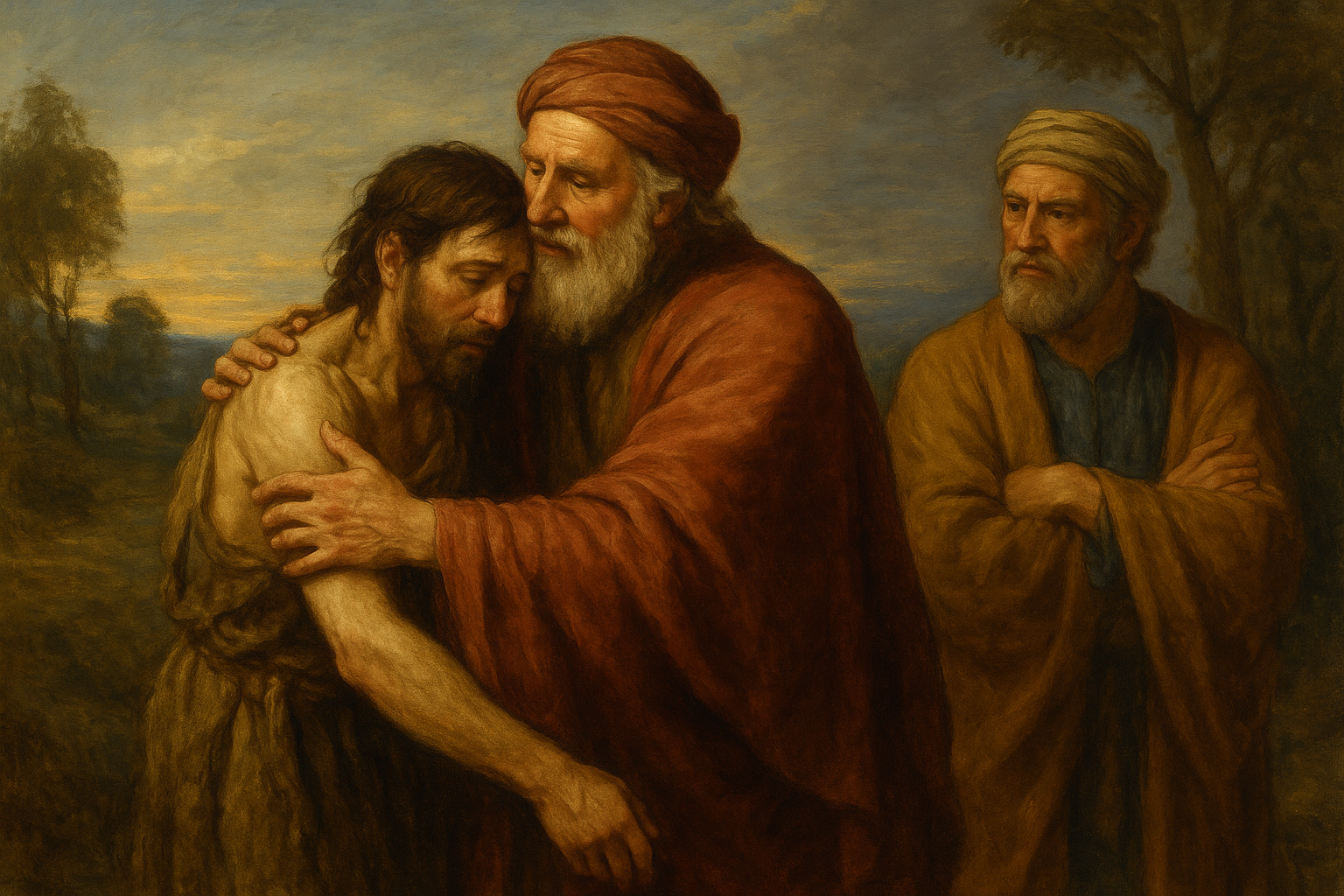
    • The Father’s initiative dominates. Even when the son “comes to himself,” his restoration depends entirely on the father’s action: running, embracing, clothing, feasting. As Kenneth Bailey points out, the father’s humiliating sprint down the road would have been a shocking reversal of social norms, emphasizing that reconciliation is his work from beginning to end (Poet and Peasant, pp. 162–165). It was the father’s right to embrace or reject.
    • The older brother unmasks works-righteousness. The real punchline is the elder brother’s refusal to celebrate. As Craig Blomberg notes, “the climactic point of the parable lies not with the prodigal’s repentance but with the elder brother’s refusal to rejoice” (Interpreting the Parables, p. 170). The parable critiques legalism, not Calvinism.

    A Reformed Reading

    When read covenantally, the prodigal son actually illustrates Reformed doctrines of grace rather than contradicting them:

    • Total depravity. The son is destitute, degraded, and feeding pigs—an unclean, helpless image. He has nothing to offer.
    • Unconditional election. His sonship is not revoked by his rebellion. He is restored not because he meets conditions, but because the father has mercy.
    • Effectual grace. The father’s embrace interrupts the son’s rehearsed speech. The decisive act of reconciliation is the father’s, not the son’s.
    • Perseverance of the saints. The son never ceases to be a son, even when estranged. His identity is secured by the father’s covenant faithfulness.

    As N. T. Wright reminds us, the parable is “about Israel coming home from exile,” and the tragedy is that Israel’s leaders refuse to join the party (Jesus and the Victory of God, p. 128). In Calvinist terms, this is the visible covenant community rejecting the grace set before them, while the repentant return is sealed by the Father’s action.

    Why This Matters

    By placing the prodigal son back into its covenantal frame, we not only read the parable more faithfully but also avoid a false theological dilemma. The story does not pit Jesus against Calvinism. Instead, it dramatizes covenant mercy, exposing the folly of self-righteousness and celebrating the Father’s joy in welcoming the wayward home.

    The prodigal son, far from being a foil to Calvinism, becomes one of its richest parables. It shows that God’s grace always precedes, always secures, and always rejoices in the return of His children.

    In Part 3: Coming Home to the Father’s Joy
  • The Prodigal Son: It’s Not About You (Or Me)—Part 1

    The Prodigal Son: It’s Not About You (Or Me)—Part 1

    This is Part 1 of a 3-part blog mini-series.

    When most Christians hear the parable of the prodigal son, they hear a salvation story. A sinner “runs away from God,” squanders his life, hits rock bottom, and finally comes home. The father runs to meet him, embraces him, and restores him. It’s a moving picture of God’s mercy toward repentant individuals. And that’s true—as far as it goes.

    But if we stop there, we risk flattening Jesus’ parable–of removing the context which makes it unique. In reality, this parable is much more deeply rooted in Israel’s covenant history, in Jesus’ ministry to His own people, and in His confrontation with the Pharisees.

    The Setting: Jesus vs. the Pharisees

    Luke 15 begins with a specific confrontation: “Now the tax collectors and sinners were all drawing near to hear him. And the Pharisees and the scribes grumbled, saying, ‘This man receives sinners and eats with them’” (Luke 15:1–2).

    That context matters–Pharisees and scribes upset that Jesus was fellowshipping with rebelling Jews (tax collectors and “sinners”). Jesus tells three parables in response—the lost sheep, the lost coin, and finally the lost son(s). Each ramps up the stakes, from an animal to money to a child. These aren’t random stories about “people getting saved.” They are a direct rebuke of the Pharisees’ attitude toward the “sinners”–fellows Israelites–Jesus was welcoming.

    As N. T. Wright puts it, these parables are not just timeless truths; they are part of Jesus’ campaign, his urgent summons to Israel to come back from exile, to come back to God (Jesus and the Victory of God, p. 127).

    The Prodigal As Israel’s Outcasts

    With this context in view, the parable begins to take shape. The younger son doesn’t represent generic pagans (i.e. Gentiles). He represents those Israelites who had squandered their covenant inheritance—tax collectors, prostitutes, and “sinners” who had abandoned Torah life. They were still sons of the house—Jews—but estranged.

    This mirrors the prophets’ language. Hosea 11:1–4 describes Israel as God’s son, called out of Egypt, yet turning to idols. Deuteronomy 32:18–20 speaks of Israel as a “faithless son” who forgot his Father. The imagery is covenantal, not merely personal.

    Kenneth Bailey, who spent decades teaching in the Middle East, points out that the younger son’s actions—demanding the inheritance early, leaving the family, and wasting it among the nations—fit the Jewish picture of Israel’s wayward children, those who had broken faith with the covenant community (Poet and Peasant, pp. 162–165).

    When the prodigal returns, broken and repentant, the father’s extravagant welcome mirrors what God was doing through Jesus: embracing the covenant outsiders and restoring them as true sons.

    The Older Brother As The Pharisees

    The older brother, meanwhile, embodies the Pharisees and the established religious system. He insists on his obedience, claims merit, and resents grace.

    This, too, has strong covenant echoes. Malachi 1:6–7 shows Israel complaining about God’s treatment, despite their “service.” The older brother is not unlike Israel’s leaders who saw themselves as faithful but refused to rejoice in God’s mercy.

    Craig Blomberg observes that the climactic point of the parable lies not with the prodigal’s repentance but with the elder brother’s refusal to rejoice over the restoration of his sibling (Interpreting the Parables, p. 170).

    The Parable As Israel’s Story

    Read this way, the parable isn’t just about how an individual gets saved. It’s about who truly belongs to Israel. Jesus is redefining the family of God around repentance and mercy, not self-righteousness and pedigree.

    N. T. Wright makes this point sharply: “The return of the prodigal is the return of Israel from exile. But the refusal of the elder brother shows that Israel’s leaders do not want to share in the joy of God’s kingdom” (Jesus and the Victory of God, p. 128).

    The prodigal son is Israel’s story, not ours.

    Why It Still Matters For Us

    Of course, the parable still speaks to individuals. Yes, the parable still speaks to the Church. Every Christian can identify with the prodigal’s repentance and the Father’s embrace. Any church can fall into the older brother’s resentment. But when we recover the Jewish covenantal frame, the story becomes sharper and richer.

    It reminds us that God’s kingdom is not about preserving status or merit, but about rejoicing when the lost return. It’s about restoration and reconciliation. It challenges us to ask: Are we more like the Father, eager to welcome, or more like the older brother, resentful when grace offends our sense of order?

    To be continued in Part 2: The Prodigal Son and Calvinism