Tag: prodigal-son

  • The Prodigal Son: It’s Not About You (Or Me)—Part 1

    The Prodigal Son: It’s Not About You (Or Me)—Part 1

    This is Part 1 of a 3-part blog mini-series.

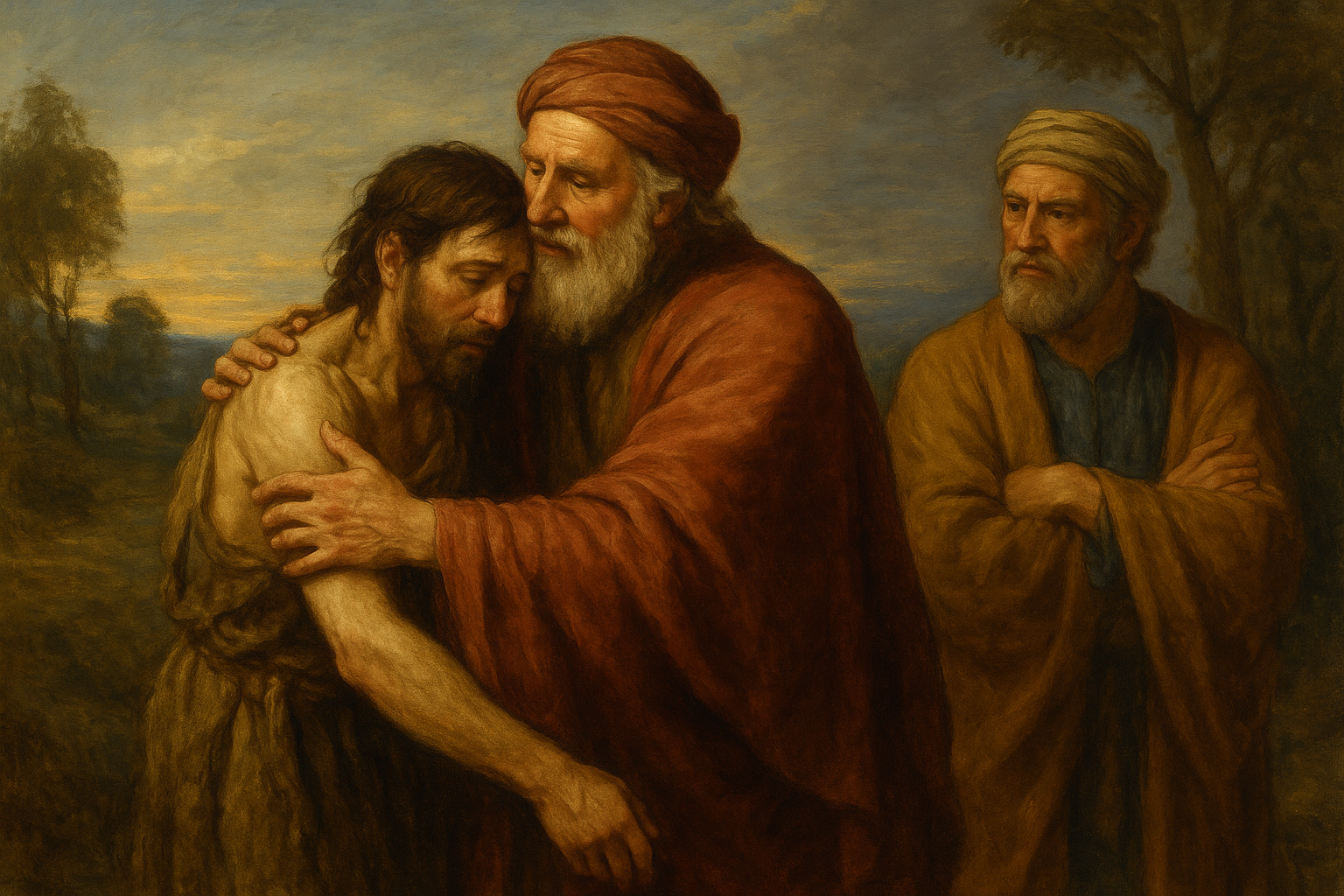
    When most Christians hear the parable of the prodigal son, they hear a salvation story. A sinner “runs away from God,” squanders his life, hits rock bottom, and finally comes home. The father runs to meet him, embraces him, and restores him. It’s a moving picture of God’s mercy toward repentant individuals. And that’s true—as far as it goes.

    But if we stop there, we risk flattening Jesus’ parable–of removing the context which makes it unique. In reality, this parable is much more deeply rooted in Israel’s covenant history, in Jesus’ ministry to His own people, and in His confrontation with the Pharisees.

    The Setting: Jesus vs. the Pharisees

    Luke 15 begins with a specific confrontation: “Now the tax collectors and sinners were all drawing near to hear him. And the Pharisees and the scribes grumbled, saying, ‘This man receives sinners and eats with them’” (Luke 15:1–2).

    That context matters–Pharisees and scribes upset that Jesus was fellowshipping with rebelling Jews (tax collectors and “sinners”). Jesus tells three parables in response—the lost sheep, the lost coin, and finally the lost son(s). Each ramps up the stakes, from an animal to money to a child. These aren’t random stories about “people getting saved.” They are a direct rebuke of the Pharisees’ attitude toward the “sinners”–fellows Israelites–Jesus was welcoming.

    As N. T. Wright puts it, these parables are not just timeless truths; they are part of Jesus’ campaign, his urgent summons to Israel to come back from exile, to come back to God (Jesus and the Victory of God, p. 127).

    The Prodigal As Israel’s Outcasts

    With this context in view, the parable begins to take shape. The younger son doesn’t represent generic pagans (i.e. Gentiles). He represents those Israelites who had squandered their covenant inheritance—tax collectors, prostitutes, and “sinners” who had abandoned Torah life. They were still sons of the house—Jews—but estranged.

    This mirrors the prophets’ language. Hosea 11:1–4 describes Israel as God’s son, called out of Egypt, yet turning to idols. Deuteronomy 32:18–20 speaks of Israel as a “faithless son” who forgot his Father. The imagery is covenantal, not merely personal.

    Kenneth Bailey, who spent decades teaching in the Middle East, points out that the younger son’s actions—demanding the inheritance early, leaving the family, and wasting it among the nations—fit the Jewish picture of Israel’s wayward children, those who had broken faith with the covenant community (Poet and Peasant, pp. 162–165).

    When the prodigal returns, broken and repentant, the father’s extravagant welcome mirrors what God was doing through Jesus: embracing the covenant outsiders and restoring them as true sons.

    The Older Brother As The Pharisees

    The older brother, meanwhile, embodies the Pharisees and the established religious system. He insists on his obedience, claims merit, and resents grace.

    This, too, has strong covenant echoes. Malachi 1:6–7 shows Israel complaining about God’s treatment, despite their “service.” The older brother is not unlike Israel’s leaders who saw themselves as faithful but refused to rejoice in God’s mercy.

    Craig Blomberg observes that the climactic point of the parable lies not with the prodigal’s repentance but with the elder brother’s refusal to rejoice over the restoration of his sibling (Interpreting the Parables, p. 170).

    The Parable As Israel’s Story

    Read this way, the parable isn’t just about how an individual gets saved. It’s about who truly belongs to Israel. Jesus is redefining the family of God around repentance and mercy, not self-righteousness and pedigree.

    N. T. Wright makes this point sharply: “The return of the prodigal is the return of Israel from exile. But the refusal of the elder brother shows that Israel’s leaders do not want to share in the joy of God’s kingdom” (Jesus and the Victory of God, p. 128).

    The prodigal son is Israel’s story, not ours.

    Why It Still Matters For Us

    Of course, the parable still speaks to individuals. Yes, the parable still speaks to the Church. Every Christian can identify with the prodigal’s repentance and the Father’s embrace. Any church can fall into the older brother’s resentment. But when we recover the Jewish covenantal frame, the story becomes sharper and richer.

    It reminds us that God’s kingdom is not about preserving status or merit, but about rejoicing when the lost return. It’s about restoration and reconciliation. It challenges us to ask: Are we more like the Father, eager to welcome, or more like the older brother, resentful when grace offends our sense of order?

    To be continued in Part 2: The Prodigal Son and Calvinism

  • From Servants and Citizens to Sonship

    From Servants and Citizens to Sonship

    Sometimes, I allow myself to simply sit in silence.” That is a sentence you will rarely if ever hear me say, and my wife will strongly attest to that. However, this week when driving back from our EPC General Assembly, I finished an audio-book, couldn’t find one something else interesting, and just sat in silence for a while. And it is often in those moments that my brain becomes creative. Allow me to share something that I am still processing through, but occurred to me regarding the Parable of the Prodigal Son (Luke 15:11-32).

    We all know the parable well: the younger son demands his inheritance, squanders it on worldly pleasures, and then—after hitting rock bottom—returns to his father, hoping to be admitted as a servant. But upon arrival, his father embraces him, clothes him, and celebrates with the fattened calf. The mercy and forgiveness demonstrated here is unimaginable. But the older son, the one who remained and worked faithfully for his father, is upset—how could the father celebrate such a squandering failure of a son? When confronted with this, the father responds, “‘Son, you are always with me, and all that is mine is yours. It was fitting to celebrate and be glad, for this your brother was dead, and is alive; he was lost, and is found.’”

    Most commentators recognize three distinct figures in this parable. The first is the father, who represents God the Father, who forgives and redeems. The second is the older son, who represents the Jews/Pharisees, or perhaps the faithful Christians, who have remained with the Father, but cannot find joy when a sinner repents. The third is the prodigal, the one who squandered everything, representing either the Gentiles or a rebellious Christian, and comes to his senses. But these three figures are actually not the focus of this article—instead, I am thinking about the other two groups of people mentioned in the parable—have you ever noticed them?

    The Servants
    The first group I want to point out are the servants—these are the ones who prepare the feast, the ones whom the prodigal thought he could join upon his return. These servants might represent the angelic hosts—the servants of the Most High celebrating when a sinner is saved (Luke 15:7). This would certainly make sense. But I want to suggest that they might represent another group of people: the visible church. The visible church is all of those that are outwardly part of the Christian faith, but not so inwardly—they haven’t truly been adopted as sons, though they are present at all the family reunions. In this parable you have these servants hanging around, helping out, serving, claiming the Father as their master—but not the title of sons.

    Now consider the prodigal son: hoping to return as one of these servants. Friends, how many people do we know who have been steeped in sin—at their breaking point, wallowing in misery—look to the church as something that they are unqualified to embrace yet deeply knowing they need it? Thinking that their sin is too great for adoption into the family of God, too awful ever be truly forgiven. or, maybe they simply aren’t convinced that this family isn’t that special, not not sure it’s worth digging in deeper. Either way, this group finds themsleves on the outsides of church life—they may show up, they may watch online, but the idea of God’s mercy being enough to cover their sins is more than they could hope for, or maybe simply uneccesary. This community, this fellowship isn’t for them in its fullness.

    We all have these people in our churches. We all have members of the visible church, serving alongside us as times, participating in the party at times, but not yet adopted as sons. When a prodigal son returns to your flock, to your church body, how often do we approach those yet to be adopted, those yet to embrace God’s mercy, those struggling to see the full value of this family, and show them that Jesus’ blood is good enough, rich enough, worth enough to move them from outside the family to sonship and inheritance in Christ, just like that prodigal? That’s the first neglected group in the parable.

    The World
    The second group neglected in this parable is the “citizen” mentioned in verse 15. This is the man for whom the prodigal agreed to work when his wealth was depleted. He represents, I suggest, the world. Consider this: when a prodigal returns to the faith, why does the world he left think? What does the world think he left behind or sacrificed in the process? Does the world think he’s groveling back to be a slave, or that he is being embraced in the goodness of the Father? I guess the question is: Are we using this as an opportunity to go into the vacancy he left and tell the story of how the prodigal was restored beyond his wildest imagination by the great mercy of the Father? Do we tell them that the Father has robes, rings, and fattened calves for them too, if only they would abandon the filth in which they wallow?

    You see, we typically focus on the main characters, as we rightly should: the Father, the older son, and the prodigal son. But I think we sell ourselves (and the story) short if we stop there. Friends, if we miss the opportunity to lead the visible church into the invisible church (sonship), and we forgo the chance to bring the world to the Father, we have neglected to use a tremendously powerful example of the Gospel of Jesus–we’ve failed to apply the testimony of God’s goodness to their prospective spheres.

    Here’s the challenge: Let the prodigal son’s return be a tool with which we call servants and citizens to the Father, and to sonship through Jesus Christ.