Category: Theology

  • From Abel to Zechariah: The Two Witnesses and the Covenant Lawsuit Against Jerusalem

    From Abel to Zechariah: The Two Witnesses and the Covenant Lawsuit Against Jerusalem

    Introduction

    The identity of the two witnesses in Revelation 11 has long intrigued readers and scholars. Are they literal figures from Israel’s history—perhaps Moses and Elijah, or Enoch and Elijah—returned to the stage of redemptive history? Or are they symbolic representations of the Church, the Law and the Prophets, or the faithful community? In the swirl of interpretations, one striking possibility has received less attention: the idea that the two witnesses represent Abel and Zechariah, the first and last martyrs of the Old Testament period, as identified by Jesus in Matthew 23:35. This study reexamines the identity of the two witnesses in Revelation 11, suggesting they represent Abel and Zechariah as symbolic figures in a covenantal indictment.

    In this article, I argue that the two witnesses symbolize these two prophetic martyrs, not as resurrected individuals but as archetypal figures. Their witness is not merely individual but covenantal—bearing testimony to God’s justice in the face of Israel’s long history of persecuting the prophets. This reading finds strong support in Jesus’ words to the religious leaders of His day, when He says that all the righteous blood shed on earth—from Abel to Zechariah—would come upon that generation (Matt. 23:35–36).

    When viewed through the partial-preterist lens, which understands much of Revelation as a prophetic vision of events leading up to the destruction of Jerusalem in 70 A.D., this identification makes theological and narrative sense. Revelation 11 becomes part of a larger covenantal lawsuit against Israel, one that began with the first blood shed (Abel) and culminated in the martyrdom of Zechariah. The two witnesses stand as the final testimony against the “great city… where their Lord was crucified” (Rev. 11:8)—a city ripe for judgment.

    Matthew 23:35 and the Arc of Prophetic Martyrdom

    In Matthew 23, Jesus delivers one of the most sobering pronouncements of judgment in the New Testament. Speaking to the scribes and Pharisees, He unveils a scathing indictment of Israel’s history of killing the prophets and rejecting God’s messengers. The climax comes in verses 34–36:

    “Therefore I send you prophets and wise men and scribes, some of whom you will kill and crucify, and some you will flog in your synagogues and persecute from town to town, so that on you may come all the righteous blood shed on earth, from the blood of righteous Abel to the blood of Zechariah the son of Barachiah, whom you murdered between the sanctuary and the altar. Truly, I say to you, all these things will come upon this generation.” (Matt. 23:34–36, ESV)

    Here, Jesus frames Israel’s history of prophetic martyrdom as a unified witness—a long chain of testimony that condemns the covenant people’s rebellion. Abel, murdered by his brother Cain (Gen. 4:8), is recognized as the first martyr. Zechariah—likely Zechariah son of Jehoiada,1 murdered in the temple court during the reign of King Joash (2 Chron. 24:20–22)—is presented as the last in the Hebrew canon’s historical order (Genesis to Chronicles).

    The phrase “from Abel to Zechariah” functions as a literary merism, covering the entire span of Old Testament prophetic witness. And notably, Jesus says that this generation—the very one He was addressing—would bear the consequences. In partial-preterist interpretation, this statement refers directly to the judgment that fell on Jerusalem in 70 A.D., when the temple was destroyed and the Old Covenant order decisively ended.

    In this context, Abel and Zechariah are more than individual martyrs; they represent the cumulative indictment of a nation that rejected God’s messengers. It is precisely this legal and prophetic function that links them to the two witnesses of Revelation 11. Jesus sets the interpretive framework: these two martyrs stand for the righteous blood that calls for justice and precedes divine judgment.

    Revelation 11: The Two Witnesses and the Judgment on Jerusalem

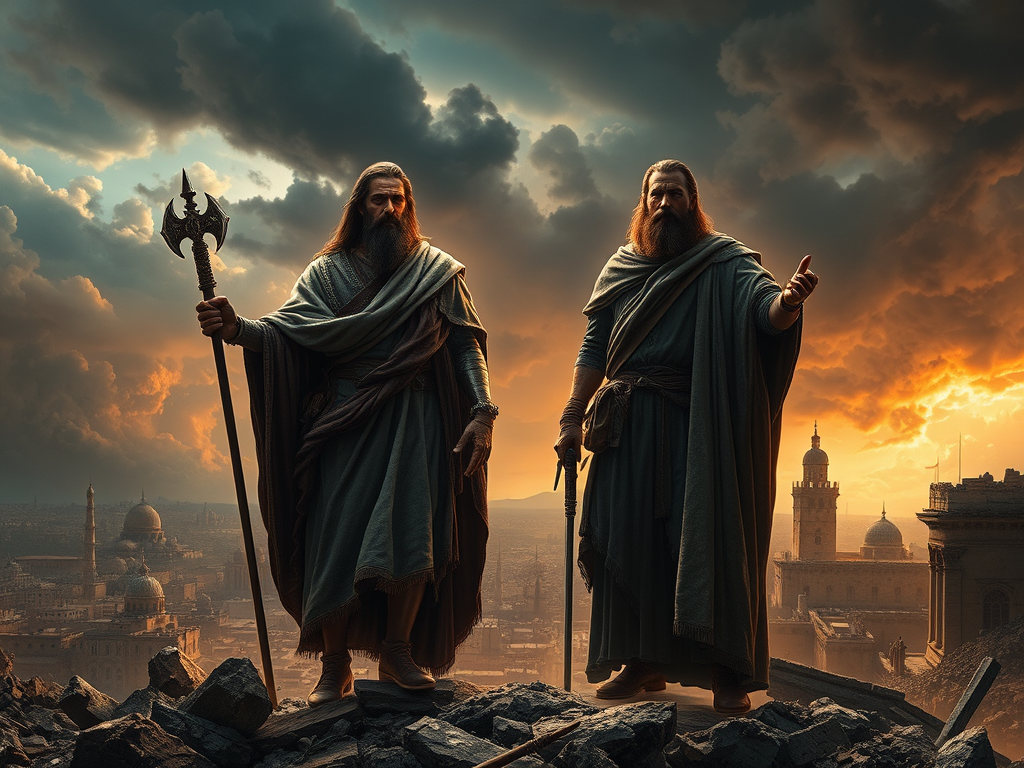
    Revelation 11 introduces two mysterious figures—“my two witnesses”—who prophesy for 1,260 days, clothed in sackcloth.2 Their ministry is powerful, echoing the deeds of Moses and Elijah. They are described as “the two olive trees and the two lampstands that stand before the Lord of the earth” (Rev. 11:4), a clear allusion to Zechariah 4. After their testimony, they are killed by “the beast that rises from the bottomless pit,” and their bodies lie unburied in “the great city that is symbolically called Sodom and Egypt, where their Lord was crucified” (Rev. 11:7–8).

    That final phrase—“where their Lord was crucified”—grounds the setting in Jerusalem. And Jerusalem, in the partial-preterist reading, is not just the geographic location but the theological centre of covenant unfaithfulness. Just as Jesus indicted the city for killing the prophets (Matt. 23:37), Revelation dramatizes the consequences of that history in apocalyptic terms.

    The witnesses are eventually resurrected and ascend to heaven, vindicated before the watching world. Their deaths trigger a great earthquake and the destruction of a tenth of the city, a symbolic sign of divine judgment. This is not the fall of Rome or the end of the world—it is the judgment Jesus predicted would come upon “this generation” (Matt. 23:36).

    Here, Abel and Zechariah emerge as fitting symbolic identities for the two witnesses. They are not literal individuals returned to earth but archetypes of prophetic martyrdom. Just as their blood cried out to God (cf. Gen. 4:10; 2 Chron. 24:22), so the two witnesses in Revelation bear testimony against the covenant-breaking city. Their ministry, death, and resurrection encapsulate the story Jesus told in Matthew 23: a long history of rejected messengers, culminating in divine wrath.

    The Legal Function of Witnesses: Covenant Testimony and Judgment

    In biblical law, the testimony of two or three witnesses was required to establish a legal case (Deut. 19:15). This principle is echoed throughout both Testaments and provides the foundation for understanding the symbolic function of the two witnesses in Revelation 11. They are not simply prophets; they are legal agents, bearing witness in a covenant lawsuit against an unfaithful people.

    Within this legal framework, Abel and Zechariah serve as the first and final witnesses of the Old Covenant era. Abel’s blood “cries out from the ground” (Gen. 4:10), and Zechariah’s dying words were a plea for justice: “May the LORD see and avenge!” (2 Chron. 24:22). Their blood forms a bookend to Israel’s prophetic history—a continual testimony that reaches its climax in the generation of Jesus and the apostles.

    By identifying the two witnesses of Revelation 11 with Abel and Zechariah, we interpret their ministry as part of this legal and prophetic continuum. Their deaths are not merely tragic—they are judicial. They complete the testimony of the prophets, and their vindication signals that the case against Jerusalem is closed. Judgment follows.3

    This identification does several important things:

    1. It reinforces the unity of Scripture. Jesus’ words in Matthew 23 and the vision of Revelation 11 speak the same language: the blood of the prophets bears witness against Jerusalem, and God is not blind to it. The prophetic voice—beginning with Abel and ending with Zechariah—finds its final echo in the two witnesses. Revelation is not introducing a new message; it is confirming what Jesus already declared.
    2. It makes sense of the timing. Jesus explicitly said that “all these things will come upon this generation” (Matt. 23:36). The partial-preterist view takes Him at His word. The events of Revelation 11—particularly the judgment on the “great city where their Lord was crucified”—finds fulfilment not at the end of history, but within history, in the destruction of Jerusalem. Abel and Zechariah, as archetypal witnesses, testify to this judgment.
    3. It honours the covenantal structure of biblical revelation. Throughout the Bible, God brings judgment only after repeated prophetic warnings. Abel and Zechariah, as the beginning and end of the prophetic line, embody this divine patience. Their resurrection in Revelation 11 symbolizes the vindication not only of their own testimony, but of the entire faithful remnant under the Old Covenant.
    4. It deepens the significance of Christ’s ministry. Jesus did not merely warn of judgment; He located it in a long history of martyrdom. By invoking Abel and Zechariah, He made clear that His generation stood at the tipping point of covenant history. Revelation 11, by recalling this imagery, underscores that same truth: Christ was not only crucified in Jerusalem—He was the final Prophet, and those who rejected Him rejected the whole prophetic witness.4

    Conclusions and Response to Counterarguments

    The identification of the two witnesses in Revelation 11 as Abel and Zechariah offers a cohesive, theologically rich interpretation that aligns with Jesus’ own words in Matthew 23 and fits naturally within a partial-preterist reading of Revelation. These two figures, as the first and last martyrs of the Old Covenant era, represent the fullness of Israel’s rejection of God’s messengers. Their prophetic ministry, death, and vindication reflect the pattern of covenantal faithfulness met with hostility, culminating in divine judgment on Jerusalem in 70 A.D.

    By seeing Abel and Zechariah as symbolic, collective figures—embodying the witness of the faithful rather than acting as literal resurrected individuals—we preserve the prophetic, literary nature of apocalyptic imagery while rooting it firmly in biblical history and theology.

    Response to Counterarguments

    1. “The two witnesses must be Moses and Elijah, or Enoch and Elijah.” These figures are often chosen because they performed similar miracles or were taken up without dying. However, Revelation 11 is symbolic, not literalistic. Abel and Zechariah better match the thematic focus on martyrdom, covenant witness, and judgment—precisely the themes Jesus emphasized in Matthew 23.
    2. “Zechariah’s identity is unclear—Jesus may be confusing the son of Jehoiada with Zechariah son of Berechiah.” While Matthew 23 refers to “Zechariah son of Barachiah,” the context more strongly fits Zechariah son of Jehoiada, who was murdered in the temple (2 Chron. 24:20–22). This fits the narrative flow of Jesus’ indictment, which spans from Genesis to Chronicles—the full arc of the Hebrew Bible. The textual ambiguity does not undermine the theological point: Jesus is summarizing the full history of prophetic martyrdom.
    3. “The two witnesses symbolize the Church, not individuals.” Indeed, many scholars view the witnesses as a symbol of the Church’s prophetic role, serving the role of faithful testimony as two or more witnesses. But Abel and Zechariah can function in the same symbolic capacity: not merely as individuals, but as representative archetypes—the faithful who speak for God and suffer for it. Their identification doesn’t exclude corporate symbolism; it deepens it by anchoring it in redemptive history.

    Final Thoughts

    If Revelation is a covenantal document, as the partial-preterist interpretation holds, then its visions must be understood in the context of covenant history. The witness of Abel and Zechariah—like the ministry of Christ—marks the end of an era. Their prophetic blood cries out, not only from the ground, but from the pages of Scripture, testifying to a generation that stood on the brink of judgment. And in Revelation 11, God answers their cry for justice.

    Footnotes

    1. Admittedly, there is a significant textual concern for this argument which depends upon which Zechariah Jesus is referencing. Some scholars argue that “son of Barachiah” may be a scribal error or oral conflation. It’s possible that a copyist accidentally inserted the name Barachiah, perhaps confusing him with Zechariah the prophet, the author of the book of Zechariah (Zech. 1:1), who was the son of Barachiah—but was not martyred. The manner and location of the death (“between the sanctuary and the altar”) precisely matches the temple setting described in 2 Chronicles 24, where the Zechariah son of Jehoiada was martyred. Even if, however, “Barachiah” was included by Jesus, it’s possible He was blending identifiers to make a larger typological point (as He sometimes does), referencing a figure whose martyrdom exemplifies Israel’s long rejection of the prophets. It is worth noting, some ancient versions and manuscripts (including Syriac and some early patristic sources) omit “son of Barachiah.” This may suggest that the reference to Barachiah was not original but a later addition to clarify or harmonize. ↩︎
    2. These 1,260 days align nicely with the siege of Jerusalem from 66-70 AD: from the beginning of the Jewish Revolt in 66 AD to the fall of the city in 70 AD. It’s important to note that the Christians, heeding the prophecy of Jesus in Matthew 24:15-16, fled Judea and Jerusalem before the “abomination of desolation” could destroy them out as collateral damage along with the rebelling Jewish population. ↩︎
    3. A possible support for this theme would be the parable of the wicked tenants, who reject the messengers of the vineyard owner, eventually killing the master’s son. Their punishment would be death and a passing of the vineyard to those who are worthy (Matthew 21:33-46; Mark 12:1-12; Luke 20:9-19). ↩︎
    4. Again, see the parable of Wicket Tenants: Matthew 21:33-46; Mark 12:1-12; Luke 20:9-19 ↩︎
  • Always Reforming: Eschatology and the Call of Scripture

    Always Reforming: Eschatology and the Call of Scripture

    “Ecclesia reformata, semper reformanda secundum verbum Dei”—

    “The church reformed, always being reformed according to the Word of God.”

    This ancient-sounding phrase didn’t come from the 16th-century Reformers themselves, but it has become one of the most enduring expressions of the Reformed tradition. It captures a critical and humbling reality: even a theologically “reformed” church is always in need of further reformation—not according to cultural trends or human systems, but according to the Word of God.

    The Origin of the Phrase

    The phrase semper reformanda—”always reforming”—originated not with Luther or Calvin, but with Jodocus van Lodenstein, a 17th-century Dutch Reformed pastor associated with the Nadere Reformatie (“Further Reformation”) movement in the Netherlands. He saw that while the Reformation had recovered much biblical truth, the hearts and lives of God’s people were still in need of reform. His cry was not for doctrinal innovation but for personal and corporate sanctification rooted in Scripture.

    Over the centuries, this phrase has been both treasured and misused. In some contexts, it has been distorted into a license for constant novelty or theological deconstruction. But rightly understood, semper reformanda calls us to a deeper, more faithful submission to Scripture. It urges us to return again and again to the Bible—to let God’s Word reform our hearts, our practices, and yes, even our theological systems.

    Letting Scripture Reform Our Eschatology

    This brings us to a present concern: eschatology—our doctrine of the last things. In many Christian circles today, particularly in the American context, dispensationalism has become the default (and often unknowingly adopted) framework for understanding prophecy, the end times, and Israel. It is presented as biblical, sometimes even as the only faithful way to read the Bible. But dispensationalism, as a system, is relatively recent, emerging in the 19th century through figures like John Nelson Darby and gaining popular traction through the Scofield Reference Bible and later popular media.

    Here’s the danger: whenever we inherit a fully-formed system—whether dispensational, amillennial, postmillennial, or otherwise—we are tempted to fit the text of Scripture into our eschatology, rather than letting Scripture shape or challenge our views. We run the risk of reading the Bible through the lens of our system, instead of submitting our system to the scrutiny of the Bible.

    This is not a problem unique to dispensationalism; it’s a human problem. But it becomes especially pressing when one system becomes dominant in popular teaching and church culture.

    But the Reformed tradition calls us to be always reforming. This means we must constantly bring our presuppositions and systems back to Scripture (Acts 17:11), testing all things and holding fast to what is good (1 Thessalonians 5:21).

    All Scripture is breathed out by God and profitable for teaching, for reproof, for correction, and for training in righteousness…” — 2 Timothy 3:16

    The sum of your word is truth, and every one of your righteous rules endures forever.” — Psalm 119:160

    If our theological system cannot bear that scrutiny, then it needs to be reformed. If it prevents us from hearing what Scripture clearly says, then it has become an idol.

    Always Reforming Means Always Submitting

    Semper reformanda reminds us that we must never hold our theological frameworks with greater authority than the text of Scripture itself. The moment we defend our views more fiercely than we test them, we’ve stopped reforming. The moment our eschatology becomes untouchable, we’ve replaced biblical authority with theological pride.

    A Reformed posture is not merely about affirming the Five Solas or the Westminster Standards. It’s about a heart that is always willing to be corrected by God’s Word, even when it costs us—especially when it costs us our comfort, our systems, or our traditions.

    Preaching the Whole Counsel of God

    Semper reformanda also means that we do not gloss over or ignore uncomfortable passages of Scripture. We are not free to mute the voice of God when it challenges our categories or unsettles our traditions. As Paul said to the Ephesian elders:

    I did not shrink from declaring to you the whole counsel of God.” — Acts 20:27

    Faithfulness requires preaching and teaching all of Scripture—not just the passages that align neatly with our frameworks. This includes difficult prophetic texts, apocalyptic literature, and themes of judgment and restoration. It means searching out the eschatological implications of the text and understanding how the original audience would have understood it. This is difficult and convicting work that challenge our presuppositions. However, pastors are not called to protect the flock from discomfort; we are called to form them by truth, even when that truth provokes hard questions or opposition (2 Timothy 4:2–4).

    Reforming Toward Christ

    Eschatology is not a secondary matter—it shapes how we view redemption, history, mission, suffering, and hope. But our views must be shaped by what the Bible actually says, not what our charts or traditions assume. Semper reformanda, therefore, is not about discarding tradition, but about testing it. Traditions can bolster, but not determine. Theological traditions let us know the company we keep–and it is important that we pay attention to such things. But semper reformanda, at the heart, is about being reforming people—not just reformed in name.

    Let us be committed to this: that our eschatology, like all our theology, stands under the judgment and light of Scripture. And where we find that we have built upon assumptions rather than exegesis, let us return—not to our comfort zones, but to the Word of God. For the church reformed is a church still reforming, under the gracious rule of Christ and the authority of His Word.

    Sanctify them in the truth; your word is truth.” — John 17:17

  • Understanding John 1:51: Jesus as Our Connection to Heaven

    Understanding John 1:51: Jesus as Our Connection to Heaven

    “And he said to him, ‘Truly, truly, I say to you, you will see heaven opened, and the angels of God ascending and descending on the Son of Man.’”

    John 1: 51

    Context

    The Gospel of John opens with a grand, cosmic prologue that introduces Jesus as the Word who was with God in the beginning and who is God (John 1:1-2). We are told that the Word is both Creator and life (John 1:3-4). This life shines through the darkness, and the darkness has not overcome it (John 1:4). It is with this cosmic and powerful prologue that John sets the stage for the entire gospel, presenting Jesus not just as a teacher or prophet but as the eternal Logos, the Word made flesh, who brings light and life to the world.

    In John 1:35-51, we see Jesus beginning to gather His first disciples. John the Baptist, having recognized Jesus as the “Lamb of God,” (John 1:29) points two of his own disciples to Jesus. These disciples, Andrew and an unnamed disciple, follow Jesus, and Andrew quickly brings his brother, Simon Peter, to meet Him. The next day, Jesus calls Philip, who then finds Nathanael and tells him that they have found the one “of whom Moses in the Law and also the prophets wrote, Jesus of Nazareth, the son of Joseph” (John 1:45).

    Nathanael is skeptical at first, famously asking, “Can anything good come out of Nazareth?” But when he meets Jesus, Nathanael is astonished at Jesus’ knowledge of him, even before they meet. Jesus tells Nathanael that He saw him under the fig tree before Philip called him, leading Nathanael to declare, “Rabbi, you are the Son of God! You are the King of Israel!” (John 1:49). Jesus responds to Nathanael’s confession of faith with the profound statement in John 1:51, indicating that Nathanael will see even greater things, specifically “heaven opened, and the angels of God ascending and descending on the Son of Man.”

    Exegetical Reflection

    The phrase “truly truly,” employed for the first time here in John’s Gospel, comes from the Greek words “amen amen.” The original Hebrew word for “amen” comes from a root denoting certainty and steadfastness. When someone other than Jesus says these words, it voices hearty agreement. But when Jesus, Creator of all things uses these words, they confirm and emphasize trustworthiness and importance. In other words, Jesus’ “truly truly” is more than hope, it is certainty.

    Devotional Reflection

    John 1:51 is a powerful and prophetic verse that echoes the story of Jacob’s ladder in Genesis 28:12, where Jacob dreams of a ladder stretching from earth to heaven with angels ascending and descending on it. In this dream, God reaffirms His covenant with Jacob, promising him land, descendants, and His continued presence. Jacob awakes and declares that the place is “the gate of heaven.”

    By referencing this story, Jesus reveals something extraordinary about His identity. He is the trueladder, the connection between heaven and earth, the mediator between God and humanity. The angels ascending and descending on the Son of Man signify that Jesus is the focal point of God’s activity in the world. He is the bridge through which God’s blessings flow to humanity and through which humanity has access to God.

    This revelation would have been staggering for Nathanael, and it remains profound for us today. Jesus is not merely a teacher or a prophet; He is the divine Son of Man, the one who opens the way to heaven. He is both Bethel, the House of God, and the pathway to heaven. In Him, the separation between God and man is bridged, and through Him, we have access to the fullness of God’s presence.

    Application

    In our daily lives, it’s easy to lose sight of the reality that Jesus is our connection to God. We may become consumed with the challenges and distractions of the world, forgetting that in Christ, heaven is open to us. This passage invites us to live with the awareness that Jesus is always with us, that He is our mediator and the one who brings the presence of God into our lives.

    Consider where you might feel distant from God or where you need His presence today. Remember that Jesus has already bridged the gap. The door to heaven is open, and through Jesus, you have direct access to God’s love, grace, and mercy. Take time today to thank God for the gift of Jesus, and ask Him to help you live with a greater awareness of His presence. Let this awareness shape your thoughts, actions, and interactions, knowing that you walk with the One who connects heaven and earth.

  • Christ’s Eschatological Work Against Tohu Wabohu

    Christ’s Eschatological Work Against Tohu Wabohu

    The typological connections between Christ and Adam have been well-observed and well-documented. Between G.K. Beale, Meredith Kline, N.T. Wright, and John Walton, the depths of the vast network of Jesus’ faithful Adamic administration have been plumbed. However, there appears to be one area in which Christ’s eschatological work seems not to be given the theological attention it deserves: Christ’s specific task of solving the problem of Tohu Wabohu.

    Tohu Wabohu are two Hebrew words that mean “formless” and “empty/void.” We see them appear in Genesis 1:1-2, “In the beginning, God created the heavens and the earth. The earth was without form and void, and darkness was over the face of the deep.” In the following creation narrative, YHWH will begin to form and fill his creation. On creation days 1-3, God forms the spaces (1–light/darkness, 2–sky/water, 3–land/vegetation). On days 4-6, God fills the spaces with inhabitants (4–sun/moon/stars, 5–birds/fish, 6–animals/humans). In doing so, God brings order out of chaos and prepares the world to reflect his glory.

    However, on day 6, God does something different: he delegates the filling to Adam. In Genesis 1:27-28 we read, “So God created man in his own image, in the image of God he created him; male and female he created them. And God blessed them. And God said to them, ‘Be fruitful and multiply and fill the earth and subdue it, and have dominion over the fish of the sea and over the birds of the heavens and over every living thing that moves on the earth.’” Adam and Eve were, in part, tasked with filling what is still Wabohu—empty. Adam, as God’s vice-regent, was to extend God’s order by filling the world with image-bearers who would reflect God’s glory. However, Adam failed—sin entered, bringing disorder (Tohu Wabohu) back into creation through death and corruption. Redemptive history would see Adam-like figures arising and trying to restore the pre-fall cosmic order—but never ultimately succeeding. Until, as Paul calls him, the Last Adam arrives (1 Corinthians 15:45).

    Just as Adam was to fill the earth with physical offspring, Jesus fills the new creation with spiritual offspring—His redeemed people. In John 14:1-2 Jesus tells his disciples, “Let not your hearts be troubled. Believe in God; believe also in me. In my Father’s house are many rooms. If it were not so, would I have told you that I go to prepare a place for you?” As Jesus prepares to face the cross and redeem the cosmos from chaos, he echoes God’s forming of the original creation. Jesus, as the divine Son, is shaping the “new heavens and new earth” where His people will dwell.

    After the resurrection, Jesus speaks to his disciples again, giving them a new mandate, “Go therefore and make disciples of all the nations” (Matthew 28:19). This mandate not only sees God’s glory extended throughout the fallen, physical realm but has eternal, spiritual implications. All disciples of Jesus will fill the heavenly place Jesus has prepared for them. The command for disciple-making is both a present and an eschatological fulfillment of the Adamic mandate to fill the earth.

    At the end of history, Revelation 21:1-3 shows the completed work—New Jerusalem descends, and God’s dwelling is with man: “Then I saw a new heaven and a new earth, for the first heaven and the first earth had passed away, and the sea was no more. And I saw the holy city, new Jerusalem, coming down out of heaven from God, prepared as a bride adorned for her husband. And I heard a loud voice from the throne saying, “Behold, the dwelling place of God is with man. He will dwell with them, and they will be his people, and God himself will be with them as their God.” Jesus, the Last Adam, has not only formed the eternal kingdom but has also filled it with His people.

    Adam’s charge was to bring continued glory to God’s formed world by filling it with image-bearers, but he failed. Jesus, the Last Adam, does not only fulfill the mandate perfectly, but he does something greater in redeeming fallen creation by:

    1. Preparing the eternal dwelling (forming the space).
    2. Filling it with His redeemed people (spiritual multiplication).

    Thus, Christ completes Adam’s mission more significantly, eternally, bringing the ultimate order out of Tohu Wabohu—a kingdom that will never be empty or formless again. However, Christ is not merely finishing Adam’s work but is achieving something radically greater—reconciling sinners to God through His atoning sacrifice and sovereign grace.

    Application of Christ’s Eschatological Day 6 Work
    The fact that Jesus completes the Tohu Wabohu (formless and void) pattern of Genesis has profound implications for the Christian life. If Jesus is the Last Adam who forms and fills the new creation, believers are called to participate in that work. Here is how this truth impacts Christian life and mission:

    1. A New Creation Identity: From Chaos to Order
      Before salvation, our lives mirror the Tohu Wabohu—formless, void, and filled with sin and disorder. However, “if anyone is in Christ, he is a new creation” (2 Cor. 5:17). Jesus does for us personally what God did in Genesis—He forms a new identity in us and fills us with His Spirit. This means:
    • We are no longer spiritually dead but filled with the life-giving presence of God.
    • Our lives are being reordered according to Christ’s image (Rom. 8:29).

    Implication: The Christian life is about allowing Christ to shape and fill us daily, submitting to His transformative work.

    1. Participation in the Great Commission: Filling the New Creation
      Just as Adam’s calling was to “be fruitful and multiply,” and Jesus commissioned His disciples to “make disciples of all nations” (Matt. 28:19), Christians are now part of this filling process.
    • Evangelism: Sharing the gospel brings people from spiritual Tohu Wabohu (chaos) into God’s kingdom and cosmic order.
    • Discipleship: Helping others grow in faith is part of God’s filling work.
    • Church Planting & Missions: Expanding God’s kingdom mirrors Adam’s original call to extend Eden.

    Implication: Every believer is involved in God’s mission—whether locally or globally—by bringing people into His new creation.

    1. Hope in Christ’s Ultimate Completion
      Jesus is preparing a place (John 14:2) and filling it with His people. This gives us hope in suffering because we know the story ends with a fully formed and filled creation in the New Heavens and New Earth (Rev. 21:1-3), and the promise: “Behold, I am making all things new” (Rev. 21:5). Thus:
    • We endure hardship knowing chaos will not last.
    • We labor for the kingdom, knowing our work contributes to eternal restoration.

    Implication: Christians live confidently, knowing God’s ultimate goal is not destruction but renewal.

    1. Holiness: Being a Dwelling Place of God
      Since Jesus is forming and filling His people, we must live in a way that reflects His new creation work. Paul says,” Do you not know that you are God’s temple and that God’s Spirit dwells in you?” (1 Cor. 3:16). As such:
    • The Spirit fills us just as God filled creation with life.
    • We must not return to Tohu Wabohu by living in sin (Eph. 5:18).
    • Our bodies, actions, and thoughts should reflect Christ’s order and holiness.

    Implication: Christians are called to live as Spirit-filled temples, reflecting God’s order in their daily lives.

    Final Thought: Living as Builders in God’s New World
    Since Jesus is both forming and filling the new creation, we are co-workers with Him (1 Cor. 3:9). This means:

    • Every act of faithfulness—parenting, teaching, serving, working—participates in Christ’s filling work.
    • Our labor is not in vain because it contributes to God’s eternal purposes (1 Cor. 15:58).

    Jesus’ completion of Tohu Wabohu is not just theological it is practical—it shapes our mission, identity, and hope as Christians. His eschatological day 6 work of multiplication and fulfillment of the full Adamic mandate should encourage the Christian and motivate the individual Christian’s role in the Great Commission—may we help fill the new heavens and new earth!

  • Understanding Joshua 1: Courage and Obedience

    Understanding Joshua 1: Courage and Obedience

    7 Only be strong and very courageous, being careful to do according to all the law that Moses my servant commanded you. Do not turn from it to the right hand or to the left, that you may have good success wherever you go. 8 This Book of the Law shall not depart from your mouth, but you shall meditate on it day and night, so that you may be careful to do according to all that is written in it. For then you will make your way prosperous, and then you will have good success.

    I’ve heard this passage preached more than you might guess. It is a common slogan, encouraging verse, and a call to bravery. Joshua’s call to courage is a common text used by youth conference speakers who are hoping to instill confidence to a room full of confidence-averse teenagers. And that is helpful as far as it goes. But the mistake is made when the application of this passage focuses on perseverance of action rather than steadfastness of thought.
    Don’t fear your upcoming football game—be strong and courageous.
    Be confident as you take your exams—be strong and courageous.
    Don’t be ashamed that people know that you are a Christian—be strong and courageous.
    What tends to happen is that Joshua 1:6-7 becomes the Old Testament version of Philippians 4:13, “I can do all things through him who strengthens me.” And while there may be nothing egregiously “wrong” with these applications, they fall short of driving to the heart of the text. Sometimes, (maybe even often!), our best intentions get in the way of dependable application. So, let’s briefly revisit this text and see what it communicates about courage.

    The Recipient

    The recipient of these verses isn’t Israel, its Joshua. Joshua was the man chosen by YHWH to follow in Moses’ footsteps. Can you imagine? I was once given a piece of wisdom from a friend, “Never follow a legend at a job.” We see this concept the clearest in the sports arena. What are the chances you will prove your worth if you follow Nick Saban at Alabama? Or Phil Jackson in Chicago or LA? Even if you manage to win a championship, at best you are simply as good as the last guy. You’ve reached the expectations–there is often nowhere to go but down. But here is Joshua, following the legend. You can imagine how he must have felt. Joshua’s emotions must have been all over the place. Remember, this isn’t something as trivial as a sports championship—in view is the life or death of a nation and Joshua is to lead the way.

    The Message

    The message to Joshua is clear: be strong and courageous. But this is where we tend to drift from the meaning of the text. The charge and encouragement isn’t “be strong and courageous in conquest” the charge is “be strong and courageous to do all the Torah that Moses my servant commanded you.” In other words, victory in conquest isn’t based upon courage in warfare, but courage to obey the Torah, the law.

    Do you see the subtle but important shift from how we normally understand this passage? Its not about passing the test, landing the job, winning the game, or even winning a war—even faithful Christians will often fail at all of these things. The message to Joshua is that having courage and strength isn’t about the conquest—its about obeying the Torah in the midst of the conquest. Its about what the conquest will cause you to think and do; its about how the conquest will tempt you. You see, what takes courage and strength isn’t the war, rather, its about obedience to God while fighting in the war.

    Application

    With these things in view, the application of Joshua 1:7-8 begins to take shape. The charge to Joshua is less about the war and more about how he reacts to the war. Strength and courage are judged upon obedience to God’s law, not the trials set before us. Strength and courage are not about conquest but obedience—if we get that backwards then life can become very confusing.

    Friends, the call for the Church is to recognize that sometimes Christians rule nations and sometimes we are food for lions. Regardless of the result, the paths are faced the same way: strength and courage to obey all of God’s commands.

  • Moses, the God of Israel?

    Moses, the God of Israel?

    10 Then Moses and Aaron gathered the assembly together before the rock, and he said to them, “Hear now, you rebels: shall we bring water for you out of this rock?” 11 And Moses lifted up his hand and struck the rock with his staff twice, and water came out abundantly, and the congregation drank, and their livestock. 12 And the Lord said to Moses and Aaron, “Because you did not believe in me, to uphold me as holy in the eyes of the people of Israel, therefore you shall not bring this assembly into the land that I have given them.” 13 These are the waters of Meribah, where the people of Israel quarreled with the Lord, and through them he showed himself holy. (Nu 20:10-13)

    I have often struggled with how to understand this passage. It is commonly interpreted by stating something along the lines of “YHWH demands to be kept holy, and Moses and Aaron (who knew this better than anyone) fell short. Their punishment was to die with the rebellious wilderness generation, never to enter the Promised Land.” There tends to be a focus on striking the rock instead of speaking to it, and discussions about whether striking the rock twice represented misplaced anger, a physical action when verbal was commanded, or something else. While I don’t believe these to be irrelevant issues, they do seem a bit petty, don’t they? They feel a little thin–a little lacking, a little bit of an abbreviated answer to a difficult dilemma, a leap from step A to step D. Striking a rock equals denial of entrance to the Promised Land? I’ve always had trouble connecting those dots. As my high school calculus teacher might have said: “I need to see some work here.” So, let’s show a little of the work.

    A Little About Moses

    Moses was faithful, let’s not forget that. Moses was faithful when no one else was–he opposed Pharaoh, interceded for a stiff-necked people, and often, stood alone in the gap for Israel. At one point, YHWH was willing to wipe out Israel and re-establish the chosen line with Moses and his seed (Ex. 32:11-14)—for someone so faithful, how does one failure deny him his most desired of experiences—entering the Promised Land? It doesn’t feel as if the punishment at Meribah fits the crime, nor does it feel as if we see a similar punishment to so faithful a servant anywhere else in Scripture.

    Two events in particular, this one in Numbers and the death of Moses in Deuteronomy, have been on my mind recently—probably due to a combination of studying in Deuteronomy, interest in the Old Testament, and a general love of Biblical Theology. And I have come to—I believe—a richer understanding of Moses’ sin and why YHWH punished him the way he did.

    From Mediator to Provider

    Moses states in verse 10, “Hear now, you rebels: shall we bring water for you out of this rock?” Of course, Moses could not bring water out of a rock—he knew that–but YHWH could and did, despite Moses’ arrogance. It is not Moses nor Aaron who had the authority or ability to achieve such a miracle. Thus, I argue that Moses’ sin was primarily one of idolatry–of elevating his self from mediator to provider. By asking if they (“we”) should bring forth water, Moses and Aaron elevated themselves from the roles of mediators between YHWH and Israel to providers for Israel. This is, in purest form, idolatry: establishing themselves as a source of provision for Israel. And while the people may have missed the subtle shift, YHWH, of course, recognizes the comment for what it was, and states that they failed to “uphold me as holy in the eyes of the people of Israel, therefore you shall not bring this assembly into the land that I have given them” (Num 20:12). YHWH was not upheld as holy (sacred)—Moses and Aaron elevated themselves in the eyes of Israel, categorizing themselves as providers and, in doing so, violated the 1st Commandment.

    The Bigger Picture

    That is the narrow view of the scene—Moses who was “like a god” before Pharaoh (Ex. 7:1)—made the mistake of elevating himself “like a god” before Israel. So, now, let’s “show our work” and see how this understanding of Moses’ sin connects the dots to the end of the Moses narrative. Look at Deuteronomy 3:23-28:

    23 “And I pleaded with the Lord at that time, saying, 24 ‘O Lord God, you have only begun to show your servant your greatness and your mighty hand. For what god is there in heaven or on earth who can do such works and mighty acts as yours? 25 Please let me go over and see the good land beyond the Jordan, that good hill country and Lebanon.’ 26 But the Lord was angry with me because of you and would not listen to me. And the Lord said to me, ‘Enough from you; do not speak to me of this matter again. 27 Go up to the top of Pisgah and lift up your eyes westward and northward and southward and eastward, and look at it with your eyes, for you shall not go over this Jordan. 28 But charge Joshua, and encourage and strengthen him, for he shall go over at the head of this people, and he shall put them in possession of the land that you shall see.’

    As Moses stands on the edge of the Promised Land, he is recounting to the people how he asked YHWH one more time to be able to enter the land, and the answer was a definitive “no.” Why was YHWH so firm and unrelenting in this punishment when he has been so forgiving and long-suffering with so many others? Had not Moses faithfully served after the events in Numbers 20, earning the blessing to die in the Promised Land? For some, this helps fuel the narrative that the God of the Old Testament is harsh and overly demanding. But I believe the bigger picture must include the nature of Moses’ sin at Meribah: idolatry.

    Moses and Aaron had elevated themselves to the status of gods before the people— “Must WE make water come from this rock?” On the edge of conquest, Israel is being sent into the land of promise with instructions to eliminate any and every form of idolatry in the land. This land was to be a holy land—a dwelling place for YHWH. It was sacramental: it was a means through which the presence of YHWH would abide with his chosen people, and as such, it was to be pure; purified upon entry, and kept pure of competing idols entering in. Moses, through his actions at Meribah, had elevated himself to a god-like status before the people—he was the one doing mighty wonders before their eyes. His sin had caused irreparable damage because Israel now saw him as a god.

    This may feel a little harsh or somewhat of an overstatement: surely not? A god? But, in Deuteronomy 4, Moses begins an exhortation to Israel, based upon his theological narrative re-telling the story of Israel’s history from Horeb (Sinai) to their second approach to the Promised Land. One of Moses’ major concerns was that Israel abstain from all forms of idolatry. Deuteronomy 4:15-31 are dedicated to warnings against idolatry. And right in the center of this section, we read:

    Furthermore, the LORD was angry with me because of you, and he swore that I should not cross the Jordan, and that I should not enter the good land that the LORD your God is giving you for an inheritance. 22 For I must die in this land; I must not go over the Jordan. But you shall go over and take possession of that good land. 23 Take care, lest you forget the covenant of the LORD your God, which he made with you, and make a carved image, the form of anything that the LORD your God has forbidden you. 24 For the LORD your God is a consuming fire, a jealous God.1

    Moses places his sin, the event that barred him from the Promised Land squarely in a passage warning against idolatry. We should not miss this: Moses never worshipped another god. Moses only worshipped YHWH unless, in a moment of anger and weakness, Moses’ pride allowed himself to elevate himself to god-like status before Israel. The placement of this event certainly adds credence to my argument.

    Add to this, the concern that YHWH took for Moses’ body. Look with me at Deuteronomy 34:1-6:

    Then Moses went up from the plains of Moab to Mount Nebo, to the top of Pisgah, which is opposite Jericho. And the Lord showed him all the land, Gilead as far as Dan, 2 all Naphtali, the land of Ephraim and Manasseh, all the land of Judah as far as the western sea, 3 the Negeb, and the Plain, that is, the Valley of Jericho the city of palm trees, as far as Zoar. 4 And the Lord said to him, “This is the land of which I swore to Abraham, to Isaac, and to Jacob, ‘I will give it to your offspring.’ I have let you see it with your eyes, but you shall not go over there.” 5 So Moses the servant of the Lord died there in the land of Moab, according to the word of the Lord, 6 and he buried him in the valley in the land of Moab opposite Beth-peor; but no one knows the place of his burial to this day.

    Also, consider a non-canonical Hebrew tradition that comes from a document called “The Assumption of Moses.” Here, Joshua is speaking after realizing that Moses will not lead the people into the Promised Land:

    5. And now what place will receive thee? 6. Or what will be the sign that marks (thy) sepulchre? 7. Or who will dare to move thy body from thence as a man from place to place? 8. For all men when they die have according to their age their sepulchres on earth; but thy sepulchre is from the rising to the setting sun, and from the south to the confines of the north: all the world is thy sepulchre. 9. My lord, thou art departing, and who will feed this people? 10. Or who is there that will have compassion on them and who will be their guide by the way? 11. Or who will pray for them, not omitting a single day, in order that I may lead them into the land of (their) forefathers? 12. How therefore am I to control this people as a father (his) only son, or as a mistress (her) virgin daughter, who is being pre- pared to be handed over to the husband she will revere, while she guards her person from the sun and (takes care) that her feet are not unshod for running upon the ground. 13. And how shall I supply them with food and drink according to the pleasure of their will? 14. For of them there will be 600,000 men, for these have multiplied to this degree through thy prayers, (my) lord Moses.[1]

    In Deuteronomy 34:1-6, the specific burial place of Moses would be left mystery. According to the Assumption of Moses, the words placed in the mouth of Joshua convey a people who see no way forward without Moses. Dennis Olsen also sees this god-image in Moses, “Did Moses have to die outside the land as a reminder that he himself was not a god, an object of worship for the people? Moses’ death shifts Israel’s allegiance from a human like Moses to Yahweh, the true God of Israel.” These observations may not solidify the argument that Moses was seen as holding god-like status, but they definitely help us see how essential he was in the eyes of Israelite tradition, potentially becoming a crutch against Israel’s ability to fully depend on YHWH. Israel needed to trust YHWH without Moses—it was part of their development as a people of the Lord.

    With these things in mind, there is a good case to be made that the reason the body of Moses was unable to be found—the reason YHWH buried Moses in an unknown, unmarked location—was because Israel would worship him at his burial site. In other words, his grave would be seen as a talisman of sorts. We know the locations of the other patriarchs, even some of their wives. Moses is a significant figure to leave out. Later, Israel will worship the bronze serpent once raised up in the wilderness (2 Kings 18:4), all of Israel will whore after the ephod of Gideon (Judges 8), and let’s not forget the golden calf in Israel’s recent past (Exodus 32). As noted, it seems that Moses himself even alludes to the danger of his grave (or anything else) becoming a site of idolatry in Deuteronomy 4:22-24.

    Putting it all together.

    In putting it all together, here is what we can see:

    1. Moses elevated himself from mediator to provider, establishing himself as a god in the eyes of Israel. This was his sin of not upholding YHWH as holy: idolatry.
    2. The Promised Land was to be a land pure of idolatry—no idols could remain, and none could enter in. Thus, Moses must remain outside the Promised Land as a result of his self-disqualifying sin.
    3. In YHWH’s mercy, he allowed Moses to look into the land, but held firm to his judgment.
    4. YHWH then takes Moses’ life and buries him in an unknown location so that his body might not become a place of idolatry for Israel. 

    In summary, the sin of Moses was that he set himself up as a competitor with YHWH, directly violating the 1st Commandment: “You shall have no other gods before me.” And while this may not have been the intent, it was the reality—Israel had come to see Moses as a god, and Moses himself reinforced that perception at Meribah. Some sins have life-long and disqualifying repercussions—this was the case for Moses.

    Epilogue 

    But we are left with the question: does this make YHWH harsh? How has this perspective changed our view of YHWH or has it? Many have been forgiven for what seems like much worse transgressions—after all, wouldn’t David’s son Solomon (the result of David’s his marriage to Bathsheba) rule Israel? Let’s consider an intriguing (yet unproveable) idea:

    The Scriptures state that Moses died while still strong and able:

    So Moses the servant of the Lord died there in the land of Moab, according to the word of the Lord, and he buried him in the valley in the land of Moab opposite Beth-peor; but no one knows the place of his burial to this day. Moses was 120 years old when he died. His eye was undimmed, and his vigor unabated. (Dt. 34:5-8)

    Moses was clearly not a man on his deathbed. Why would YHWH “put him down” with so much vigor and youth still in his bones? Add to this that there are two and a half tribes remaining outside the Promised Land—Reuben, Gad, and half of Manasseh (Num. 33)—why couldn’t Moses have lived out the remainder of his life with them—close to the Promised Land, but not in it?

    If you consider the life of Moses, he really had two significant requests of YHWH. The first was to see the face of YHWH (Ex. 33:18-23), but the request was denied, “But,” he said, “you cannot see my face, for man shall not see me and live” (Ex. 33:20). The second request was to enter the Promised Land, and as we’ve seen, Moses disqualified himself from that possibility. But I believe that YHWH, in denying Moses the second request, gave Moses his first request: seeing the face of YHWH. I believe Moses died on the mountain because YHWH revealed his face to him out of sight of the people. Of course, as YHWH has already said, no man can live after seeing YHWH in his unveiled glory.

    And this becomes a beautiful end to the story of Moses: a sinful man longing to see God’s glory, to honor him, and to see others honor him. Of course, he falls short—we all do—and in a period of weakness, he fails to uphold God as holy, and misses out on seeing the fruit of his life’s work. His public sin disqualifies him. But YHWH is a merciful God who rewards his faithful servants—and while he must remain just, he offers Moses the first desire of his heart: to see the face of YHWH. So ends his life, so ends his work. Now, Israel must wait for another (Deuteronomy 18:15), who will be God himself, who can be both mediator AND provider, who will lead his people to the Promised Land where there will be no idolatry; who is worthy to be worshipped—but not worshipped at his grave, for he would overcome such a state—but in heaven after he defeats death. Israel must wait for Jesus Christ, the greater Moses, the only true and worthy god-man.


    [1] The Assumption of Moses, XI.5-14. Translated by R. H. Charles (London: Adam and Charles Black, 1897)


    [2] I am grateful to my friend Logan Mattox for adding another thought to this: “Israel really hadn’t trusted YHWH up to that point but had trusted Moses.”

    1. Deuteronomy 4:15-31 (ESV) ↩︎
  • From Servants and Citizens to Sonship

    From Servants and Citizens to Sonship

    Sometimes, I allow myself to simply sit in silence.” That is a sentence you will rarely if ever hear me say, and my wife will strongly attest to that. However, this week when driving back from our EPC General Assembly, I finished an audio-book, couldn’t find one something else interesting, and just sat in silence for a while. And it is often in those moments that my brain becomes creative. Allow me to share something that I am still processing through, but occurred to me regarding the Parable of the Prodigal Son (Luke 15:11-32).

    We all know the parable well: the younger son demands his inheritance, squanders it on worldly pleasures, and then—after hitting rock bottom—returns to his father, hoping to be admitted as a servant. But upon arrival, his father embraces him, clothes him, and celebrates with the fattened calf. The mercy and forgiveness demonstrated here is unimaginable. But the older son, the one who remained and worked faithfully for his father, is upset—how could the father celebrate such a squandering failure of a son? When confronted with this, the father responds, “‘Son, you are always with me, and all that is mine is yours. It was fitting to celebrate and be glad, for this your brother was dead, and is alive; he was lost, and is found.’”

    Most commentators recognize three distinct figures in this parable. The first is the father, who represents God the Father, who forgives and redeems. The second is the older son, who represents the Jews/Pharisees, or perhaps the faithful Christians, who have remained with the Father, but cannot find joy when a sinner repents. The third is the prodigal, the one who squandered everything, representing either the Gentiles or a rebellious Christian, and comes to his senses. But these three figures are actually not the focus of this article—instead, I am thinking about the other two groups of people mentioned in the parable—have you ever noticed them?

    The Servants
    The first group I want to point out are the servants—these are the ones who prepare the feast, the ones whom the prodigal thought he could join upon his return. These servants might represent the angelic hosts—the servants of the Most High celebrating when a sinner is saved (Luke 15:7). This would certainly make sense. But I want to suggest that they might represent another group of people: the visible church. The visible church is all of those that are outwardly part of the Christian faith, but not so inwardly—they haven’t truly been adopted as sons, though they are present at all the family reunions. In this parable you have these servants hanging around, helping out, serving, claiming the Father as their master—but not the title of sons.

    Now consider the prodigal son: hoping to return as one of these servants. Friends, how many people do we know who have been steeped in sin—at their breaking point, wallowing in misery—look to the church as something that they are unqualified to embrace yet deeply knowing they need it? Thinking that their sin is too great for adoption into the family of God, too awful ever be truly forgiven. or, maybe they simply aren’t convinced that this family isn’t that special, not not sure it’s worth digging in deeper. Either way, this group finds themsleves on the outsides of church life—they may show up, they may watch online, but the idea of God’s mercy being enough to cover their sins is more than they could hope for, or maybe simply uneccesary. This community, this fellowship isn’t for them in its fullness.

    We all have these people in our churches. We all have members of the visible church, serving alongside us as times, participating in the party at times, but not yet adopted as sons. When a prodigal son returns to your flock, to your church body, how often do we approach those yet to be adopted, those yet to embrace God’s mercy, those struggling to see the full value of this family, and show them that Jesus’ blood is good enough, rich enough, worth enough to move them from outside the family to sonship and inheritance in Christ, just like that prodigal? That’s the first neglected group in the parable.

    The World
    The second group neglected in this parable is the “citizen” mentioned in verse 15. This is the man for whom the prodigal agreed to work when his wealth was depleted. He represents, I suggest, the world. Consider this: when a prodigal returns to the faith, why does the world he left think? What does the world think he left behind or sacrificed in the process? Does the world think he’s groveling back to be a slave, or that he is being embraced in the goodness of the Father? I guess the question is: Are we using this as an opportunity to go into the vacancy he left and tell the story of how the prodigal was restored beyond his wildest imagination by the great mercy of the Father? Do we tell them that the Father has robes, rings, and fattened calves for them too, if only they would abandon the filth in which they wallow?

    You see, we typically focus on the main characters, as we rightly should: the Father, the older son, and the prodigal son. But I think we sell ourselves (and the story) short if we stop there. Friends, if we miss the opportunity to lead the visible church into the invisible church (sonship), and we forgo the chance to bring the world to the Father, we have neglected to use a tremendously powerful example of the Gospel of Jesus–we’ve failed to apply the testimony of God’s goodness to their prospective spheres.

    Here’s the challenge: Let the prodigal son’s return be a tool with which we call servants and citizens to the Father, and to sonship through Jesus Christ.

  • Consistency?

    Consistency?

    I was texting a good friend last night—we were discussing politics, sports, and sending goofy memes to each other (“mee-mee’s” as I heard one person call them). Whether it be sports, politics, inflation, or just life in general, we both came to the same conclusion: all we ask for in life is consistency—consistency in how we apply the law, how we apply logic, how we apply trust—consistency in how we apply our values to each other. In short, we were both expressing desires for a stable environment in which to be left alone and left to thrive. But, that’s a fairy tale, isn’t it?

    In the history of mankind being “left alone in a stable environment” has never really existed. Before the fall, Adam and Eve were not alone—YHWH was in the garden. After the fall, there was no longer any sense of a stable environment—Abel was murdered for simply worshipping God with his whole heart. The idea of a “stable environment” or “consistency” in life is simply not a reality in this fallen world. Sure, there are times in which it feels that way—seasons of life, whether that be nationally or locally, where life seems predictable and arranged. But we all know how quickly the rug can be pulled out from under us—an unexpected death, a car wreck, or sudden job loss. But beyond personal issues, on a larger scale we can be shaken by new legislation, elections, or wars (and rumors of wars). The reality is that the only consistency in life, the only stability is found in this fallen world IS inconsistency and instability—the ocean will always have waves. Sometimes the waves are big, sometimes, small; sometimes they are rogue, sometimes they settle to near stillness, and sometimes danger lurks beneath the surface. This uncertainty is one of the reasons that I believe that the ocean—or sea— features so prominently in Scripture.

    In the Old Testament, the sea (יָם, yam), is first introduced in Genesis 1:10, “God called the dry land Earth, and the waters that were gathered together he called seas. And God saw that it was good.” Moving forward in Scripture, we see that the sea represents chaos and de-creation—when YHWH judges the earth in Genesis 6, he does so by bringing the world back to its pre-created state—waters covering the face of the earth. As Scripture continues to unfold, the sea becomes more and more prominent as a metaphor for evil, often used in parallel with the term “deep” (תְּהוֹם, tehom) in biblical poetry, standing for primordial chaos, or the abyss. YHWH defeats cosmic enemies in the form of sea serpents or sea dragons (“Leviathan,” or “Rahab” in Job 41:4). Israel’s enemies are often seen in conjunction with sea, the armies of Pharaoh being swallowed up by them. Israel passed through the sea, through the Jordan, and we pass through water baptism. The sea means chaos and sin. Thus, a simple observation: if YHWH is control and cosmos, sin is lawlessness and chaos.

    Now, back to my text conversation with my friend: as we reflected on the world, we simply wanted consistency. But in that moment, like Peter on the raging sea, all we could identify was the continual rolling and breaking of the waves—the sea, the chaos of the deep.

    And through this, I was reminded of something last night: I actually do have consistency and stability—I just do not have it with the world. The consistency and stability that I have is found only in Christ, my rock and fortress, my ever present help in times of need. To look to the world for stability is to place my faith in something other than the redeeming work of Christ. Would political, financial, and peaceful stability be nice? Of COURSE it would, but that isn’t the norm in this fallen world, and “a predicatbale life” is not the norm for a Christian on this side of glory. The sea will continue to roll and neither you nor I can depend on it or expect it to do otherwise.

    So, what do we do? Like Christ, we all must learn to sleep in the boat buffeted by the waves, to collect firewood from asps when shipwrecked, and to know that the only consistency or stability for the Christian is Christ. If we keep thinking “that wave was the last one,” we are in for one confusing and discouraging journey.

  • A New Frontier for Local Missions?

    A New Frontier for Local Missions?

    One of the cornerstones of the Christian conviction is missions. Paul exhorts the church in Romans 10:14-15, “How then will they call on him in whom they have not believed? And how are they to believe in him of whom they have never heard? And how are they to hear without someone preaching? And how are they to preach unless they are sent? As it is written, ‘How beautiful are the feet of those who preach the good news!’” Christian conviction and mission conviction should go hand-in-hand.
    Money Numbers
    Annually, Christians spend around 32 billion dollars on missions. According to a 2019 survey, 61% of a church’s missions budget is spent on local missions, 20% on US missions, and 19% on international missions. This means that roughly 20 billion dollars are spent on local missions in the United States.
    People Numbers
    According to a 2020 Pew Research survey, in 1972, a staggering 90% of the US population claimed to be “Christian.” By 2020, that number had dropped to 64%, with a tremendous downward trend beginning in 1990. In 2021, a Gallup poll revealed that church membership in the US has fallen below 50%. Studies and trends project that less than 35% of the US population will claim the name of Christ by 2070. These numbers tell me two things:
    1. What we are currently doing is not working.
    2. Parents are losing their children to the world.

    A Factor
    I believe that one of the significant factors in the decline of Christianity in the US is influence. With the growth of technology and increased access to thoughts, people, and philosophies that influence our children at younger and younger ages, the church is losing the battle of catechizing their children. While that sounds like a wild, churchy, word, to “catechize” simple means “to instruct orally, make hear.” In other words, parents are being beaten to the oral instruction of the Gospel; they are unable to make their children hear the truths of the Scriptures because the children are already being instructed by and hearing another gospel.

    Who is doing the Catechizing?
    As a sad reality, the primary influence catechizing our children is found in the local schools. You do not have to look far to see not only anti-Christian agendas, often from the top down, but, even at “Christian” schools, our children are often surrounded by peers who have rejected the Gospel of Christ. And as parents, we are left with a couple of hours each day(at best!) attempting to counter the influence of the world upon our children—the influence in which they have been immersed for the past eight hours, five days per week (let’s not forget social media, etc!)

    A Radical Suggestion
    So, here is where this all ties together—the missions numbers, church stats, and discussion of influence: should the focus of local missions change? In other words, it is becoming abundantly clear that we are losing the battle for souls within our very own homes, not outside them. What does it say about the church when we are watching the souls of our children walk into darkness and embrace it, but focus instead on the soul of our neighbor? This may sound harsh, but there is a deep-seated truth to the reality that the Gospel worked primarily through the family unit for the majority of history—what does it mean when that is no longer the case? What does that say about our Christian homes, the priority of the family unit, and the focus of our discipleship?

    The bottom line is this: What would it look like if we reconsidered local missions spending and began allocating funds to help church members homeschool? Or, what if local missions looked like scholarships aimed at helping parents afford to send their children to Bible-grounded, Gospel-driven, Christian schools? What would it look like to support our church members so their mothers could remain home and raise children under the influence of the Gospel of Jesus, instead of whatever that daycare worker or teacher choose impresses upon them? What if local missions began focusing on our most vulnerable age group of pre or not-yet-Christians in our very midst? Friends, we must first take care of our own house. Unfortunately, the Christian church in the US is overwhelmingly failing to do this and the evidence is right before our very eyes.

    *A personal note: I have many good and godly friends who work in both private and public schools–both as administrators and as teachers. And while I do believe they work in some of the best remaining public and private schools, those environments are few and far between. For most public schools, there is often no ability to shield children from Christian homes from the influence of other children or non-Christian teachers. The curriculum is not composed to reinforce biblical ethics or morals–often it is in direct conflict with them. For those friends of mine who work in these environments: continue to fight the good fight!

  • Re-Hitch to the Old Testament

    Re-Hitch to the Old Testament

    In my seminary studies, I have come to appreciate the Old Testament more than I ever thought possible. Although I would not have admitted it before graduate school, I mostly treated the Old Testament as a history of the ancient world and the church. Let me clear, I believed it to be a true and accurate historical account, but outside of some mostly now-irrelevant prophecy and proverbial wisdom, not much else. However, all of that has changed.

    In 2018, mega-church pastor Andy Stanley stated that Christians need to “un-hitch” their faith from the Old Testament. In all fairness to Stanley, he also stated that the Old Testament is “divinely inspired,” but added that it shouldn’t be the go-to source for behavior in the church. While I have much to say on this, the point of this post is not necessarily to re-hash the Andy Stanley “un-hitch” statement, but to point to a deeper issue that I believe Stanley’s statement revealed: the perceived irrelevance of the Old Testament in the Christian church.

    While many Christians acknowledge that the Old Testament is the inspired Word of God, and that it must be something more than simply a history lesson, the average-Joe Christian struggles to articulate how this is so. Therefore, I want to offer ten reasons—though there are more—that the Old Testament should receive just as much of our attention as the New Testament.

    1. The Old Testament re-orients our minds to the main character of the Bible–God.

    2. The Old Testament reveals our purpose as humans.

    3. The Old Testament provokes in us wonder of God.

    4. The Old Testament places the fault for sin at our own feet.

    5. The Old Testament illuminates us to the state of our hearts.

    6. The Old Testament demonstrates our need for a Divine Deliverer.

    7. The Old Testament illustrates our propensity to wander.

    8. The Old Testament catalogues God’s faithfulness.

    9. The Old Testament introduces us to the Messiah.

    10. The Old Testament contains the moral law.

    After his resurrection, Jesus “beginning with Moses and all the Prophets, interpreted to them in all the Scriptures the things concerning himself” (Luke 24:27). In other words, Jesus used the Old Testament to explain who he is to his disciples. If we refuse to do the same, we are failing to imitate the Apostle Paul in declaring the “whole council of God” (Acts 20:27).