Author: WestonBlaha

  • The Prodigal Son: It’s Not About You (Or Me)—Part 1

    The Prodigal Son: It’s Not About You (Or Me)—Part 1

    This is Part 1 of a 3-part blog mini-series.

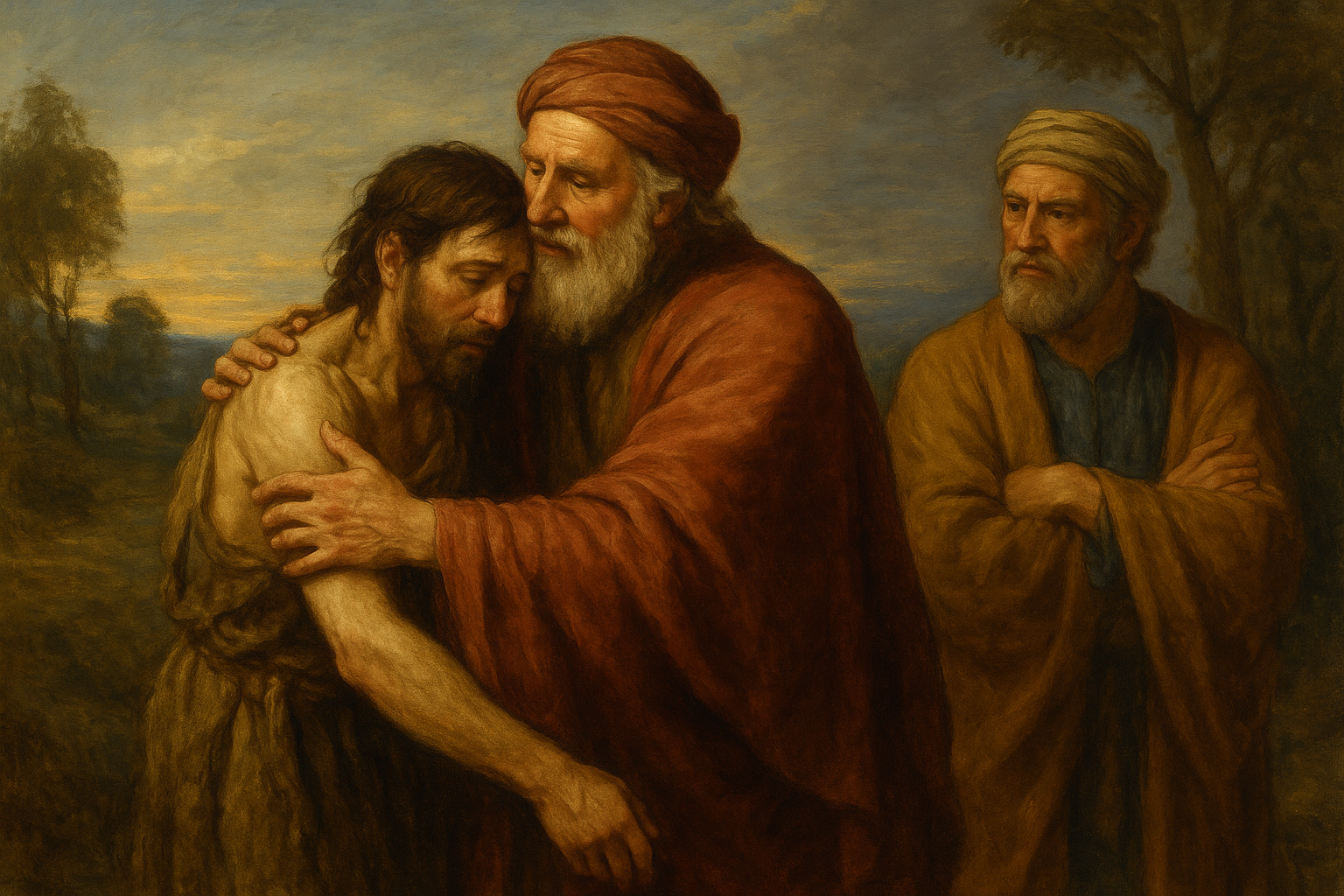
    When most Christians hear the parable of the prodigal son, they hear a salvation story. A sinner “runs away from God,” squanders his life, hits rock bottom, and finally comes home. The father runs to meet him, embraces him, and restores him. It’s a moving picture of God’s mercy toward repentant individuals. And that’s true—as far as it goes.

    But if we stop there, we risk flattening Jesus’ parable–of removing the context which makes it unique. In reality, this parable is much more deeply rooted in Israel’s covenant history, in Jesus’ ministry to His own people, and in His confrontation with the Pharisees.

    The Setting: Jesus vs. the Pharisees

    Luke 15 begins with a specific confrontation: “Now the tax collectors and sinners were all drawing near to hear him. And the Pharisees and the scribes grumbled, saying, ‘This man receives sinners and eats with them’” (Luke 15:1–2).

    That context matters–Pharisees and scribes upset that Jesus was fellowshipping with rebelling Jews (tax collectors and “sinners”). Jesus tells three parables in response—the lost sheep, the lost coin, and finally the lost son(s). Each ramps up the stakes, from an animal to money to a child. These aren’t random stories about “people getting saved.” They are a direct rebuke of the Pharisees’ attitude toward the “sinners”–fellows Israelites–Jesus was welcoming.

    As N. T. Wright puts it, these parables are not just timeless truths; they are part of Jesus’ campaign, his urgent summons to Israel to come back from exile, to come back to God (Jesus and the Victory of God, p. 127).

    The Prodigal As Israel’s Outcasts

    With this context in view, the parable begins to take shape. The younger son doesn’t represent generic pagans (i.e. Gentiles). He represents those Israelites who had squandered their covenant inheritance—tax collectors, prostitutes, and “sinners” who had abandoned Torah life. They were still sons of the house—Jews—but estranged.

    This mirrors the prophets’ language. Hosea 11:1–4 describes Israel as God’s son, called out of Egypt, yet turning to idols. Deuteronomy 32:18–20 speaks of Israel as a “faithless son” who forgot his Father. The imagery is covenantal, not merely personal.

    Kenneth Bailey, who spent decades teaching in the Middle East, points out that the younger son’s actions—demanding the inheritance early, leaving the family, and wasting it among the nations—fit the Jewish picture of Israel’s wayward children, those who had broken faith with the covenant community (Poet and Peasant, pp. 162–165).

    When the prodigal returns, broken and repentant, the father’s extravagant welcome mirrors what God was doing through Jesus: embracing the covenant outsiders and restoring them as true sons.

    The Older Brother As The Pharisees

    The older brother, meanwhile, embodies the Pharisees and the established religious system. He insists on his obedience, claims merit, and resents grace.

    This, too, has strong covenant echoes. Malachi 1:6–7 shows Israel complaining about God’s treatment, despite their “service.” The older brother is not unlike Israel’s leaders who saw themselves as faithful but refused to rejoice in God’s mercy.

    Craig Blomberg observes that the climactic point of the parable lies not with the prodigal’s repentance but with the elder brother’s refusal to rejoice over the restoration of his sibling (Interpreting the Parables, p. 170).

    The Parable As Israel’s Story

    Read this way, the parable isn’t just about how an individual gets saved. It’s about who truly belongs to Israel. Jesus is redefining the family of God around repentance and mercy, not self-righteousness and pedigree.

    N. T. Wright makes this point sharply: “The return of the prodigal is the return of Israel from exile. But the refusal of the elder brother shows that Israel’s leaders do not want to share in the joy of God’s kingdom” (Jesus and the Victory of God, p. 128).

    The prodigal son is Israel’s story, not ours.

    Why It Still Matters For Us

    Of course, the parable still speaks to individuals. Yes, the parable still speaks to the Church. Every Christian can identify with the prodigal’s repentance and the Father’s embrace. Any church can fall into the older brother’s resentment. But when we recover the Jewish covenantal frame, the story becomes sharper and richer.

    It reminds us that God’s kingdom is not about preserving status or merit, but about rejoicing when the lost return. It’s about restoration and reconciliation. It challenges us to ask: Are we more like the Father, eager to welcome, or more like the older brother, resentful when grace offends our sense of order?

    To be continued in Part 2: The Prodigal Son and Calvinism

  • The Telegraph, Technology, and the Birth of the Therapeutic Age

    The Telegraph, Technology, and the Birth of the Therapeutic Age

    Why Counseling Became Normal

    Why is it that therapy feels as normal today as visiting the dentist? It has not always been so. For most of history, people carried their burdens within family, village, and church, and grief was shared through rituals of mourning, prayer, and confession. Today, however, counseling has almost become a cultural necessity — a rite of passage for college students, an expectation for professionals, and a lifeline for many in a world of constant anxiety.

    This shift cannot be explained by psychology alone. The normalization of counseling correlates with the rise of technologies that overwhelmed us with global suffering. The crucial turning point came not with the internet or even television, but much earlier — with the telegraph. For the first time, human beings could know of calamities thousands of miles away almost instantly, but could do little about them. That gap — between knowledge and agency — produced an unbearable psychic burden. Counseling, in this view, is the social technology we cultivated to survive the information technologies we built.

    The World Before the Telegraph: Local Grief, Local Care

    Before the nineteenth century, news traveled at the speed of the horse or the ship. One might hear of a famine in a neighboring region or the death of a local soldier months after the event. Even wars were often distant rumors. The human nervous system was buffered by slowness.

    In such a world, pastoral and communal structures bore most of the weight of care. Families mourned together. Villages gathered around funerals. Churches provided ritual and language to interpret suffering. John Durham Peters puts it well: pre-modern communication was “situated and embodied.”1 One only bore the griefs one could touch.

    The Telegraph and the Collapse of Space-Time

    Samuel Morse’s invention of the telegraph in the 1840s changed this forever. Suddenly, distance collapsed: a death in Chicago could be reported in New York within hours, a war in Europe could be transmitted across the Atlantic before it was over.

    Neil Postman described this as the invention of “the peek-a-boo world.”2 The telegraph produced a flood of “news from nowhere, addressed to no one in particular, for no reason.”3 Information became detached from context. A local newspaper reader could now be daily confronted with tragedies they could neither avert nor alleviate.

    The result was a new kind of anxiety: the burden of awareness without agency. To know of suffering but be unable to respond is to feel the weight of helplessness. In this sense, the telegraph inaugurated the psychic conditions of the modern therapeutic age.

    From Telegraph to Television: Intensified Exposure

    If the telegraph shrank the world, radio and television immersed us in it. The Second World War was narrated in radio bulletins that reached millions simultaneously. The Vietnam War was fought in American living rooms through nightly broadcasts. Marshall McLuhan’s maxim that “the medium is the message”4 rang true: television didn’t just report suffering, it transmitted emotion.

    Daniel Boorstin warned in The Image that mass media created “pseudo-events” — spectacles that demanded attention without demanding action.5 Each medium intensified exposure, further straining the soul’s capacity to bear grief. By the mid-twentieth century, the average person was not simply a member of a community; they were a spectator to the world’s traumas. This spectator role came with no matching expansion of agency. Again, therapy stepped into the gap.

    The Internet and the Smartphone: Permanent Global Trauma

    If the telegraph brought distant grief into the newspaper, and television brought it into the living room, the smartphone brought it into the palm of the hand — and with it, into the bedroom, the dinner table, the morning commute, and the nightstand.

    The internet transformed information into a constant stream, and smartphones made it inescapable. A war in Ukraine, a wildfire in California, a famine in Sudan — each appears on the same screen as your sister’s wedding photos or your child’s soccer highlights. The world’s crises are collapsed into a single feed, integrated into the same emotional register.

    Sherry Turkle, in Alone Together, describes this paradox: we are hyper-connected, yet lonelier than ever.6 The cost of instant access is emotional exhaustion. Jean Twenge’s iGen goes further, showing a direct correlation between smartphone use and rising rates of anxiety and depression, particularly among teens.7

    The logic of the telegraph has reached its culmination. We not only know of distant grief, we live inside a world where grief is always “breaking.” The psychological result is an ambient anxiety that never resolves. In this climate, counseling ceases to be optional — it becomes a lifeline.

    Counseling as Surrogate for Human Limits

    What pastoral care once bore in local settings, counseling now bears for the globalized soul. Historically, the church provided the language, ritual, and communal solidarity to process suffering. But the church was never designed to carry the full freight of the globe’s pain — nor were families, nor villages.

    Charles Taylor, in A Secular Age, argues that modern life has produced a “buffered self” — an individual sealed off from cosmic and communal meaning, who must navigate crises largely alone.8 In that vacuum, therapy becomes not simply a treatment for mental distress, but a cultural infrastructure for survival.

    Therapy offers what traditional communal structures once did: a place to speak grief aloud, to make meaning out of suffering, and to be told that one is not alone. In a sense, the counseling office has become a secularized confessional booth, a ritual of unburdening in a world that has lost its rituals. This does not mean therapy is fraudulent. It means that therapy arose to meet a very real need: the human attempt to metabolize griefs we were never designed to carry.

    Conclusion: The Telegraph’s Legacy and the Future of Care

    The rise of therapeutic counseling is not an accident of psychology but a consequence of technology. From the telegraph to the smartphone, each communication revolution has widened the gap between knowledge and agency, between exposure and capacity. Humans are now spectators to the world’s traumas — a role for which we are not equipped–and never will be.

    Normative counseling has become normative because it helps us survive in this unnatural role. But its very necessity should alert us to the deeper truth: our technologies have expanded our horizons beyond our limits. If the church does not recover communal forms of care, therapy will remain the default surrogate. The church community must return to a place of priority in the Christian psyche.

    As new technologies emerge — artificial intelligence, virtual reality, immersive media — the human soul will be pressed even further. The question is not whether counseling will remain, but whether it will be enough. Or, perhaps, whether we might yet recover older forms of bearing grief together, refusing the illusion that we must know and feel everything all at once.


    1. Peters, John Durham, Speaking into the Air: A History of the Idea of Communication, (Chicago: University of Chicago Press, 2001), 1-20, 33-62. ↩︎
    2. Neil Postman, Amusing Ourselves to Death, (1985), 63-83. ↩︎
    3. Ibid., 67 ↩︎
    4. McLuhan, Marshall, Understanding Media: The Extensions of Man, (New York: McGraw-Hill, 1964), 7-21. ↩︎
    5. Boorstin, Daniel J, The Image: A Guide to Pseudo-Events in America, (New York: Vintage Books, 1962), 3-12, 35-65. ↩︎
    6. See Turkle, Sherry, Alone Together: Why We Expect More from Technology and Less from Each Other, (New York: Basic Books, 2011), esp. 152-179. ↩︎
    7. Twenge, Jean M., iGen: Why Today’s Super-Connected Kids Are Growing Up Less Rebellious, More Tolerant, Less Happy—and Completely Unprepared for Adulthood, (New York: Atria Books, 2017), 93-118. ↩︎
    8. Taylor, Charles, A Secular Age, (Cambridge: Belknap Press of Harvard University Press, 2007), 539-593. ↩︎
  • Sabbath As Rebellion

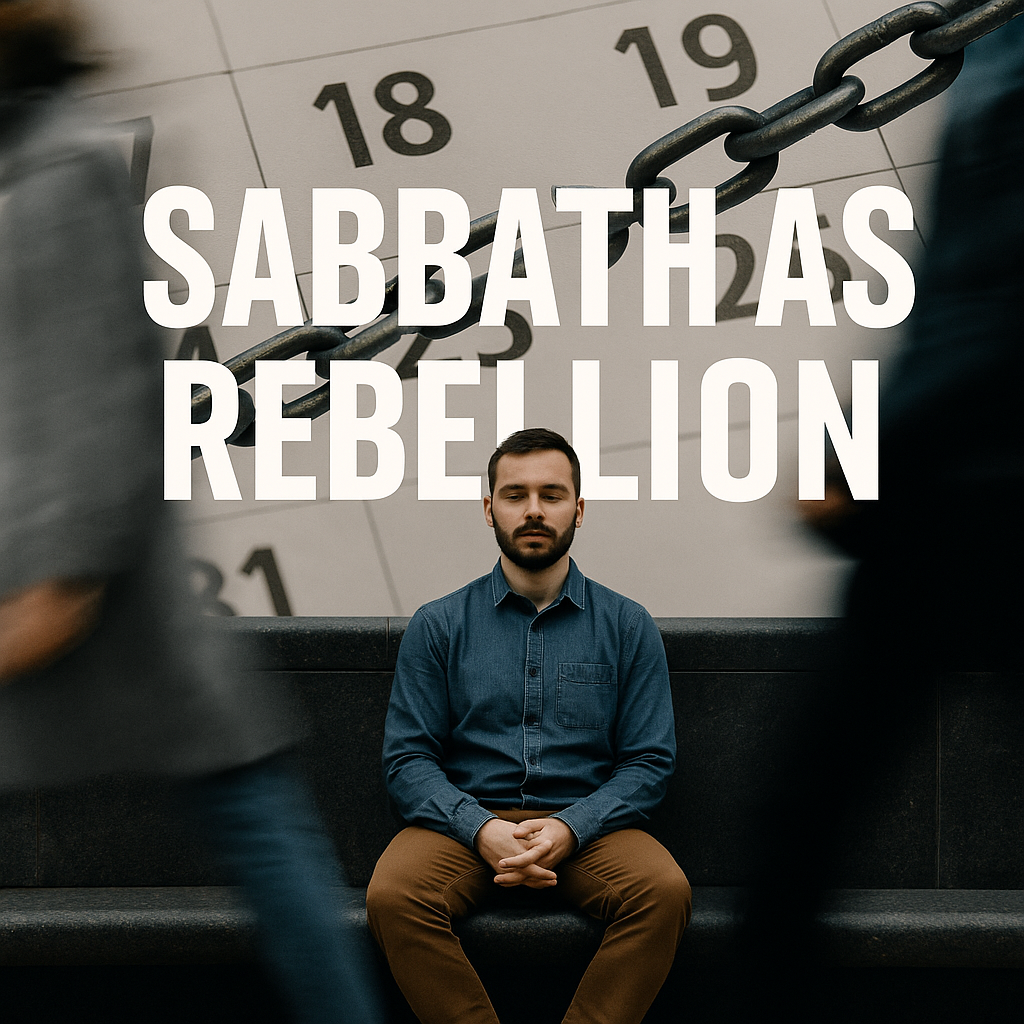
    Sabbath As Rebellion

    “The Sabbath was made for man, not man for the Sabbath. So the Son of Man is lord even of the Sabbath.”

    — Mark 2:27–28

    A Subversive Rest

    In a world where your worth is measured by productivity, rest is a rebellion. The Sabbath command isn’t about squeezing in a nap or catching up on Netflix. It is God’s weekly declaration that His people are not slaves to Pharaoh, Wall Street, or Silicon Valley.

    Ponder this overlooked theological truth: When we stop, we resist. We say with our lives: “I am not defined by my output but by the God who redeemed me.”

    The Sabbath as a Weapon Against Pharaoh

    When Moses delivered Israel from Egypt, God’s people were freed from endless quotas and brickmaking. Pharaoh’s economy demanded ceaseless labor. God’s covenant commanded rest. Observing the Sabbath was Israel’s way of saying, “We are not Pharaoh’s slaves anymore. We belong to Yahweh.”

    Whether we recognize it or not, our world has its own Pharaohs. The demand for constant availability, the cult of hustle, the unspoken law of emails at midnight—these are modern brick quotas. Keeping the Sabbath is rebellion against those powers. It’s a declaration of independence from the gods of busyness. It trust that Yahweh supplies what Pharaoh demands. Our rest cries out “Jehovah Jireh,” Yahweh provides.

    The Sabbath as Counter-Cultural Identity

    In an interesting shift from the Exodus law, the Sabbath command in Deuteronomy 5 is rooted not in creation alone but in redemption:

    “You shall remember that you were a slave in the land of Egypt, and the LORD your God brought you out…” (Deut. 5:15)

    To stop working is to remember you’re free—to worship is to remember who set you free.

    For Christians, the Lord’s Day extends this logic into resurrection life. Christ has triumphed over sin and death; therefore, we rest not only from our labor but in His finished work. Sabbath rest proclaims that the victory is already won. It proclaims that rest is the established for His people—as such, we gather in Sabbath worship as a corporate body, not as individuals. He saved His people, not his persons. To be in Christ is to be in the corporate community.

    Why Sabbath Is More Than “Self-Care”

    Our culture loves to market rest as self-care: spa days, Netflix binges, vacations that leave us exhausted. But biblical rest isn’t consumeristic—it’s covenantal. It reorients us to God, His people, and His promises.

    When the church gathers in worship, when families put away their devices, when believers refuse the tyranny of constant emails, that is not mere self-care—it’s spiritual warfare.

    Sabbath as Eschatological Protest

    Every time we keep Sabbath, we proclaim that the kingdoms of this world are not ultimate. Capitalism isn’t ultimate. Politics isn’t ultimate. My own to-do list isn’t ultimate.

    Sabbath is a weekly protest march declaring that Christ reigns and that eternal rest is coming. But even more than that—as wild as this may sound—it’s also evangelistic. To observe the Sabbath is a visible marker of serving Christ instead of Pharaoh. And everyone else who continues to make bricks without straw needs to see you setting the work aside for the true divine Son of God.

    Rest as Rebellion

    Can you imagine how the Egyptians would have responded if the Hebrews in slavery simply stopped? If they set the bricks aside and said “today we worship the true God.” Anyone would identify that action as rebellion. Friends, to observe the Sabbath is to rebel. To rest in Christ is to subvert the false gods of productivity, consumerism, and self-definition.

    So here is the ultimate question: Does your Sabbath reflect bondage to Pharaoh or rest in Yahweh? Who rules your time—Pharaoh, or Christ?

    True freedom is not found in endless hustle or maxed-out schedules—but in holy rest.

  • Jericho Fell, The Temple Fell: God’s Plan for the Nations

    Jericho Fell, The Temple Fell: God’s Plan for the Nations

    Jericho fell so the Seed of promise might be sown. The Temple fell so that Christ’s harvest might be won.

    Sometimes a single line can capture the sweep of the whole Bible. From the walls of Jericho to the stones of the Temple, God has been writing one story: the story of Christ for the nations.

    Jericho Fell: A Seed Planted in the Land

    When Israel marched around Jericho and the walls came crashing down, it wasn’t just a victory for one nation. It was God’s way of planting His people in the land He had promised to Abraham.

    Why? Because God had already promised that through Abraham’s Seed all nations would be blessed (Genesis 12:3; Genesis 22:18). Jericho’s fall wasn’t about Israel’s glory—it was about clearing the ground so the Seed could take root in history. Because the Seed in view is a singular seed–its THE Seed: Christ. The land was never the ultimate goal; it was the soil in which God would grow His greater plan. The soil from which a Seed would become a cosmis tree:

    "I myself will take a sprig from the lofty top of the cedar and will set it out… On the mountain height of Israel I will plant it, that it may bear branches and produce fruit and become a noble cedar. And under it will dwell every kind of bird; in the shade of its branches birds of every sort will nest." (Ezekiel 17:22-24)

    The land was the down-payment. It was the security deposit. It was never the end goal. Jericho must fall so the Seed could be planted.

    The Temple Fell: A Harvest Opened to the World

    Centuries later, another set of stones fell. In A.D. 70, the Temple in Jerusalem was destroyed. For many, it looked like the end of Israel’s story. But in reality, it was the next step in God’s plan.

    The Temple had pointed forward all along: to the once-for-all sacrifice of Christ, the true Lamb of God (John 1:29; Hebrews 10:11–14). When Christ died and rose again, the need for animal sacrifices ended. And when the Temple fell, the gospel was no longer tied to one city, one altar, or one people. The harvest of the nations had begun (John 12:24; Matthew 28:18–20).

    The tree was spreading its branches to cover the whole earth.

    One Story, One Savior, One Mission

    From the fall of Jericho to the fall of the Temple, God was moving history toward the same goal: salvation through Christ for all peoples.

    God’s plan has always been global. Always Christ-centered. Always aimed at a harvest of people from every tribe, tongue, and nation worshiping the Lamb (Revelation 7:9). Just as Jericho fell so the Seed might be planted, so the Temple fell so the branches might extend.

    What This Means for Us

    It means that God’s plan is unstoppable. What looks like ruin in the moment—whether the collapse of Jericho’s walls or the destruction of the Temple—is actually God’s way of moving His story forward. And it means that we, the Church, are caught up in this mission. We are the fruit of the harvest and also the laborers sent into the field (Matthew 9:37–38).

    So when we look back at Jericho and the Temple, we aren’t just reading history—we’re seeing our place in God’s story. Christ is the Seed. Christ is the Temple. Christ is for the nations.

    When you see the ruins of Jericho and the rubble of the Temple, remember: God builds His kingdom, not on human walls, but on Christ alone. And that kingdom has no boundaries.

  • Why Is Saul Naked in 1 Samuel 19?

    Why Is Saul Naked in 1 Samuel 19?

    What Jonathan gave freely, Saul lost by force—and what that teaches us about Christ’s lordship.

    The Naked King
    This is the kind of Bible passage that makes Sunday school teachers squirm. In 1 Samuel 19, Saul—the king of Israel—lies flat on the ground, stripped of his clothes (1 Sam. 19:23–24). It’s a strange and unsettling image and, as such, is the sort of passage we tend to skim past. When this scene appears, the reader’s attention is already drawn to previous unusual details, like the household idols in David’s house (1 Sam. 19:13), the company of prophets around Samuel (1 Sam. 19:18-20), or Saul’s violent pursuit of David (1 Sam. 19:8-10). But the narrator lingers on Saul’s nakedness—and he does so for a very important reason. However, the key to understanding why comes from the broader narrative: just one chapter earlier, Saul’s son Jonathan also removes his royal robe. When placed side by side, the contrast between these two episodes couldn’t be sharper.

    Jonathan’s Voluntary Surrender
    In 1 Samuel 18:3–4, Jonathan takes off his robe and gives it to David. This is no small act. In the ancient world, clothing symbolized identity and status. Jonathan’s robe wasn’t just fabric; it represented his position as crown prince. To give it away was to yield his claim to the throne. Jonathan’s gesture is covenantal and deliberate. It’s an act of humility, a recognition that God’s hand rests on David. He decreases so that David may increase. His submission is voluntary, born of faith and love.

    Jonathan’s actions anticipate the New Testament pattern of discipleship. To follow Christ is to “put off the old self” and “put on the new” (Eph. 4:22–24). To be his disciple is to “hate” father, mother, wife, children, brother, sister—even his own life (Luke 14:26). Jonathan prefigures this dynamic by laying aside his own honor and clothing another with it. He voluntarily casts his crown at the feet of the anointed one of YHWH (Rev. 4:10-11).

    Saul’s Forced Humiliation
    By contrast, Saul’s disrobing is not chosen but compelled. In 1 Samuel 19:23–24, the Spirit of God overwhelms him, and Saul strips off his clothes and lies helpless throughout the day and night. What Jonathan surrendered in covenant love, Saul loses in humiliation. Far from a heroic prophetic moment, Saul’s nakedness symbolizes his undoing. The king who resists God’s anointed is forcibly stripped of his dignity—the one who would not yield is brought low.

    The Bible often uses clothing as a sign of honor or shame. Joseph is given a magnificent coat of honor (Gen. 37:3). The Prodigal Son is covered in his father’s best robe (Luke 15:32). In contrast, Adam and Eve hide in shame once they realize their nakedness (Gen. 3:7). Job tears his robe when undone by grief (Job 1:20). Isaiah walks naked as a prophetic sign of judgment (Isa. 20:2–4). To be clothed is to be honored, but to be stripped bare is to be exposed, powerless, and humiliated. Saul’s unraveling fits this biblical pattern.

    Commentators agree on this basic understanding but highlight different angles. Robert Alter describes Saul’s condition as “the grotesque abasement of the king.”1 David Tsumura emphasizes that the removal of garments likely signified the loss of royal dignity.2 Dale Ralph Davis underscores the humiliation of a king undone by God’s Spirit.3 Walter Brueggemann notes the biting irony: Saul, who sought to destroy God’s anointed, finds himself unmade by God’s power.4 In general, scholars tend to agree that Saul’s nakedness symbolizes a loss of royal status. Yet the irony is sharper when read alongside Jonathan’s robe-giving: what Jonathan does willingly, Saul experiences unwillingly.

    Reading the Forest, Not Just the Trees
    If one read these episodes in isolation, the rhetorical contrast might be overlooked. Jonathan’s robe-giving simply seems like a tender story of friendship. Saul’s nakedness looks like a bizarre prophetic frenzy. Read as disjointed stories results in merely moralized illustrations for the church. But when read together, they form a deliberate juxtaposition—two paths of submission.

    This is why it is so valuable to read large swaths of Scripture at once. The Bible’s authors were master storytellers. When we zoom in too tightly, we risk missing the broader patterns. Jonathan and Saul’s contrasting acts make sense not as stand-alone vignettes but as side-by-side portraits of willing surrender versus forced humiliation.

    Every Knee Will Bow
    This contrast points us forward to a deeper reality. Paul writes in Philippians 2:10–11 that one day “at the name of Jesus every knee should bow, in heaven and on earth and under the earth, and every tongue confess that Jesus Christ is Lord.”

    Some, like Jonathan, will bow gladly—casting down their crowns in joyful submission.
    Others, like Saul, will be brought low despite themselves.
    Either way, Christ will be confessed as King.

    Encouragement for the Church
    So why is Saul naked in 1 Samuel 19? Because Jonathan was naked in 1 Samuel 18. One disrobed in covenant love, the other in divine humiliation. One bowed gladly, the other was brought low.
    The contrast isn’t only about two men in Israel’s history; it’s about two ways all people respond to God’s Anointed. One day, every knee will bow—some with joy like Jonathan, others in judgment like Saul. Either way, Christ will be confessed as King.

    That’s why the church can take courage today. Those who humble themselves now are not left exposed but are clothed in the righteousness of Christ. The question is not whether Jesus will be confessed as Lord, but how. Will it be the willing surrender of faith—or the forced acknowledgment of defeat?

    Jonathan shows us the path of covenant loyalty, humility, and joy. Saul shows us the path of resistance, pride, and humiliation. Both remind us that the Lord will not be mocked: his anointed King will be honored.

    How Might We Practice “Forest Before Trees” Bible Reading Today?
    A few suggestions:

    1. Read whole books in one sitting. Just as letters weren’t meant to be piecemeal, neither were Samuel or Acts. Try reading through an entire Gospel or prophetic scroll in a single afternoon.
    2. Trace repeated themes. Look for how clothing, covenant, exile, or temple imagery develops across the text.
    3. Ask narrative questions. How does one scene echo or contrast with another? How does this section prepare for what follows?
    4. Then zoom in. Once the big picture is clear, dig into word studies, cross-references, and applications.

    By reading broadly, we not only see the forest—we start to understand why each tree was planted where it is.

    1. Robert Alter, The David Story, (New York: W.W. Norton & Company, 1999), 118–19 ↩︎
    2. David Tsumura, The First Book of Samuel, NICOT (Grand Rapids: Eerdmans, 2007), 508–9 ↩︎
    3. Dale Ralph David, 1 Samuel: Looking on the Heart, (Glasgow: Christian Focus, 2000), 196–202 ↩︎
    4. Walter Brueggemann, First and Second Samuel, (Louisville: Westminster John Knox Press, 1990), 138–39 ↩︎
  • A Pitch for Fast Change in Church Revitalization

    A Pitch for Fast Change in Church Revitalization

    “No one pours new wine into old wineskins. If he does, the wine will burst the skins—and the skins will be destroyed. But new wine must be put into fresh wineskins.” Luke 5:37–38

    Church revitalization is among the hardest assignments a minister can receive. And while many congregations long for renewal, few actually experience it. Research in organizational behavior shows that 60–70% of all business change efforts fail.1 In ministry, the numbers may be even worse. Thom Rainer (CEO of Lifeway) argues that traditional approaches to revitalization carry very low odds of lasting change—just 2% in many cases.2 Yet failure is not inevitable. How we approach change makes all the difference.

    Traditional wisdom seems to be that slow, incremental adjustments are the safest course. Ease people into new songs. Nudge the governance structure. Introduce mission language gradually. These are slow but methodical culture shifts are geared towards the heart–the hope is that change can be embraced in small bites, whereas wholesale upheaval might cause complete imposion. But more often than not, this “slow fade” approach does not work. The statistcs cited above back this up. The Reformed tradition—and Scripture itself—suggests a better way: decisive, gospel-driven reformation.

    Why Slow Change Fails

    The instinct to move slowly is understandable, but it has a host of areas in which it can backfire.

    1. Nostalgia lingers. The “good ole days” remain within reach, and the congregation never feels cut off from its old identity. You can honor history without clinging to the past. But too often, churches get this formula skewed.
    2. Resistance solidifies. Incrementalism gives opponents time to organize. In many churches, the mindset becomes: “This too shall pass. If we wait long enough, the pastor will move on.”
    3. Change fatigue sets in. Endless tweaks without visible transformation wear people down. Organizational scholars call this change fatigue.3 In church life, it manifests as apathy, disengagement, and cynicism. The congregations experiences change fatiuge by losing energy in new initatives; the leadership experiences it by growing weary of constantly having to make difficlut decisions.

    This is why in the corporate world, only 13% of organizations with weak change management succeed—while those with clear, decisive strategies succeed 88% of the time.4 The principle carries over: timidity does not lead to reformation.

    Why Fast Change Fits the Reformed Vision

    Fast change, done with wisdom and pastoral care, aligns better with both the data and the theology of the Reformed tradition.

    • It creates urgency. John Kotter’s famous “burning platform”5 illustrates how bold change communicates that the status quo is no longer an option. The prophets did the same: “How long will you go limping between two opinions?” (1 Kings 18:21).
    • It resets identity. The church is not called to be a museum of its past but a living body under Christ the Head. Decisive shifts help the congregation see itself not through the lens of nostalgia, but through the lens of its covenant identity in Christ.
    • It closes the back door. Just as sanctification calls us to “put off the old self” (Eph. 4:22–24), revitalization requires a decisive putting away of old habits. Alcoholics Anonymous understands that cutting off is more effective than tapering; the same is true in congregational reform.

    Biblical Models of Decisive Reform

    The pattern in Scripture is not gradual drift but decisive covenant renewal.

    • Nineveh (Jonah 3:6-10): When the Assyrian people of Nineveh heard the news of judgment, they embraced immediate reform. Sackcloth, ashes, mourning—their whole world stopped. While the change did not buy them eternity, it did provide a delay—YHWH’s judgment would wait: they had ceased their wickedness.
    • Josiah’s reforms (2 Kings 23): He tore down high places and smashed idols in one sweeping act of obedience. Reformation meant removal, not slow accommodation. Josiah had no concern for offending Israel–his concern was faithfulness to YHWH.
    • Pentecost (Acts 2): The Spirit constituted the church in one dramatic event, reorienting its identity from fearful disciples to bold witnesses.

    The Reformed tradition has always echoed this. The Reformation was not a tweak of medieval practice; it was a decisive recovery of sola Scriptura and the gospel of justification by faith alone. Calvin called for “the pure preaching of the Word, the right administration of the sacraments, and the faithful exercise of discipline” (Institutes 4.1.9)—marks that require clarity, not gradualism.

    What Fast Change Looks Like in Practice

    In a local church, fast change does not mean recklessness. It means courageous, biblically grounded leadership. It means upopular decisions. It means follow-through. Examples include:

    • Worship: Move decisively to Christ-centered, Word-saturated liturgy, rather than “sneaking in” new songs.
    • Mission: Frame and announce a gospel-driven mission statement that redefines the congregation’s identity in light of the Great Commission.
    • Structures: Replace broken committee models with elder-led polity decisively, not piecemeal. This reflects the New Testament pattern (Titus 1:5).
    • Prayer & Repentance: Call the church to corporate prayer in areas in which personal comfort has been prioritized over Gospel calling and brotherly love.

    In each case, decisive change helps God’s people live in line with their covenant identity.

    The Pastoral Charge

    Fast change will sting. Some may resist. Some may even leave. But the call of the shepherd is to lead God’s people toward health, not to protect nostalgia. If the shepherd sees a wolf, he quickly drives the sheep to safety. If the sheep are headed toward a cliff, the shepher re-directs the sheep–even if the grass on the edge of the cliff is wonderful. The calling of the shepherd is alignemnet with the Great Shepherd–should we draw this out for fear of offense? The Westminster Confession reminds us that Christ alone is Head of the Church (WCF 25.6). Faithful pastors must lead congregations away from cultural captivity and toward Christ’s rule—even if it requires ripping off the band-aid.

    The alternative is slow decline, which leaves Christ’s body weak and malnourished. Or, it is often years of constant conflict, leaving shepherds weary and burnt out. Better to endure the pain of bold reform than the slow death of timidity.

    Conclusion

    Revitalization rarely succeeds through slow, hesitant adjustment. Both research and Scripture point to the same reality: lasting transformation comes through decisive, biblically-grounded change. Our congregations do not need a never-ending project on their hands–they need to be fed the kind of food that is nurturing to their soul. If they are fed well through the change, they will mature and grow, able to show others where to find food that nourishes the soul.

    Pastor, if you are called to revitalize, lead with clarity, urgency, and conviction. Ground every shift in the Word, lean on the Spirit through prayer, and shepherd with love. But do not delay. Some may leave. But in my conversations and experiences through multiple church reforms–those people were probably going to leave anyways. There would eventually be a limit to how much change would be acceptable–be wary of catering to disgruntled sheep who refuse to be fed.

    Rip off the band-aid. Reform for the glory of Christ and the good of His Church.

    “New wine must be put into fresh wineskins” (Luke 5:38).


    1. Beer, Michael & Nohria, Nitin. Breaking the Code of Change. Boston: Harvard Business School Press, 2000. ↩︎
    2. https://replantbootcamp.com/should-we-revitalize-or-replant/ ↩︎
    3. Lewis, Laurie K. Organizational Change: Creating Change Through Strategic Communication. Wiley-Blackwell, 2019. ↩︎
    4. Prosci. Best Practices in Change Management. 11th Edition, 2020. ↩︎
    5. Kotter, John. Leading Change. Boston: Harvard Business School Press, 1996. ↩︎
  • Why David Feared Losing the Spirit (and Why You Don’t Have To)

    Why David Feared Losing the Spirit (and Why You Don’t Have To)

    Most of us know Psalm 51 as David’s heartfelt prayer after his sin with Bathsheba. It’s the psalm we turn to when we need to confess, when we feel the weight of our sin, when we cry out for God’s mercy. But one little line in the psalm often puzzles people:

    “Cast me not away from your presence, and take not your Holy Spirit from me” (Psalm 51:11).

    Why does David pray that? Doesn’t God promise to never leave us? Doesn’t the Spirit dwell in every believer forever?

    The answer becomes clearer when we remember David’s story—and the tragic story of the king before him.

    David Saw What It Looked Like to Lose the Spirit

    David wasn’t speaking in the abstract. He had lived through Saul’s collapse.

    Saul was Israel’s first king, demanded by the people, chosen by God, and anointed with the Spirit. But when Saul disobeyed—first in offering an unlawful sacrifice, and later in sparing what God commanded him to destroy—God rejected him as king. Scripture tells us:

    “The Spirit of the LORD departed from Saul, and a harmful spirit from the LORD tormented him” (1 Samuel 16:14).

    From that moment forward, Saul’s reign unraveled. He became paranoid, insecure, and violent. David—who served in Saul’s court as a musician—watched the whole thing unfold up close. In other words, part of David’s kingly “education” was as an eyewitness to how easily life unravels for kings who are deprived of YHWH’s Spirit.

    So when David sinned with Bathsheba, he knew exactly what was at stake. He wasn’t just afraid of feeling spiritually “dry.” He knew what God’s divine justice demanded—and he begged God not to let that be his fate.

    The King’s Sins Were Never Just Personal

    In Deuteronomy 17, God gave Israel a vision for kingship. Contrary to ancient Near Eastern norms, the king wasn’t supposed to be a military powerhouse or a collector of wealth. Instead, he was to be a brother among brothers, someone who kept God’s Word close, wrote out a copy of the law, read it daily, and led by example.

    In other words: the king was supposed to embody covenant faithfulness for the people. He was to be the “Israelite exemplar.”

    That’s why Saul’s disobedience was catastrophic—not only for him, but for all of Israel. And that’s why David’s repentance mattered so much. His cry in Psalm 51 was not just a guilty conscience seeking comfort; it was a king asking God to restore him so that Israel itself wouldn’t be left adrift. David’s cry of repentance and mercy was intercessory as much as it was personal.

    What About Us?

    So what does all this mean for us today? A few takeaways:

    1. The Spirit is essential for true leadership. Titles, charisma, or influence can never replace God’s presence. Without the Spirit, leadership is hollow.

    2. Repentance is more than personal. When leaders repent, they don’t just restore themselves—they help preserve the health of the whole community they serve.

    3. Christ is the King who never lost the Spirit. Saul lost Him. David feared losing Him. But when the Spirit descended on Jesus at His baptism, John tells us it “remained on Him” (John 1:32). Through Christ, the Spirit is secured in the Kingship for His people forever.

    The Good News

    David’s prayer shows us the fragility of human leadership. But it also points us to something better. Our hope doesn’t rest in pastors, parents, or earthly kings getting everything right. Our hope rests in Christ, the true King, who perfectly obeyed, who always pleased the Father, and who pours out His Spirit on the church without measure.

    So when you read Psalm 51, don’t hear David panicking about losing salvation. Hear a king who knows what happened to Saul and desperately wants to avoid the same fate. And then lift your eyes to Jesus, in whom we are secure forever.

  • The Sheep, the Goats, and the “Least of These”: Reading Matthew 25 in Context

    The Sheep, the Goats, and the “Least of These”: Reading Matthew 25 in Context

    Few passages in Scripture stir the conscience like Jesus’ parable of the sheep and goats in Matthew 25:31–46. The King returns, gathers the nations, and divides them as a shepherd separates sheep from goats. His criterion? How they treated “the least of these my brothers.”

    This phrase is often taken out of its first-century context and made into a universal humanitarian slogan—“Be kind to everyone, especially the poor.” While Christians are indeed called to compassion for all people (Gal. 6:10), this is not the point of Matthew 25. The passage has a sharper edge: it is about how the nations respond to Christ’s people—His disciples—during the period of gospel proclamation leading up to the judgment on Jerusalem in AD 70.

    Who Are “the Least of These My Brothers”?

    In Matthew’s Gospel, “brothers” (ἀδελφοί) consistently refers to Jesus’ disciples (see Matt. 12:48–50; 28:10). The “least” are those who are weak, marginalized, and often persecuted for the sake of the gospel. Jesus had already taught this connection in Matthew 10:40–42—receiving His messengers is receiving Him; rejecting them is rejecting Him.

    The parable in Matthew 25 comes at the end of the Olivet Discourse (Matt. 24–25), where Jesus has been speaking about His coming in judgment against Jerusalem. The “nations” (ἔθνη) are not gathered for some vague, end-of-time general inspection of morality; rather, they are being evaluated for how they treated Christ’s emissaries in the generation before the great tribulation of AD 66–70.

    Why This Matters

    While there are many variations of echatology, I share the perspective that the “coming” in Matthew 25 is not describing the end of the physical world but Christ’s coming in judgment against the covenant-breaking nation in the first century. The sheep and goats judgment, then, is tied to the mission of the disciples to the nations (Matt. 28:18–20) and the response they receive.

    In this light, the parable warns that nations and individuals would reveal their allegiance to Christ by their treatment of His people during the gospel’s explosive first-century advance. Supporting, sheltering, and aiding these persecuted witnesses was not mere charity—it was a recognition of the authority of the risen King. Refusing them was to side with the enemies of Christ.

    The Danger of the Humanitarian Hijack

    When “the least of these” is flattened into “the needy” in general, the historical context disappears. The parable is not a moral pep talk for random kindness—it is an eschatological warning rooted in covenant loyalty. Stripping away that context can turn the church into a generic NGO and rob the passage of its sharp, Christ-centered meaning.

    To be clear, this is not about narrowing our compassion; it’s about clarifying what this text is saying. The sheep are not commended for generic philanthropy, but for siding with Christ through tangible care for His people during a time of testing.

    Living the Text Today

    While the original setting is rooted in the first-century gospel mission and judgment on Israel, the principle remains: how we treat Christ’s people is how we treat Christ. Even now, caring for persecuted believers, supporting missionaries, and standing with the church in hardship is not optional charity—it is allegiance to the King.

    To serve “the least of these my brothers” is to serve Christ Himself.

    Sidebar: Common Objections

    Objection 1: “Doesn’t ‘the least of these’ just mean the poor in general?”
    Answer: In Matthew, “brothers” (ἀδελφοί) consistently refers to Jesus’ disciples (Matt. 12:49–50; 28:10). Matthew 10:40–42 directly connects welcoming Christ’s messengers with welcoming Him. This is a covenant family term, not a generic reference to humanity.

    Objection 2: “But shouldn’t Christians care for everyone, not just believers?”
    Answer: Absolutely—Galatians 6:10 makes that clear. But Matthew 25 has a specific, historical focus: the nations’ response to Christ’s messengers before the AD 70 judgment. General compassion is biblical, but this parable is about covenant allegiance.

    Objection 3: “Isn’t this interpretation too narrow?”
    Answer: Narrow doesn’t mean wrong—just precise. In the Olivet Discourse, Jesus is speaking about His return in judgment on Jerusalem and the mission of His disciples in that period. The “least” are persecuted simply because they belong to Him, not because they are poor.

    Objection 4: “What about Luke’s emphasis on the poor and marginalized?”
    Answer: Luke does highlight concern for the economically poor, but Matthew’s context is different—rooted in mission and covenant judgment. We must let each Gospel speak on its own terms instead of importing themes from one into another.

    Objection 5: “Doesn’t this make salvation depend on works?”
    Answer: No. The works in Matthew 25 are the evidence of allegiance to Christ, not the basis of salvation. The sheep are not saved because they aided His brothers, but their care for Christ’s people demonstrates that they belong to Him.

  • The American Eyes Are Tunnel Visioned

    The American Eyes Are Tunnel Visioned

    “If one member suffers, all suffer together; if one member is honored, all rejoice together. Now you are the body of Christ and individually members of it.”
    — 1 Corinthians 12:26–27

    American evangelicalism has a strange blind spot–and its one not really shared with Christendom outside of America. With one eye fixed firmly on Israel and the other seemingly closed to the persecuted church around the world, we’ve developed what can only be called tunnel vision. We raise our voices in prayer for the geopolitical survival of a secular nation—while our brothers and sisters in Christ are being beheaded by radical Islamists in Africa.

    Where is the urgency for the actual body of Christ?


    Praying for a Pagan Nation While Ignoring the Persecuted Church

    Let’s be clear: modern Israel is a secular nation. While it retains immense biblical significance as the historical homeland of God’s covenant people, the current state of Israel is not a theocracy under Yahweh. In fact, Israel ranks as one of the most unreached nations in the world as well as one of the most theologically liberal nations, with fewer than 0.3% of the population identifying as evangelical Christian (Joshua Project, 2025). Missionary efforts are often actively opposed by Israeli authorities.

    By contrast, over 360 million Christians today live under high levels of persecution, many of them in Muslim-majority regions (Open Doors USA, World Watch List 2024). In Nigeria alone, more than 4,100 Christians were killed for their faith in 2023—most at the hands of Islamist groups like Boko Haram or Fulani militants .

    These are our brothers and sisters in Christ. Yet American churches are largely silent.


    A Misplaced Missional Focus

    There is also an enormous gap between where God is working and where the American church is looking.

    While missions to the Jewish people are important, statistical data suggests that Muslims are converting to Christianity at vastly higher rates than ethnic Jews. According to one peer-reviewed study by Duane Alexander Miller and Patrick Johnstone:

    “The number of Muslim-background believers (MBBs) worldwide has grown from around 200,000 in 1960 to over 10 million today.”
    (The World’s Muslim Population and the Growth of the Church, IJFM Vol. 31:1, 2014)

    That’s a 50-fold increase in just over 60 years. Compare that to estimates of Jewish believers in Jesus worldwide—around 300,000 globally, according to Jews for Jesus (2022) .

    Statistically, this means Muslims are coming to Christ at over 30x the rate—and some estimates put it even higher, depending on region. God is moving powerfully in the Muslim world. So why aren’t we paying attention?


    Christ in His Body, Not in a Flag

    To care about Israel is not wrong. To prioritize a political state at the expense of the global church is. Paul says clearly that “not all who are descended from Israel belong to Israel” (Rom. 9:6), and again, that “if you are Christ’s, then you are Abraham’s offspring, heirs according to promise” (Gal. 3:29).

    In the New Covenant, the church is called “the Israel of God” (Gal. 6:16). Christ died for His bride—the Church—not for a political entity or ethnic group. He now dwells not in temples or geographic borders, but in His people by the Spirit (Eph. 2:19–22).

    To fixate on modern Israel while ignoring Christian martyrdom is to betray the very body of Christ.


    What Should We Do?

    1. Pray for the persecuted church: Resources like Voice of the Martyrs and Open Doors provide regular updates and prayer guides.
    2. Recalibrate your eschatology: If your eschatology blinds you to the Body of Christ, its time to re-evaluate it. Covenant theology rightly emphasizes the unity of God’s people throughout redemptive history.
    3. Support missions among Muslims: Ministries like Frontiers, Global Gates, and Elam Ministries are seeing unprecedented gospel fruit in the Muslim world.
    4. Repent of nationalism masquerading as Christianity: The kingdom of God knows no earthly borders and flies no earthly flag.

    Final Word

    Jesus is not coming back for a nation-state. He is coming for His bride, the Church. And that bride is bleeding in the shadows of Nigeria, Afghanistan, and Indonesia. When American Christians cry out for Israel but fall silent at the sound of the martyr’s blade, something is deeply wrong.

    Let us fix our eyes on Christ—and on His body. The gospel is not a foreign policy tool. It is the power of God unto salvation. And it is spreading—not in headlines, but in hidden places. Let us see rightly.


    A Pastoral Note to My Brothers and Sisters

    I know these words may feel weighty—perhaps even uncomfortable. But they are written with love, not condemnation. I write not as someone who has it all figured out, but as one who has been convicted by the very blindness I describe. This is not a call to abandon concern for Israel or to neglect prayer for any people group. Rather, it’s a plea to remember the Church. To lift our eyes and see the whole Body of Christ—suffering, growing, advancing—in places we’ve often overlooked.

    Let us be people of truth and compassion. People shaped more by the Word than by the news. People whose hearts beat in rhythm with our Savior, who laid down His life for the church.

    And let us pray—deeply, earnestly—for our brothers and sisters who bear that cross every day.


    Sources

    1. Joshua Project. “Country: Israel.” https://joshuaproject.net/countries/IS
    2. Open Doors USA. World Watch List 2024 Report. https://www.opendoorsusa.org
    3. Duane Alexander Miller and Patrick Johnstone, “Believers in Christ from a Muslim Background: A Global Census,” International Journal of Research and Ministry Vol. 31:1, 2014.
    4. Jews for Jesus. “How Many Jewish Believers Are There?” https://jewsforjesus.org

  • When the Kingdom Came in Power: Filling in the Gaps of Mark 8:38-9:1

    When the Kingdom Came in Power: Filling in the Gaps of Mark 8:38-9:1

    In Sunday’s sermon, we explored the sobering and triumphant declaration of Jesus in Mark 8:38–9:1. There, Jesus calls His followers to costly discipleship, warns of judgment, and makes a striking promise: that some standing there would not taste death until they saw the kingdom of God come with power.

    That closing line (9:1) is one of the most debated statements in the New Testament. What did Jesus mean? And did it really come to pass? If not, is it a future event yet to occur? Or could Jesus have been mistaken? This blog post is meant to fill in some of the historical and theological gaps from the sermon and to reaffirm the heart of the message: Jesus was not mistaken. He meant what He said. And His words were fulfilled within a generation.

    The Covenant Context of “Coming”

    In the ancient world, a god “coming” was often a metaphor for divine intervention in history—especially in judgment. This concept saturates the Old Testament. YHWH came in the cloud at Sinai (Ex. 19), in judgment on Egypt (Isa. 19), and through the armies of Babylon against Judah (Hab. 1:6). Significantly, to say that “God is coming” didn’t always mean a physical, visible appearance; it meant His presence would be made known in real and often terrifying ways.

    Jesus picks up that same covenantal framework (He is YHWH, after all–see “Is Jesus YHWH” for more on that). When He says that the Son of Man will come “in the glory of His Father with the holy angels” (8:38), He is invoking Daniel 7—a vision of the Son of Man receiving dominion and judgment authority. This “coming” is judicial, not geographical. In other words, it is expressly covenantal.

    Deuteronomy 28 and the Pattern of Judgment

    In Deuteronomy 28, Israel was warned that if they broke covenant, God would bring foreign nations as judgment: “The Lord will bring a nation against you from far away… like an eagle swooping down” (v. 49). This is the language of divine coming through historical agents. When Jesus predicted Jerusalem’s destruction (cf. Mark 13), He wasn’t imagining some distant apocalypse—He was announcing that the covenant curses were about to fall. And in AD 70, they did—Rome came like a flood.

    Why Not the Transfiguration?

    Some argue that Mark 9:1 refers to the Transfiguration, which happens just six days later. While there are connections—the glory, the divine voice, the cloud—the time-frame of the promise feels exaggerated if it only meant one week later. Additionally, Jesus says that “some standing here will not taste death.” That implies that most would die before this event—hardly a fitting way to describe something happening six days later. With his death, resurrection, ascension, and Pentecost only months away, the fall of Jerusalem nearly 40 years later fits the language better.

    Theological Support

    R.C. Sproul wrote, “The ‘coming’ of Christ in judgment was a real and visible event for those who lived through the fall of the city… not merely a future return.” N.T. Wright likewise argues that Jerusalem’s fall was the public vindication of Jesus’ kingdom mission. Even Matthew Henry notes that Christ’s prediction in Mark 9:1 was fulfilled within that generation.

    So What?

    Jesus’ words came true. Some of those standing there—perhaps John, perhaps others—lived to see the kingdom come in power through judgment. It was not the end of the world, but it was the end of an age. The temple fell, the old covenant was judged and fulfilled, the Church expanded, and Christ was vindicated as Lord.

    For us today, this means Jesus’ words are trustworthy. His kingdom is real. And when He speaks of discipleship, judgment, and glory, He is not playing with vague metaphors, rather, He is proclaiming covenant truth. So take up your cross. Don’t be ashamed of Him. The kingdom has come in power—and it’s still advancing today.